Introduction
The changeover to the digital street signs of restaurants is occurring rapidly, and restaurants are losing walk-ins due to long waits. If your curb message cannot respond to weather, wait times, or today’s specials, you lose the ‘right now’ customer who was about to decide within seconds.
“Your exterior is your first checkout page—if it’s stale, customers bounce.”
Modern restaurant exterior signage is no longer in isolation. The best installations are currently combined with POS signals, social media, and reservation systems to ensure that what is happening out there matches what’s actually happening inside. In this guide, you’ll see how digital changes exterior restaurant signage design, what tools help you publish faster, what the realistic restaurant exterior signage cost looks like, and how restaurants achieve measurable ROI.
Take your curb appeal digital—explore Nento’s cloud-based signage platform for restaurants.
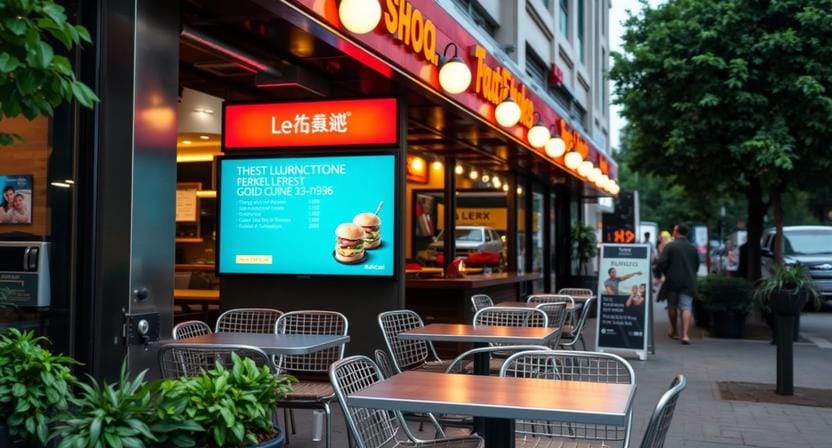
Why Traditional Exterior Signage for Restaurants No Longer Works Alone
Permanent branding through exterior signage is still important to restaurants, but it is not dynamic enough to meet real-time requirements. The printed board is not weather-sensitive and does not update when the kitchen has run out of a trendy product or a sudden spike in wait time. It is this disconnect that has led to a hybrid system of many restaurants: fixed branding and a digital message board to update live.
“Static signage builds recognition; digital signage wins the moment.”
The overview emphasizes that online cues have the potential to make the interaction more immersive, as movement and dynamic content are more difficult to overlook than non-moving text. A relevant offer is more likely to make someone who is walking or driving past stop than a sign they’ve already seen a hundred times.
Exterior Restaurant Signage Design for a Digital World
The design of exterior restaurant signage on screens is subject to other rules than printed boards. The screens should be legible at a distance and within a short time, with a large amount of glare and varying daylight.
Design rules for screens vs. static signs
Bold and high-contrast fonts can be easily scanned, particularly pricing and brief offers. Dark backgrounds tend to minimize glare and help text stay legible during bright periods. A loop time of 6–10 seconds per message ensures continuous flow of content without congesting the viewers.
Using animation, countdown timers, and QR codes
Animation shouldn’t be arbitrary—there must be a purpose to the animation, rather than it being distracting and making the menu difficult to read. Countdown timers are most effective with limited-time offers, happy hours, or a message about the kitchen closing in 30 minutes when the urgency is high. QR codes can bridge the gap between your outdoor signage and your restaurant, whether it is online ordering, reservations, or your social page, and make curb attention a reality.
“If a customer can scan and act instantly, your sign becomes a sales channel.”
7 Best Exterior Signage Options for Restaurants and Cafes
These are the most suitable exterior signs of restaurants and cafes in case you want to have digital possibilities and be able to operate at any time.
1. LED message centers
LED message centers are suitable in case of short messages of high contrast and frequent changes. They can be used particularly when you need fast headlines such as “Lunch Specials,” “Open Late,” and “Walk-ins Welcome” that can be relied upon to change.
2. Outdoor LCD windows (high-brightness, 2500+ nits)
The outdoor LCD window displays are in high brightness and are best used in cases where you need to show details—photos, menus, and organized pricing. The outline identifies 2500+ nits of sunlight visibility and the variation between legible and illegible content.
3. ePaper/eInk signs (ultra-low power)
ePaper will work well when power consumption is a consideration and you do not need video. It is commonly applied to pricing boards, daily specials, and simple messaging, which still requires remote updates.
4. Projection mapping on facades
Projection mapping is an impactful event, launch, and seasonal campaign option. It works best when your objective is spectacle and brand buzz as opposed to daily communication on the menu.
5. Interactive touchscreen directories
Touchscreen directories are most effective in multi-tenant areas, food halls, and big spaces. They assist the visitors to locate restaurants fast and can emphasize featured offers or promotions in an organized manner.
6. Restaurant digital street signage with live menu boards
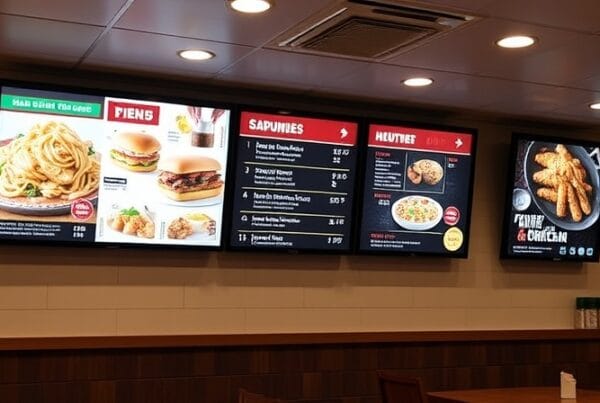
This format will be used to have real-time menu rotation and visibility. When linked to time and operation cues, it can be an ever-present marketing medium that can vary by daypart, inventory, or demand.
7. Hybrid channel letters with embedded digital displays
Hybrid arrangements have permanent brand identity (channel letters) with a digital area that can spin offers. This will allow you to maintain your brand but have a flexible content layer to do promotions and updates.
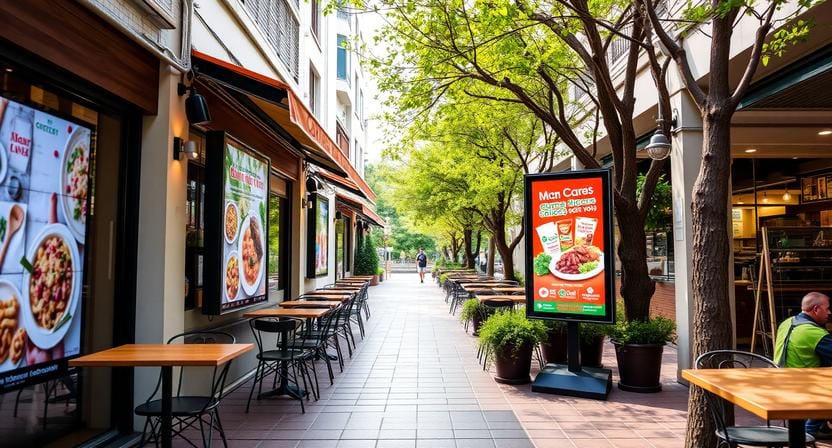
Restaurant Outdoor Signage Ideas Powered by Digital Tech
These outdoor restaurant signage concepts are based on real-time data to maintain the relevance and conversion-oriented message.
Live wait times from your POS
Posting wait times is a way of creating expectations and lowering walkaways due to lack of knowledge. When individuals encounter 15 minutes, rather than make a guess, they will remain.
Today’s specials + remaining portions count
A clear ‘limited portions left’ message would evoke urgency without being salesy. It also aids in protecting service flow, as it will direct the demand to what you can comfortably provide.
Weather-triggered messages
Weather-based triggers—such as rainy days? 20% off soup—make the signage local and time sensitive. These messages are effective because they are in tandem with the present situation of the customer and not what they planned yesterday.
Social media walls
Showing recent Instagram posts related to a branded hashtag helps to develop trust based on the real content of customers. It also encourages visitors to share, which forms a cycle of exposure and social validation.
Happy hour countdown timers
Offers that have a time limit and are explicit will lead to action with countdowns. They particularly work well in busy locations where you would want passersby to make a decision.
Real-time signage is most effective when the message is appropriate to the moment.
“Real-time signage works best when the message matches the moment.”
Restaurant Exterior Signage Cost: Digital vs. Static
To comprehend the cost of restaurant exterior signage, it is necessary to split between the initial hardware costs and software and content maintenance.
Cost comparison
| Category | Typical Cost Range |
| Static signage (one-time) | $500 – $4,000 |
| Digital hardware | $2,500 – $12,000 |
| Software subscription (per screen) | $20 – $150/month |
Hidden savings that change the ROI math
Digital saves time and money that would be used in reprinting and staff time in making manual updates, particularly in multiple locations. Remote publishing also averts the mismatch of a promo being live online but not on the street that can often cost walk-in conversions.
ROI example
The outline gives the range of ROI in which the digital signage can contribute to adding incremental sales of $800-2500/month. Although outcomes will be affected by traffic and implementation, the process is the same: the timelier the promos, the more comprehensible the message, and the faster the conversion at the curb.
“The payback isn’t just fewer prints—it’s more walk-ins that decide now.”
Software to Design Restaurant Exterior and Signage
Choosing the right software to design the exterior and signage of the restaurant determines how fast you can create, schedule, and publish your work without any bottlenecks.
Digital-first tools
- Nento—purpose-built for restaurant digital signage with scheduling, templates, and multi-location management.
- PosterMyWall—fast outdoor graphics when you need quick promo creatives.
- Canva + export – flexible design tool when paired with a signage publishing system.
- Figma—advanced custom animations and design systems for teams with more design maturity.
Why Nento beats generic tools for exterior execution
Design tools are generic, assisting you in designing assets but not resolving real-time publishing, menu synchronization, weather-triggered messaging, and stable remote updates. The idea behind Nento is to bridge that gap to make exterior communication less manual.
Choosing Among Exterior Signage Companies for Restaurants
In choosing exterior signage companies to serve restaurants, the digital age requires fabrication and installation to be more than just that.
What to demand from a modern provider
Avoid closed systems that lock you in, hardware and software should be able to cooperate. The cloud management dashboard should be such that you do not need to visit the site to update. Another expect support that protects uptime of outdoor displays, since a failure is conspicuous and expensive.
Nento collaborates with the major outdoor display producers to offer a hassle-free deployment process and concentrate on the software layer to ensure content is correct and simple to control.
Stop managing static signs—let Nento automate your exterior messaging. Start your 14-day free trial.
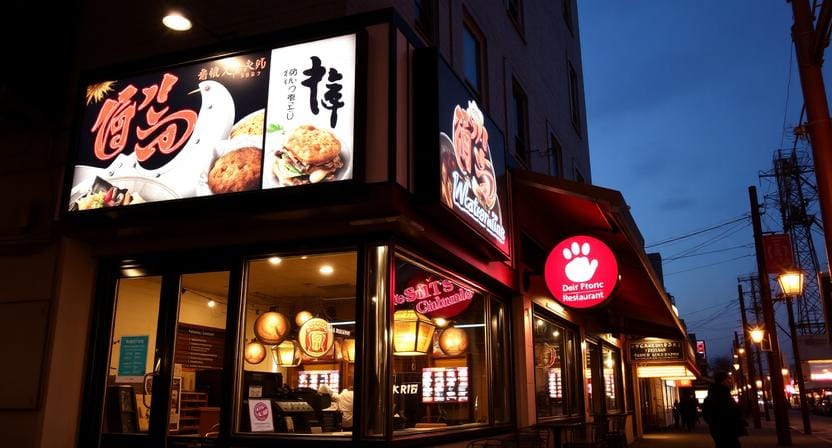
Restaurant Digital Street Signage: The Always-On Marketing Channel
What it is
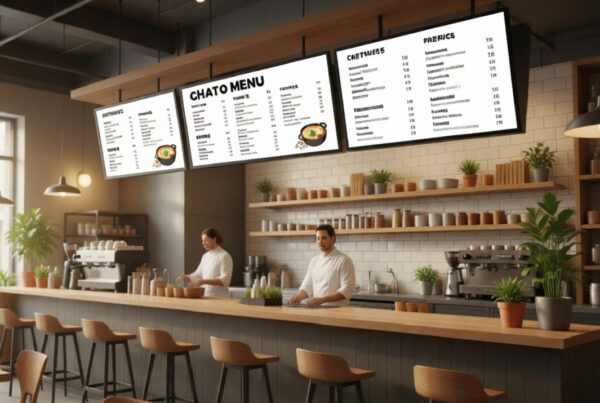
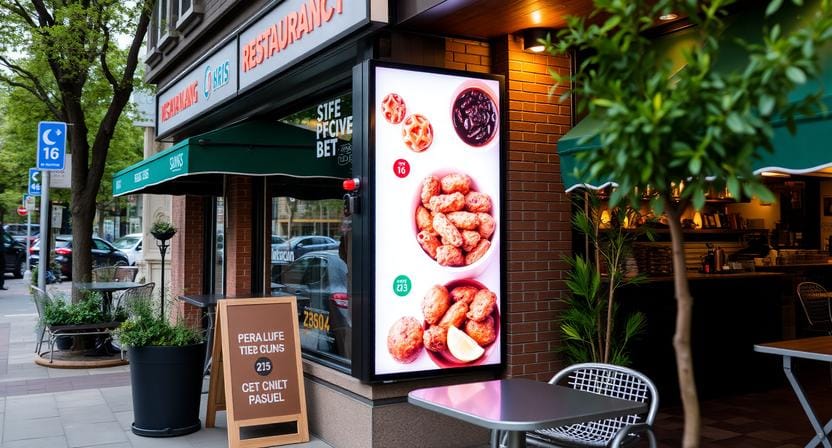
Digital street signage in restaurants is outdoor LED/LCD messages that are operated using cloud software. It is created to be visible all the time, updated quickly and with message rotation to keep the content fresh.
Where to place it
Typical locations are over doors, windows that face the sidewalk, drive-through lanes and street-facing sign areas where pedestrians tend to slow down.
Best practices for performance
Where possible, brightness should automatically adjust, and the message should rotate every ~8 seconds to keep the attention without dragging. The aim is to achieve high readability and rapid understanding in high-motion street settings.
Case study
The outline refers to a pizza chain that has been able to boost walk-in traffic by 62% through digital street signs that display the real-time count of crusts. The lesson is that the credibility-based real-time messaging can attract customers when it seems to be genuine and up-to-date.
“The street decides fast—your signage should too.”
Frequently Asked Questions
Can I convert my existing static restaurant exterior signage to digital?
Yes, you can insert the digital components or change the face to an LED panel. Nento software is compatible with hybrid arrangements.
What is the average restaurant exterior signage cost for a digital setup?
$3,000–$15,000 installed + $30–$150/month for software like Nento.
Which software to design restaurant exteriors and signage is easiest for non-designers?
Nento has drag-and-drop templates that are dedicated to restaurant menus and promos.
What are the best exterior signage options for restaurants and cafes with limited budgets?
Begin with one digital display and scale from there.
Is restaurant digital street signage waterproof?
Yes – look for IP65 rating. Nento’s recommended hardware is weather-sealed.
Can I schedule different messages for breakfast, lunch, and dinner?
Yes—the scheduler of Nento allows you to adjust the content hour by hour, day by day, or even by weather.
Do exterior signage companies for restaurants offer software support?
Not many of them do—Nento focuses on software and collaborates with the hardware suppliers on complete solutions.
Conclusion
Digital restaurant exterior signage is no longer a luxury; it is a competitive need when clientele makes their decisions within a few seconds. Permanent branding still requires using static signs, but software-driven displays, which are smart and agile, offer relevance and ROI. The future is digital and centrally managed, whether it is in regard to exterior restaurant signage design or real-time content and cloud management.
Future-proof your restaurant’s first impression. Book a free 1-on-1 demo with Nento and see your exterior come alive digitally