Introduction
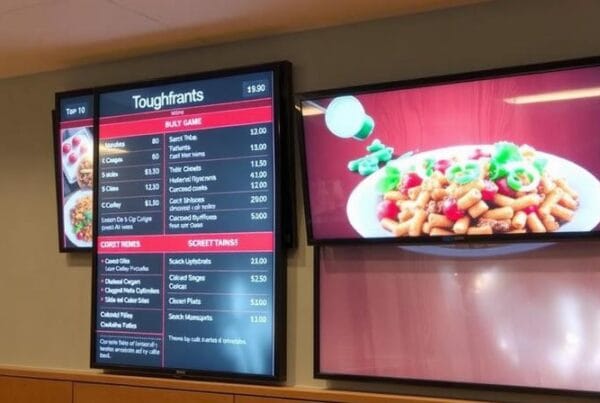
Consider a customer passing a fixed poster that looks identical at 9 AM, 3 PM, and 9 PM. Suppose now that they go past a screen that changes its content depending on the weather, time of day, or the type of people in front of it—hot coffee deals on cold mornings, family packages when a group comes by, or indoor dining deals when it starts to rain. That difference is shifting AI digital signage from ‘interesting’ to strategic.
Digital signage no longer consists of mere video loops. It has become a data-driven communication channel that is aimed at reacting, learning, and optimizing. This guide explains the actual meaning of what AI-powered digital signage is, its application in various industries, and how it is transforming content into a more personalized and more efficient one.
So, what is digital signage AI? It is the convergence of display hardware (usually supported by an AI-enabled digital signage player) and software that decides what data is analyzed and what content is shown automatically. The system is able to send smarter messages to many audiences because, instead of pushing one playlist to everyone, it uses signals, such as time, location, anonymized audience insights, etc.
“When content responds to context, attention lasts longer.”
What is AI Digital Signage?
Definition
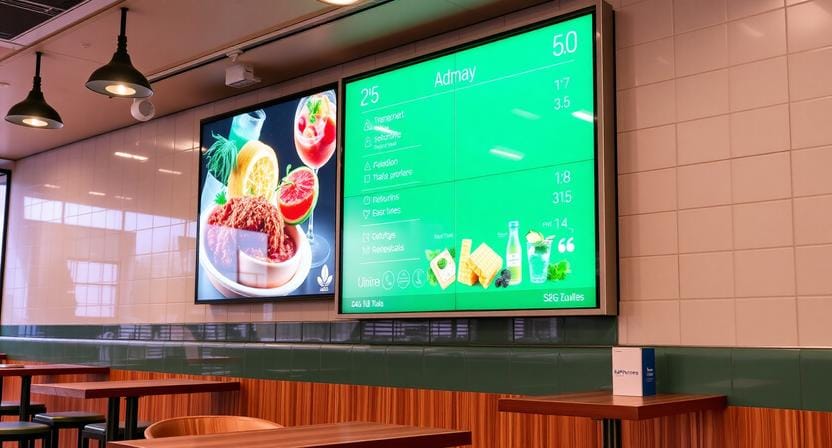
AI digital signage is a combination of artificial intelligence and digital displays that can analyze the behavior of viewers, make predictions about what is going to work, and customize content automatically. It’s not just automation—it drives better outcomes such as engagement, conversion, and operational efficiency through the delivery of the most relevant message at the most relevant time.
The Components
Hardware: AI workloads cannot be implemented on a basic media player. An AI-powered digital signage player gives the computing capabilities required to make real-time decisions, particularly when analytics are performed on the device (edge computing) rather than a cloud-hosted server. The reason why edge approaches are gaining popularity is due to the lower latency and the ability to provide privacy-first designs.
Software: AI digital signage software is in charge of content rules, triggers, and analytics. It is the interface between campaign objectives and what is shown on-screen, and it allows operators to control a fleet of digital screens that are driven by AI from a single dashboard.
Sensors/Cameras (privacy-first): Many AI signage systems use sensors/cameras to track… in anonymized or aggregated form and not identifiable individuals. This gives the option to make content choices without making the screen a surveillance tool. Anonymized demographic segmentation and engagement measurement are usually highlighted in real-world deployments and vendor case studies.
The Latest Trends: Digital Signage AI News You Need to Know
This section reflects what’s driving digital signage AI news: where the technology is headed and what companies are putting more priority on as AI can be made more feasible at the edge and in the cloud.
Generative Content
Generative AI is increasingly used to produce variations of ad copy, layouts, and other creative content more quickly, even to the extent of customizing messaging to location or performance during a time window. Practically, this would not imply fully autonomous advertising, but it would imply faster experimentation and a more customized creative without a bulky design workload.
Predictive Analytics
The signage systems can predict and modify menus or promotions based on the times of the day when the business will be the busiest. In the case of retail and hospitality, this may be to schedule content depending on the expected traffic, the weather, or previous performance—such that the right offers appear when they are likely to be converted.
Voice Activation
Voice interaction is becoming a means of making really interactive, artificially intelligent digital displays, particularly in kiosks and service settings where touch-free interaction is important. Although adoption is still patchy depending on the venue, the trend is obvious: voice and conversational AI is broadening the number of ways a customer can interact with a screen, beyond touch.
“The trend isn’t just smarter screens—it’s screens that can respond.”
How Does AI Digital Signage Enhance Content Personalization?
Audience Recognition (anonymized)
So, how does digital signage improve content personalization? Broad audience recognition is one of the methods. Cameras or sensors can estimate whether the viewer is a child, an adult, or part of a group and show something that is more appropriate to the probable purpose—without the name, accounts, or personal identities. This is typically achieved by anonymous demographic segmentation and engagement signals and not by individual identification.
Contextual Awareness
External data also provides personalization. During rain, it could advertise umbrellas or delivery; during hot weather, cold drinks; and during commute times, fast-grab bundles. The power of context triggers is that they enhance relevance without the need to know the individual, but rather just the situation.
Dynamic Pricing and Menus
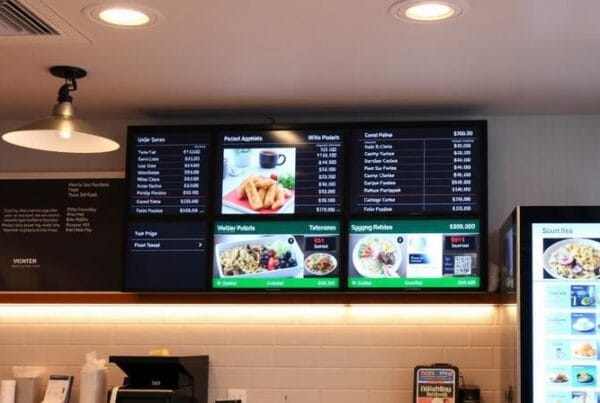
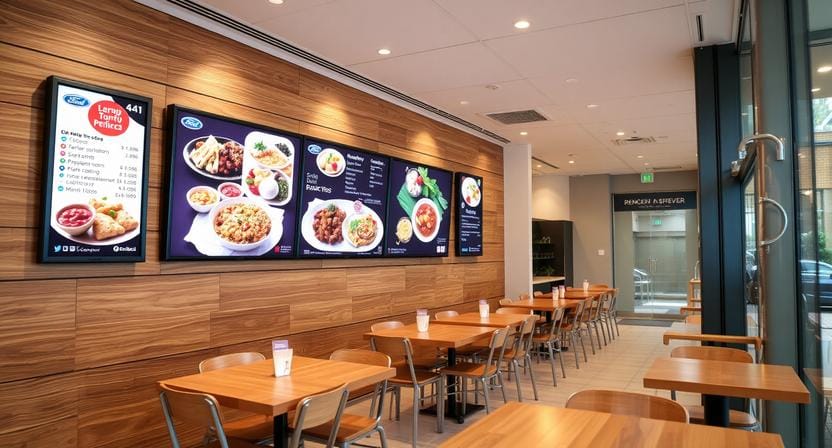
Digital signage can be used in restaurants where AI can support dynamic menu strategy and switching of what is highlighted based on time of day, demand, or inventory. This may involve marketing high-margin products at slow times or making best sellers conspicuous when there are long lines in order to hasten the decision-making process. The benefit is practical: the menu isn’t static—it’s dynamic.
Ready to move beyond one-size-fits-all content? Nento’s AI-powered solutions help you deliver the right message at the right time. Explore Nento’s Personalization Tools
Key Applications of Artificial Intelligence Digital Signage
Retail
Retail applications usually revolve around suggestions, interactive experiences, and smarter merchandising. Depending on the traffic trends, product performance, or audience segments, AI is able to prioritize various forms of promotions, making AI signage a conversion tool with measurable results, as opposed to branding.
Corporate
In the business world, AI in conference rooms enables wayfinding, visibility into room reservations, meeting notifications, and real-time occupancy information. This reduces friction on the side of employees and visitors and enhances the level of reliability and speed of communication at the workplace.
Healthcare
The wayfinding, updates on queues, and communication with patients are common features of healthcare apps. The use of AI-backed displays can minimize the confusion and enhance the flow by directing the visitors to the necessary departments and changing the information according to time frames and service demand.
QSR (Quick Service Restaurants)
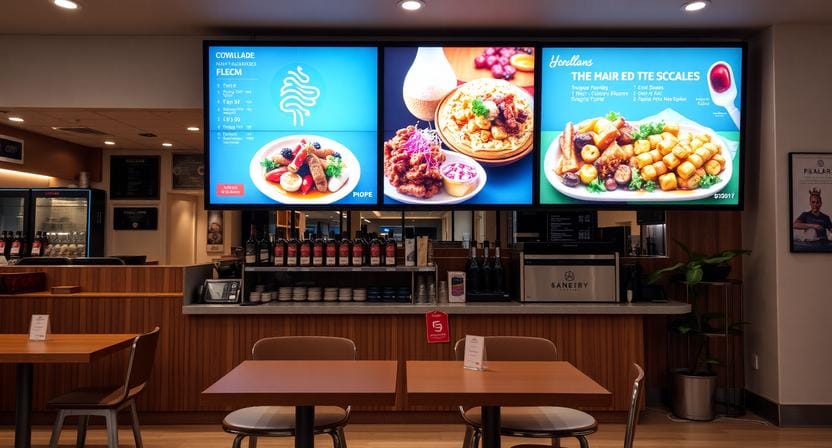
AI could be used to assist upsell logic and menu optimization in QSR. Breakfast combinations in the morning, family packages in the after-school times, and high-throughput best-sellers can be highlighted on a menu board and can be used to minimize hesitations. These are useful artificial intelligence digital signage solutions since they directly tie the content to speed and revenue.
“AI doesn’t replace the menu strategy—it executes it consistently.”
The Technology Behind the Magic: Hardware and Software
The Player
A typical media player isn’t built to understand data and make decisions. This is why AI signage is frequently based on a capable AI-driven digital signage player, which is able to handle data on-site (edge computing). Local processing lowers the latency and enables applications such as real-time audience metrics and quick content switching without necessarily using cloud round trips.
The Platform
It is a centralized location that enables operators to manage fleets of AI-controlled digital displays in different locations. This is where the importance of the AI digital signage software is so essential: the content rules, triggers, reporting, and device health need to be controlled via the same dashboard in case the system is to be scaled.
Integration
AI signage is of great importance when linked with business systems. Connections to CRMs, POS systems, and IoT devices can enable content to be updated based on real operations, whether inventory changes, staffing status, queue size, or loyalty campaigns, without needing to be published manually. This makes personalization measurable and repeatable and not creative experimentation.
Why Choose Nento for Your AI Signage Journey?
The Nento Difference
Nento is designed to be suitable to the businesses that believe in modern digital signage yet avoid getting lost in complexity. The objective is practical implementation: smart displays that can be installed more easily, controlled more easily, and optimized more easily.
Streamlined Solutions
Nento offers a full-stack solution, including the AI-enabled digital signage player and the software dashboard, that enables businesses to scale up to AI-powered digital signage without integrating fragmented solutions. This minimizes the risk of integration and minimizes the time between installation and performance.
Support
Intelligent systems need monitoring, care, and guidance—even during AI rollouts. The managed services and support provided by Nento guarantee that your AI signage remains stable and that your employees learn how to use personalization and analytics over time.
Don’t let complex technology slow you down. Nento simplifies AI digital signage deployment so you can focus on engaging your audience. Get a Demo with Nento Today
Frequently Asked Questions (FAQs)
What is digital signage AI?
It can be defined as the application of artificial intelligence technologies, including computer vision and machine learning, to viewer data in digital signage networks and automate content delivery, making AI-powered digital signage more efficient than the traditional displays.
How does digital signage enhance content personalization?
AI digital signage software can change content on demand based on audience signals by identifying their demographics or situational cues (such as weather) to ensure the message shown is always suitable.
Do I need special hardware for AI digital signage?
Yes—running advanced AI models usually requires an AI-powered digital signage player possessing adequate processing speed, not a simple media player.
What are the main artificial intelligence digital signage applications?
They are typically used in smart advertising in retail stores, digital signage in an office conference room, interactive kiosks, and menu boards in restaurants.
Is AI signage expensive to implement?
Costs have come down significantly. You can also use scalable solutions, such as Nento, which provides you with a chance to start with AI signage in one place and then expand further as your returns become noticeable.
Conclusion
AI has turned digital signage into responsive communication rather than a fixed message. The correct combination of the sensors, an AI-enabled digital signage player, and powerful AI digital signage software can help screens adjust the content depending on the audience indicators and situation, making the displays a channel that learns and gets better.
The main point is that the use of AI in digital signage is no longer just a future concept. It is turning into an operational requirement of the brands that desire to be relevant, engage audiences in a way that can be measured, and can be improved and iterated faster without always having to recreate content anew.
The future of communication is intelligent. Is your business keeping up? Partner with Nento, the digital signage company that bridges the gap between technology and engagement.