Introduction
Due to changing customer attention, restaurants are fast transitioning to moving screens as opposed to immobile posters. In a crowded restaurant, a menu that looks the same day after day becomes background noise, whereas a screen has the ability to make offers conspicuous.
“If your menu can’t change quickly, your marketing can’t either.”
Conventional boards are also quietly expensive: they always need updates, reprints, and the chance to advertise the correct things at the correct time. Nento helps restaurants run up-to-date digital signage that updates their menus quickly, uniformly, and at scale at a single site or hundreds.
The case for digital display menu boards is no longer just about looking modern; it is about raising Average Order Value (AOV) and enhancing operational efficiency. Displays that are easy to update and designed to sell are a daily revenue generator rather than a fixed cost.
Ready to upgrade your storefront? Contact Nento for a Free Consultation
Why Switch to a Digital Display for Restaurant Environments?
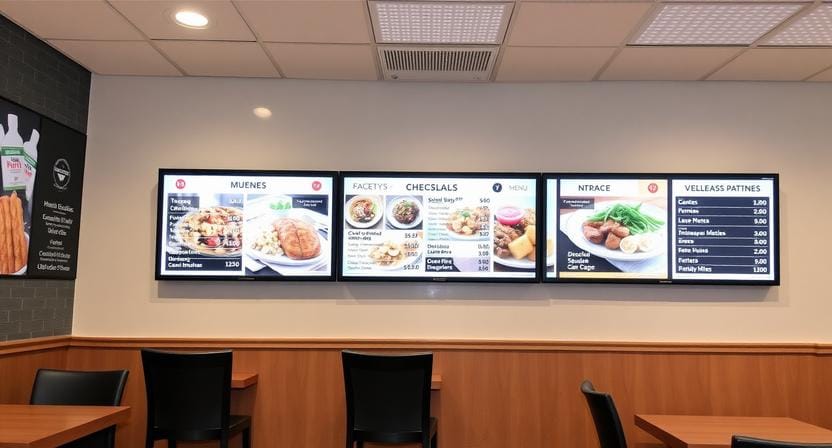
Using digital displays in a restaurant improves performance in three aspects of visibility, control, and cost. High-definition images and motion graphics are much more attention-catching than the still picture, particularly when it comes to high-traffic places where customers make decisions fast. Customers are more likely to upgrade and take less time to decide when food appears better and offers are made prominent.
“The menu is your silent salesperson—digital makes it louder.”
Operationally, digital gives you instant control. You are able to update prices, remove sold-out items, and schedule lunch/dinner menus without reprints or manual substitutes. It is also here that the digital menu display systems can be used to shorten the perceived wait times—the customers feel safer having an idea of what is available and what is popular.
Economies of scale are real, not hypothetical. Getting rid of printing runs, rush reorders, and menu change overnight shipping all add up fast, particularly when the restaurant changes its prices or promotions frequently.
Types of Digital Menu Boards
A. Indoor Digital Menu Boards
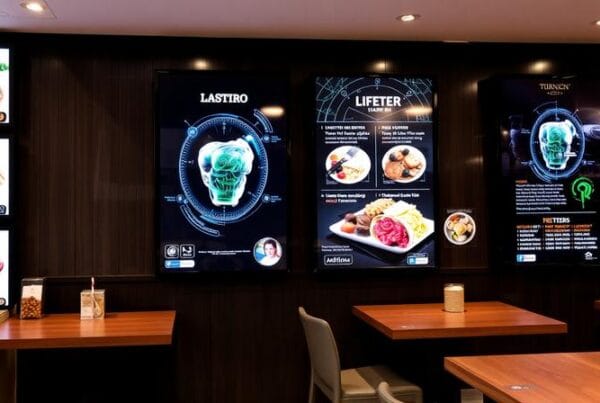
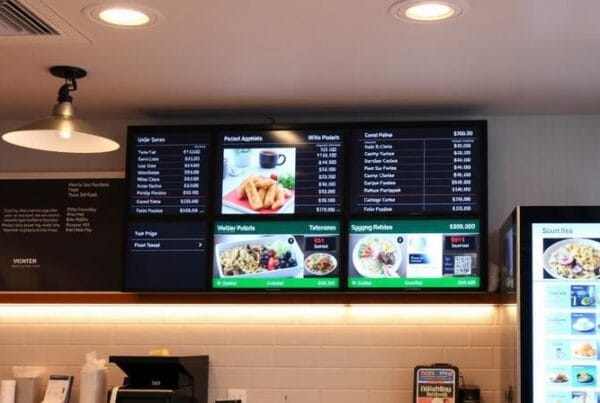
The most common location of the indoor digital menu boards is where the ordering decision is made the quickest, at the counter. They can be used successfully when they focus on best-sellers, bundles, high-margin add-ons, and a clean hierarchy instead of attempting to display everything. The biggest benefit is speed: customers can scan, make decisions, and order tickets with less hesitation.
Regarding the strategy perspective, indoor screens facilitate uniform upselling with visual callouts and intelligent positioning. Having your best combos in the most visible areas all the time means that your employees do not have to use their memory to advance upgrades. Nento supports digital menu displays that are constructed to operate on ambient indoor lighting, thus ensuring that menus are visible and clear during the day.
B. Drive-Thru Digital Menu
The drive-thru digital menu is an influential channel of generating revenue since it affects decision-making in a time-pressured situation. Outside factors complicate it further: sunlight, weatherproofing, and easy-to-follow layout are more important than content. If a screen can’t be read in noon glare, it isn’t operational.
Nento assists restaurants to have clear communication even during daylight in the sun by supporting outdoor-ready hardware and feasible layout advice. This keeps the drive-thru queue flowing and minimizes confusion at the speaker and pickup counter.
“Drive-thru wins are usually clarity wins.”
C. Tablet Menu for Restaurants
Restaurants can use a tablet menu to facilitate ordering at the table and relieve staffing strain during the busy periods. Table turnover usually increases and accuracy of orders is enhanced when customers are able to browse, customize, and place orders with less back-and-forth. Tablets also present the possibility of guided upsell, which is the proposal of sides, upgrades, or desserts at the appropriate time.
Nento’s software can be connected with the workflow of hand-held devices to ensure that the ordering process is the same and handoffs stay seamless. This is particularly useful when restaurants need to be flexible but without re-architecting their entire front-of-house process.
D. Digital Menu Display Boards for QSR vs. Fine Dining
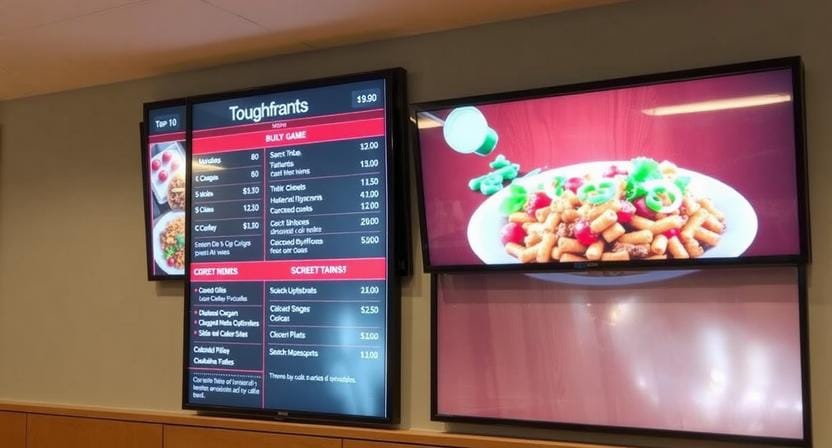
Menus aren’t used the same way across restaurants, and therefore design and hardware options differ. Quick service restaurants usually use grid-style layouts on LCD menu boards that QSRs rely on to produce sharp graphics and high readability. Fine dining can adopt less bold restaurant menu display boards that focus on ambience, specials that have been selected, and high-end positioning.
The target in both is consistency; menus must reflect the brand and support faster ordering. The digital menu display boards give you flexibility without tying you to a single style.
The Power of Interactivity and Content Management
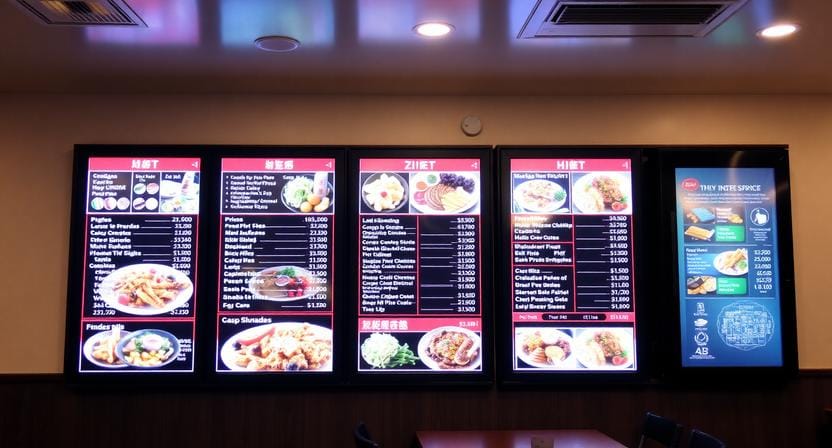
Using digital menu boards interactively can be a significant benefit. Touchscreen self-service kiosks reduce queue pressure, enhance order accuracy, and establish a standardized upsell path, which customers control. Not all restaurants need to be interactive, but where there is a high volume of service, it can effectively alleviate counter workload.
With cloud-based management, digital is actually scalable. Nento helps franchise owners control the digital menu display screens in a large number of locations through a single dashboard and maintain pricing, promotional, and seasonal items uniformly without location-by-location work. It is also operationally important to schedule switching between breakfast and lunch menus, which would minimize errors and ensure that the customers do not miss seeing the appropriate items at the appropriate time.
“The best menu system is the one you can update in minutes.”
Key Features to Look for in Electronic Restaurant Displays
1. Brightness
The brightness should be in line with the surroundings. In the case of drive-thru installations, 2,500 nits is a practical threshold for direct-sunlight readability, and indoor installations are typically capable of working around 500 or more nits based on the lighting conditions. Legibility, supported by the right brightness, protects speed.
2. Durability
Exterior units require thermal control and weather-sealing to endure prolonged working hours. Commercial reliability is still needed by the indoor units since kitchens and counters are also demanding. As a matter of fact, durability is the difference between installed and reliable.
3. Software Integration
POS compatibility helps keep the menu up to date. Changes in inventory and item availability as well as price updates should not be manually repeated across devices. Powerful electronic restaurant displays are even more useful when they reflect real operations rather than assumptions.
4. Content Design
Readability is not negotiable: font size, contrast, and motion limits should support fast scanning. Complicated layouts slow customers down; over-animated menus can hurt confidence and speed. This is the place where you have better menu performance without having to alter your kitchen.
5. Nento’s Edge
Nento’s software makes electronic restaurant displays easier to control, making it possible to always update them quickly and minimizing the need to involve technical personnel. With a system that is easy to work with, your menu stays fresh—and fresher menus sell better.
“Ease of updating is an ROI feature.”
Overcoming Common Implementation Challenges
The issue of costs is commonplace, but the ROI model is usually straightforward: more sales by means of improved upselling and fewer printing expenses will allow digital menus to pay off in a few months, particularly in high-turnover settings. The trick lies in making digital work as an operating tool, not just a design project.
Training staff is also not as painful as many owners assume. The new generation of digital menu display systems is designed to be user-friendly for non-technical users, and the templates and controls have been designed to make publishing feel like updating content, not mastering software. Nento’s user-friendly interface helps save time during training and enhances adoption.
The actual fear of operators is downtime risks. That is why support and reliability are to be considered as serious as screen specs. The 24/7 support strategy and redundancy practices of Nento assist in safeguarding peak-hour performance and keeping menus updated when traffic is at its highest point.
Future Trends in Digital Menu Technology
Recommendations based on AI are increasingly popular, and menus are now able to highlight various items depending on the time of day, weather, or the pattern of orders. The adoption of loyalty apps is also gaining momentum and assists restaurants in linking offers to repeat behavior without campaign work.
Another evident direction is sustainability. The paperless operations save waste and prevent reprint cycles, and the current digital solutions are becoming both an upgrade of operations and a green solution. The green policy of Nento helps restaurants, which do not need physical rework every day.
Don’t get left behind. Explore Nento’s Latest Digital Signage Innovations
Case Study / Real-World Application
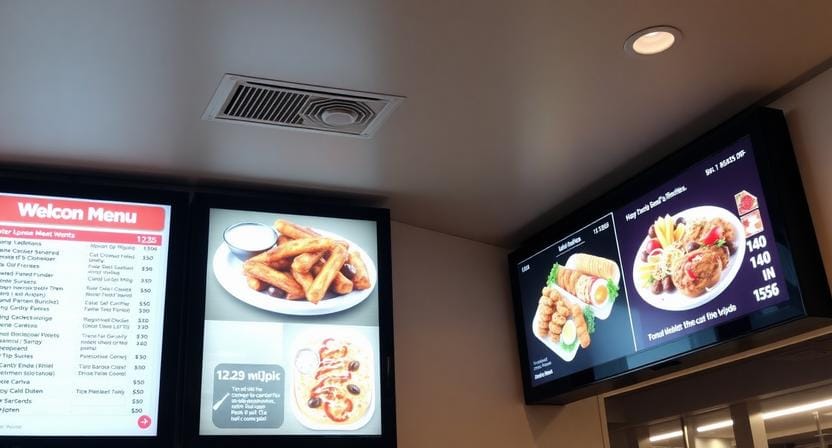
Take the example of a local fast-food chain that adopted the digital menu display boards by Nento to make upselling more consistent and minimize the friction in its operations. Following rollout, the brand increased upsell conversion (i.e., combo upgrades) by 15% due to the increased visibility of featured items and constant promotion.
They were also able to save about $2,000 per month monthly in printing expenses by avoiding reprints and last-minute updates. Customer complaints about incorrect pricing dropped because updates were centralized, which were real-time and not manual and slow.
“Consistency is a sales lever when you operate at scale.”
Frequently Asked Questions (FAQs)
What is the average cost of a digital display for restaurant use?
The price depends on screen size, brightness (indoor or outdoor), and software subscription. Nento has scalable packages that are available with single kiosk solutions up to enterprise-level franchise rollouts. Contact us for a custom quote.
Can I use digital menu display screens in a drive-thru during winter or rain?
Yes. Nento offers weatherproof, temperature-controlled drive-thru digital menu boards, which were designed to handle extreme weather and moisture to guarantee year-round reliability.
How hard is it to update the menu if I run out of an item?
The cloud-based system offered by Nento allows you to update your indoor digital menu boards in seconds. You are able to remove an out-of-stock item on your phone or laptop in real time, and this will save you the frustration of the customer.
Do digital menu board interactivity features work with older customers?
Absolutely. The interactivity of the digital menu boards can be customized. In case you select a tablet menu to be used in restaurants, the interface will be configured to have big buttons and easy navigation. In the case of counter-service, it is acceptable that the static digital displays can be read by all demographics.
Are LCD menu boards restaurants use better than LED?
Both have benefits. LCD menu boards often offer better color precision and 4K display on indoor menu boards, whereas LED is commonly applied to large exterior signs. Nento assists you in selecting the technology to fit your environment.
Conclusion
Digital menus are better because they offer a blend of sales influence as well as control over operations. The digital menu display systems help restaurants update faster, sell smarter, and have a more modern appearance that customers trust. By making your menu readable, up-to-date, and designed to support quick decisions, you safeguard speed and enhance revenue performance.
Restaurants that look modern and stay agile will win customers in a competitive market. Given that you need your menus to be more active, whether drive-thru, counter, or table-side, the most practical upgrade is going digital.
Ready to transform your restaurant’s ordering experience?