Introduction
The shift from motionless posters to moving, high-impact displays is happening everywhere—because attention is harder to capture and easier to lose. A sign has only a few seconds to attract someone in a high-traffic area such as a lobby, retail floor, or trade show to convey value and the next action.
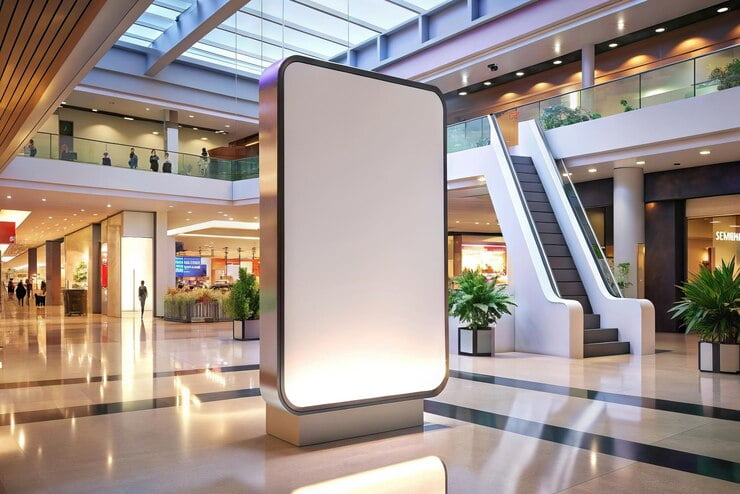
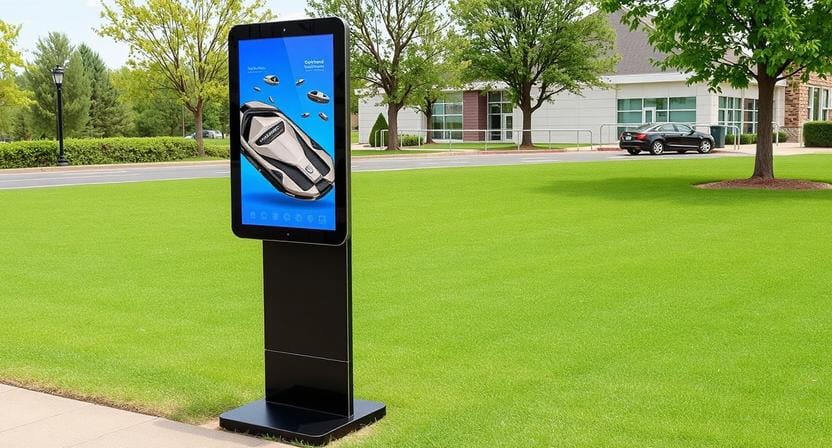
Freestanding signage is designed for these environments. Freestanding units work well at entrances, end caps, queue lines, and event booths, unlike wall-mounted displays, which require pre-existing infrastructure. This has evolved into freestanding digital signage, which is portable and has high impact and can be updated instantly without the need to reprint or reinstall.
“The best floor display is the one you can change in minutes, not days.”
Ready to upgrade your floor displays? Explore Nento’s premium freestanding digital signage solutions today.
The Rise of Freestanding Digital Signage Over Traditional Static Signs
Static signage fails because it can’t keep up. The cost of reprinting, expired promotions, and the need to manually update displays is costly—teams end up with old messages or spend hours updating them. In high-traffic businesses, that typically implies that static posters remain in place too long and cease to work.
A free-standing digital screen will fix that by transforming your floor into a living communication platform. Remote content updates: You can instantly replace promotions, pricing, and announcements on a single unit or multiple units. Stopping power improves by the ability to utilize video and animation—motion automatically attracts attention in a crowded area where static signs get overlooked.
Above all, the ROI is enhanced due to the possibility to target messaging. You can do different offers based on time of day, location, or event schedule—without printing or labor overhead. In smaller organizations, standalone digital signage is particularly attractive, since it is easy to use: install it, plug it in, post content, and refresh it any time without any special tools.
“Digital doesn’t just look better—it works harder.”
Key Applications of Corporate Freestanding Digital Signage
A top use case of corporate freestanding digital signage is lobbies, corridors, and common areas where information must be understood quickly. It can serve as a welcome sign, meeting and event board, internal communications screen, or wayfinding guide—without any wall construction or permanent installation. This is what makes it good in offices that do not stick to the same layout, have rotating events, or need flexible communication.
Freestanding displays are used in retail settings to showcase products and seasonal offers as well as high-margin feature spaces at the entrance and checkout areas. Since the content is remotely updated, the screen will stay relevant instead of becoming background noise.
Queue management, patient education, and guidance messaging are beneficial in hospitality and healthcare settings. A freestanding digital screen can help alleviate confusion and perceived wait times and enhance overall experience in these settings, particularly when messaging stays clear, timely, and consistent.
In all these applications, design and durability are important. A free-standing unit should appear professional in high-end settings and be robust enough to withstand the heavy foot traffic and repositioning.
“Freestanding screens win when they feel permanent—but move when you need them to.”
Hardware Deep Dive: Choosing the Right Freestanding Digital Screen
The first step in selecting the appropriate freestanding digital screen is size. Most businesses use the 32–86-inch range based on viewing distance and location. Smaller sizes work well where queue lines and product displays are close to each other, whereas larger sizes are effective in entrances and high-traffic areas where the visibility needs to carry farther.
Orientation is the next decision. The portrait screens tend to work well with the directory-type content, wayfinding, and poster-like advertisements. Landscape screens are effective in messaging that is video-intensive, dashboards, and menus. This is because the most effective option will be determined by the way your content is organized and the speed at which you would like people to scan it.
Outdoor vs. indoor ratings are also important. Indoor units are designed to suit controlled environments and aesthetics, whereas outdoor-rated units need to be weatherproof, brighter, and built with tougher casings. In campaigns that need to be used at entrances, open-air space, or semi-outdoor environments, the correct choice of rating will safeguard uptime and life expectancy.
Wholesale freestanding digital signage matters in case you want to roll out many units. Bulk purchasing is not only about price but also about standardization, easier management of content, and performance everywhere.
“Hardware decisions should match where the screen lives, not just what it plays.”
Need bulk pricing? Contact Nento for wholesale freestanding digital signage quotes tailored to your campaign.
Software Matters: The Role of Free Digital Signage Software
A lot of businesses begin with the search of free digital signage software, as it seems to be a low-risk point of entry. Free tools are generally capable of simple scheduling, simple templates, and limited remote management, which is sufficient when using the tools in single-screen applications where updates are infrequent.
The limitation shows up when you scale or when accountability is required. Software platforms (such as those of Nento) typically include analytics, more robust permissions, quicker publishing processes, and support, which are important when signage moves from a pilot to day-to-day operations. In case you require steady performance on more than one screen, then downtime prevention and monitoring become part of the ROI.
The ease with which your freestanding digital signage hardware can be controlled is also determined by software. Screen grouping, automated scheduling, and quick content changes should be supported by a solid platform to ensure that the display remains relevant but does not burden the employees with additional tasks.
“Software is the difference between ‘a screen’ and ‘a system.’”
Where to Source Your Units: Finding a Reliable Freestanding Digital Signage Supplier
Not all suppliers are equal. A trusted freestanding digital signage provider does not just offer a box and a screen; they offer guaranteed hardware, clear warranty terms, software compatibility, and actual assistance in case something goes wrong.
Green flags encompass transparent specifications, commercial-grade brightness and cooling, understandable service terms, and responsive after-sales service. Red flags involve unspecified specifications, lack of warranty information, and an afterthought feel of the software.
Nento is unique here: full support (hardware and software), custom branding, robust warranty, and reliable support backed by stable operation. It is also the reason why it is risky to compare on price alone—cheap freestanding digital signage may look good at first but may fail over time with low-quality components, ineffective cooling, or inadequate software support.
“The cheapest screen is expensive when it goes dark mid-campaign.”
Cost Breakdown: Is Cheap Freestanding Digital Signage Worth It?
Initial investment is not the whole tale. Low prices may be accompanied by lifetime expenses that are difficult to detect: too dim to read, consumer-quality components that wear out sooner, bad software that causes manual labor, and little service when something goes wrong. These costs show up as downtime, replacement cycles, and lost campaign performance.
Lifetime value is a more appropriate comparison. A reliable, easy-to-update, and supported screen will last longer and work consistently. The stability guards ROI since the screen keeps on giving value rather than turning out to be a maintenance nightmare.
Nento balances cost with business-level reliability, combining commercial-grade hardware with real-world deployment software and support. You either spend less and lose performance or invest in uptime, clarity, and simple management.
Real-World Success Stories (Case Studies)
A retail chain places freestanding digital signage at entrances and high-margin product areas and changes promotions and seasonal campaigns on a weekly basis. They experience a 30% increase in sales of highlighted items due to the regular visibility and improved promotional timing, mostly because of the improved attention and speed of decisions made by customers.
“Placement plus timely content is where floor displays become revenue tools.”
Corporate freestanding digital signage is a type of signage used in the lobby by a corporate office to show internal announcements, event schedules, and wayfinding. The employee engagement improves because information is visible and consistent—not just buried in email.
A trade show booth incorporates standalone digital signage to play product demos and take leads via QR-based forms. The booth invites more attention and turns more conversations into sales as the screen makes the offer clear at first sight and the next steps clear.
Future Trends in Freestanding Digital Display Technology
The personalization of content through AI is also entering the realm of standalone screens, where screens can prioritize content based on time, location, or context of the audience. Touchless interactivity is growing as well, with the use of QR and proximity to minimize physical contact but allow interaction.
Some settings that have limited power availability are going solar-powered outdoors, and cloud-controlled freestanding digital signage networks are becoming the new standard of multi-location control. All these trends are pointing in one direction: freestanding screens will be smarter, more measurable, and scalable.
“The future isn’t just digital—it’s digital plus automation.”
FAQ Section
What is the difference between freestanding signage and wall-mounted signage?
The freestanding signage is placed on the floor, is mobile, and does not need to be installed on the wall.
Can I use free digital signage software with Nento’s freestanding digital screens?
Yes, but Nento offers advanced scheduling, real-time updates, and analytics through its premium software.
Is cheap freestanding digital signage reliable for 24/7 use?
No, often not. Low-end units can be without cooling, brightness, or commercial-grade components. The Nento units are designed to run continuously.
Do you offer freestanding digital signage wholesale for multiple locations?
Absolutely. Nento offers volume-based discounts, single cloud management, and account support.
What’s the typical lifespan of a freestanding digital screen?
Many commercial-grade screens are rated around 50,000+ hours (varies by model and usage).
Can I move a standalone digital signage unit easily?
Yes, the majority of them are provided with casters or lightweight models to move around.
How do I become a freestanding digital signage supplier like Nento?
Nento has reseller and integrator partnership programs—contact our team.
Conclusion
One of the quickest methods to contemporary communication in high-traffic areas is freestanding signage, as it inserts the message right in the stream of attention. That location advantage coupled with digital control makes you get quicker updates, more interactions, and a system that can scale without printing and manual effort.
Nento is designed to be your one-stop freestanding digital signage manufacturer, providing commercial hardware, robust software, and service that ensures uptime. A freestanding digital display is the smartest upgrade you can make to your floor space, be it retail, corporate, healthcare, or events.
Transform your floor space into a revenue driver. Shop Nento’s freestanding digital signage collection now—free shipping & lifetime software support included.