Introduction
Unclear halal food signage costs more than you think. It can cause lost trust, confusion of customers at the point of sale, and critical compliance risk if you accidentally violate what is halal and what is not.
“In halal dining, clarity is credibility—and credibility is repeat business.”
In its most basic form, it’s a set of signs, notices, and menu markers that communicate what is halal and what is not and what standards you are adhering to. When properly done, it safeguards brand integrity when your message is aligned with your sourcing, handling, and certification.
Digital is becoming the new modern solution as it reduces update time and enhances consistency among locations. Halal food digital signage also simplifies the maintenance of menus in cases where the suppliers, recipes, and certifications are altered.
Ready to upgrade from static posters? Nento offers cloud-based halal food digital signage software—start a free trial/demo.
Why Halal Food Signage Matters More Than Ever
The market is growing—and expectations are rising
The USA—and the market globally—are seeing growth of the Muslim consumer market, and this growth increases the demand for clarity. There is an increasing demand on businesses to state halal status with accuracy, rather than generalizations.
Mislabeling poses two types of risk: religious risk to the customers and legal/reputational risk to the business. Lost trust can be hard to recover even in the case of an accident.
Halal-certified vs halal-friendly vs “no pork/no alcohol”
“Halal-certified” means that it is certified by an authoritative agency and adheres to written standards. “Halal-friendly” can be construed as a partial compliance, and “no pork/no alcohol” is a more limited assertion that is not necessarily halal. What you are doing should be reflected in your signage; otherwise, customers will be deceived.
Types of Halal Food Signage You Need to Know
Match signage to your operational reality
The various businesses may require varying degrees of clarity based on their fully halal operation or mixed kitchen operations. This is aimed at minimizing the ambiguity in order to allow customers to make a decision without having to question the staff.
“Halal food only” signage is suitable to an inflexible setting such as a fully halal restaurant or a halal kitchen. It indicates that it is not only a few items of your offering but also in compliance with halal requirements.
Non-halal food signage is important in shared kitchens, cafes, or cafeterias where halal and non-halal foods are sold. These warnings help protect customers by clearly stating when a product or food can have haram ingredients or risk cross-contamination.
In the USA, halal food signage should be understandable to the local standard of certification and the way your restaurant informs customers of compliance. Practically, that usually means that you are not coy about whether you are certified and what your labels imply.
Why Static Halal Signage Falls Short
Where paper and plastic break down
Permanent signs become stale, wear out, get ignored, and turn inconsistent in different places. A more significant problem is operational: a menu changes or a supplier changes, and printed signage often falls behind.
It is that lag where errors occur. Customers rely on the sign; staff rely on memory, and the difference between what is posted and what is true is risky.
Real-time updates protect both trust and compliance
Digital provides the ability to change halal status as soon as a supplier is changed, a recipe is altered, or a certification has expired. That will be easier to keep up with compliance since your signage will work as a tool, not a poster.
Stop reprinting worn-out signs. Nento’s digital signage in food & drink lets you update halal status in seconds—learn more.
Halal Food Digital Signage: A Game Changer
What halal food digital signage actually includes
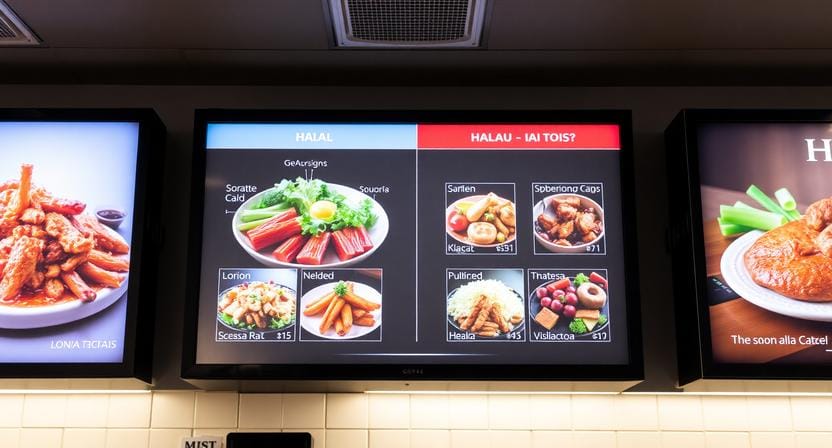
Halal food digital signage may have menu screens, entrance displays, counter signs, and even in-house kitchen signs that keep employees on track. The most important benefit is uniformity in the messaging at all customer-facing points.
This method is particularly effective when your company already has food and beverage signage in place to use as menu or promo signs or as a wayfinding aid. You retain the same screens and make halal communication clear, organized, and revised.
Use cases that benefit most
Digital is an advantage to food truck signage since trucks regularly switch menus, locations, and daily offerings. Halal labels can also be easily maintained without reprinting by using weatherproof screens and offline playback.
Another powerful use case is food drive signage since the charity events and temporary structures usually need distinct halal areas. Digital allows you to schedule signage for specific dates and time frames and turn it off after the event is over.
What halal food digital signage software should do
Good halal food digital signage software should facilitate scheduling, remote control, and multiple-location synchronization. In that manner, a single update will be applicable across all locations, and you will not run the risk of having one of the branches with outdated halal tags.
Specialized Scenarios for Halal Signage
Food trucks, food drives, and institutional dining
Food trucks require high-impact messaging within a small area, and a digital halal label block can be of particular value. The ordering line is quicker when customers can read about halal-only or non-halal ingredients immediately.
Food drives and temporary halls require fast installation and clean separation of the halal and non-halal areas. Digital scheduling lessens human error since you can plan what to show and when and where in advance.
Hospitals, schools, and corporate cafeterias are some of the institutions that are highly dependent on food service signage to minimize confusion and aid in dietary adherence. Good labeling of halal in such settings reduces repeat questions and also enhances trust—particularly when menus are changed every day.
How to Implement a Halal Digital Signage Strategy
A simple 4-step rollout
Step 1: Conduct an audit of existing signage. Determine lapses in halal vs. non-halal labeling, particularly on points of entry, menus, and preparation.
Step 2: Select Nento’s halal food digital signage software. Keep control centralized so updates can occur once and can be published everywhere, even in multi-location environments.
Step 3: Use clean templates. Use consistent symbols (like a green crescent), and keep labels explicit: “Halal Only” versus “Non-Halal” where needed.
Step 4: Educate personnel and plan automatic updates. Your signage plan must be able to still work when managers switch shifts or when places become congested.
“The best halal system is the one that still works on your busiest day.”
Common Halal Signage Mistakes
What goes wrong most often
Common errors include using inconsistent fonts and colors when labeling halal and non-halal. Customers are fast scanners, and therefore, inconsistency leads to uncertainty and delayed decision-making.
The other huge error is not updating signage after supplier changes. The restaurants frequently update the POS or kitchen sheet but leave the signs that the customers see in the restaurants outdated, and this is where the trust is broken.
Digital minimizes such errors, as the updates are centralized. You can update a single template and push it to all the screens with Nento, avoiding location-by-location drift.
“Consistency is what turns signage into trust.”
Frequently Asked Questions (FAQs)
Can I use digital signage for a temporary halal food event?
Yes, with Nento, it is possible to plan the dates and times of halal food-only signage.
What’s the difference between halal food signage and non-halal food signage?
Halal signage will ensure that the standards are met; non-halal signage will alert that something contains haram ingredients (e.g., gelatin and alcohol).
Does halal food digital signage software work on food trucks?
Absolutely. Nento supports offline playback for food trucks and rugged displays.
Do I need different signage for halal food in the USA vs. other countries?
Yes, certification bodies are different. The templates can be designed location-specifically.
Can Nento’s platform integrate with my existing food & beverage signage?
Yes. Nento is used in conjunction with menu boards, promotional screens, and wayfinding signs.
Best Practices for Designing Halal Food Signage
Design rules that improve clarity fast
Apply universal halal marks (usually a green circle or crescent) and be concise: “Halal Certified” or “No Pork, No Alcohol”—when that is exactly what you are saying. High contrast enhances visibility in high-traffic places where the customers are in a hurry.
Transparency can also be added by the use of QR codes. Interactive QR codes linking to live certificate validation can help customers not have to trust the staff to verify the information and minimize the trust friction on the counter.
“The best signage answers the question before the customer asks it.”
Conclusion
Halal food signage isn’t just labeling—it’s trust infrastructure. Clarity of halal food signage instills trust, minimizes confusion, preserves brand integrity, and prevents expensive errors associated with mislabeling.
Digital, flexible, and audit-ready digital signage in food & drink is the next step. Whenever your menus, suppliers, or certifications vary, your signage needs to update just as quickly, without involving reprinting and lack of uniformity between locations.
Join 500+ restaurants, food trucks, and cafeterias using Nento for halal-compliant digital signage.