Introduction
Static menus can silently drain restaurants and QSRs of thousands of dollars. Prices fluctuate, products go out of stock, and promotions come and go, but printed boards can never keep up. The outcome is slower decision-making, more counter questions, and fewer upsells when the customers are unable to clearly see the bundles, add-ons, and specials.
“If your menu can’t change fast, your sales strategy can’t either.”
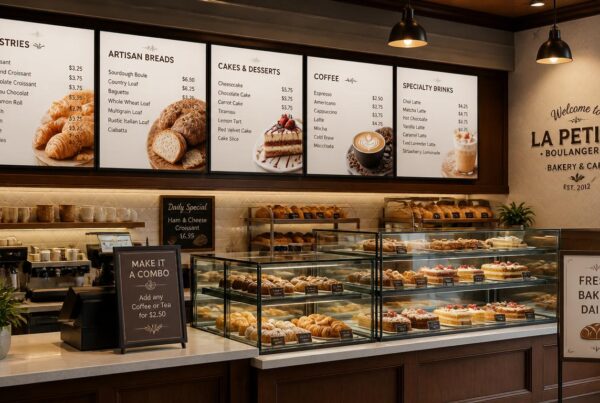
Commercial digital menu boards are dedicated systems that are installed in busy food and retail environments. As opposed to the old-fashioned boards, which are stagnant, they allow real-time updates, pre-scheduled menu changes, and content that actively contributes towards quicker ordering and higher ticket sizes. This is the reason why commercial menu screens are becoming the norm in modern menu communications.
Nento backs up this change with a restaurant-ready digital signage solution that helps companies roll out, manage, and update menus on a single display or a multi-location network.
Upgrade to Nento’s commercial digital menu boards today—book a free demo.
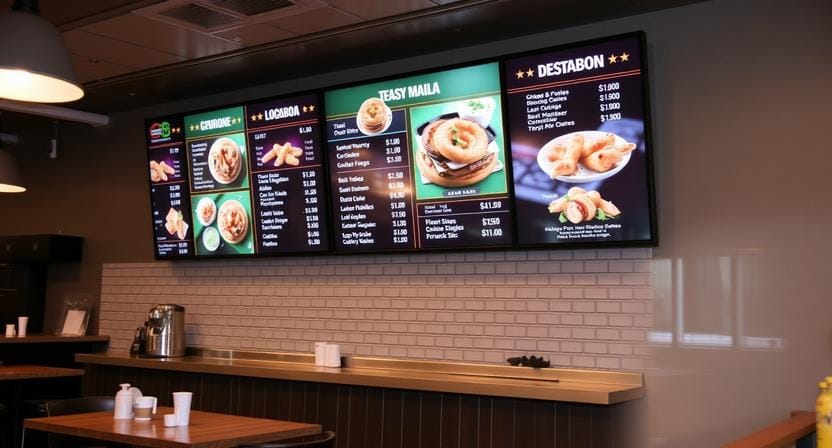
Why Switch to Commercial Digital Menu Boards?
Real-time control without reprinting costs
The speed of change is the greatest benefit. You are able to edit menu items and prices in real time without having to reprint, remount, or manually change panels. This helps avoid mismatches, reduces staff interruptions, and ensures customer expectations match what’s available.
Dayparting and dynamic pricing that runs automatically
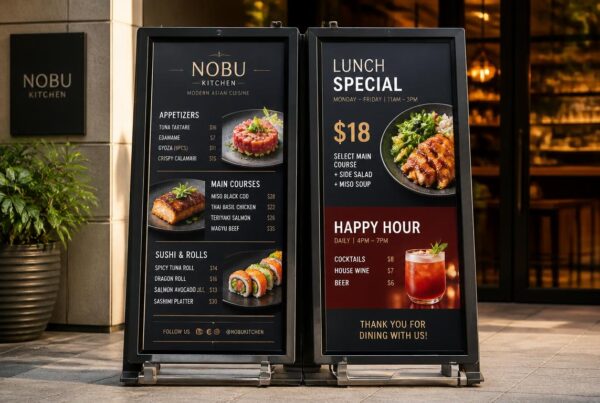
One of the reasons why businesses change is dayparting. Automating breakfast, lunch, and happy hour menus that the appropriate content can be displayed at the appropriate time without staff having to remember to make any changes.
Faster decisions and lower perceived wait time
Perceived wait time can drop by commercial menu screens. Having clear visuals, including items on display, combo setups, and pickup instructions, customers feel that the process is easier and order with more confidence. The digital menus also facilitate promotional messages that enhance average order value since upsells remain on the menu even when there is a rush.
Key Features of High-Performance Commercial Menu Screens
Brightness and visibility in real conditions
Brightness shouldn’t be compromised, particularly in drive-thru and window-facing settings. Many indoor business settings need around 700+ nits for readability in bright light. If customers can’t read quickly, your speed-of-service is reduced instantly.
Cloud control and POS integration
Commercial menu screens are scalable by cloud-based remote management. Operators are able to update pricing, specials, and promotions without having to touch each screen using a dashboard. POS integration maintains consistency between prices and availability, reducing errors and staff corrections.
Durability for heat, dust, and grease exposure
Commercial durability is an issue in actual food conditions. Screens often operate in heat, dust, and grease and must be stable throughout the day when they are in use and also not overheat or degrade easily.
“Commercial performance isn’t about looking good—it’s about staying on.”
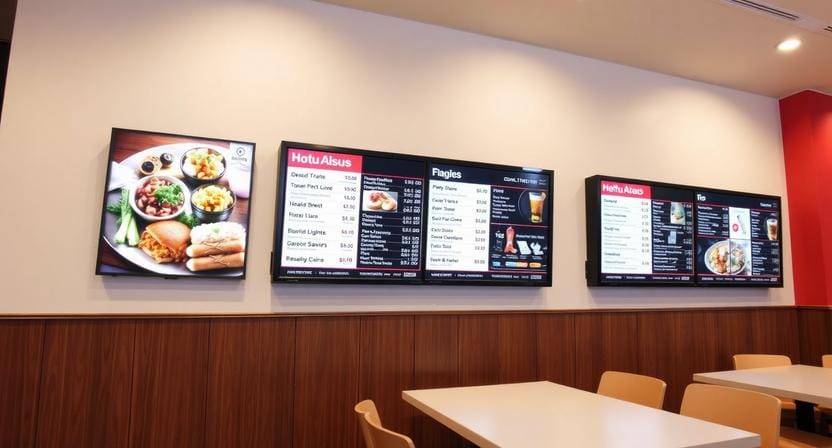
7 Creative Digital Menu Board Ideas for Restaurants & Retail
1. Video-based product highlights
Brief videos of hot burgers or drinks make them more appealing and make high-end products feel like it’s worth it.
2. Countdown timers for limited offers
Urgency is generated by timers used in a credible way: daily specials, low-stock, almost ‘sold out’ items, and deals within a time frame.
3. Social media feed integration
User-generated content builds trust and promotes impulse buying by displaying what actual customers are fond of.
4. Nutritional & allergen filtering
Effective allergy and dietary indicators minimize menu anxiety and expedite the process of making decisions among guests with dietary needs.
5. Cross-selling combos
Visual staging: Place combo prompts next to mains. Fries + drink are upsells that do well at the point of decision.
6. Queue-busting displays for busy periods
Use screens to guide customers: “Order here,” “Pickup zone,” “Next in line,” or “Popular right now” to minimize confusion during rush.
7. Local weather-based menu suggestions
The relevance is enhanced with the help of context cues: hot soup on cold days, iced drinks on hot days, and delivery promotions on rainy days.
These digital menu board concepts can increase sales per square foot by increasing visibility, lessening hesitation, and directing clients towards more lucrative options.
“Creative content works when it helps customers decide faster.”
Commercial Menu Board vs. Consumer-Grade Displays
Commercial-grade screens are designed to have long daily operation with adequate cooling, sturdier parts, and uniform brightness. Consumer television sets are made to be used at home and are usually unsuitable when it comes to constant use, particularly when it comes to hot or greasy conditions.
Software reliability is also a key difference. Commercial systems need remote monitoring and stable playback since screen downtime affects the speed of ordering in real-time. This is the reason why commercial-grade hardware and a stable software platform are usually selected by businesses that migrate to a commercial digital menu approach.
The mission of Nento’s commercial menu board solution is to ensure that it is reliable enough that restaurants aren’t left scrambling, trying to troubleshoot incompatible devices during the rush hour.
“A consumer TV can display content. A commercial system runs operations.”
How Commercial Digital Menu Board Ads Generate ROI
Internal promotions vs. paid ad placements
The commercial digital menus have two sources of ROI: the promotion of the business internally and optional monetization of ads. Internal promotions are based on your best-selling products—combos, upgrades, day-of-the-week, and daypart-specific promotions offered in a consistent manner at the point of decision.
Other companies also sell advertisements to CPG brands, where sponsored content will rotate in a special section. The outline provides an example of a coffee shop that makes $1,200/month placing paid advertisements on menu boards, and this is the best when the ads do not interfere with the clarity of the menu.
What to measure
To control ROI, monitor dwell time, promoted-item lift, upsell conversion, and upsell conversion rates associated with featured placements.
“If it’s digital, it should be measurable.”
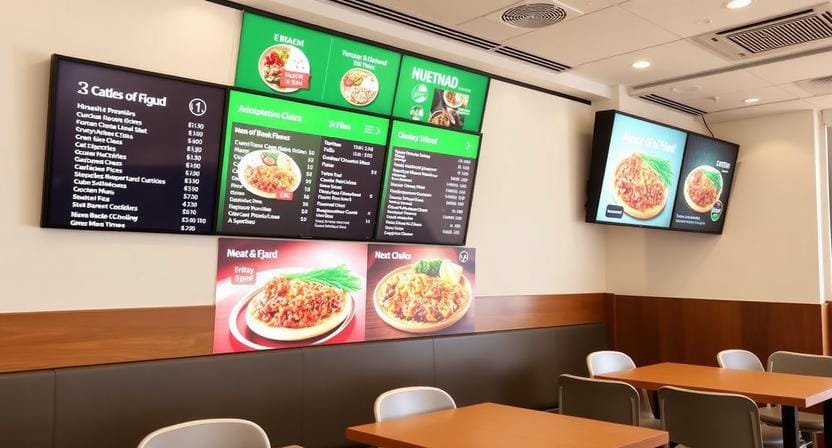
Choosing the Right Commercial Menu Display Size & Orientation
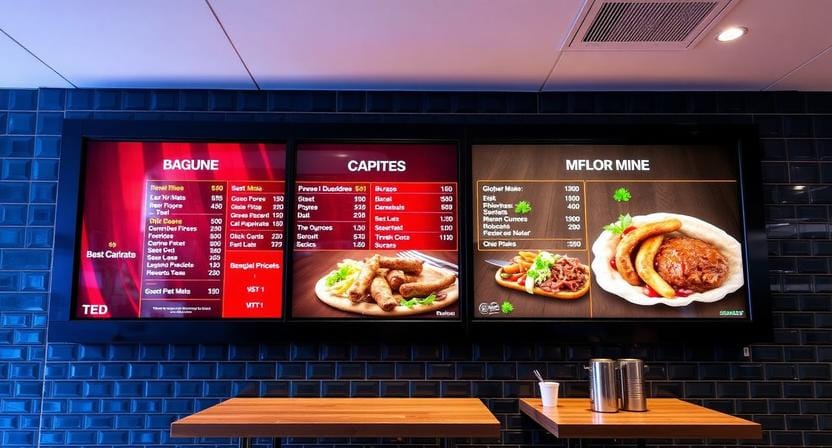
Landscape layouts are popular for drive-thru and counter menus since they accommodate category blocks and combo structures. The portrait formats can be effective in both the narrower placements and the promo-heavy layouts, particularly where there is limited wall space.
The size of the screen must be appropriate to the viewing distance, and the most frequent range is 32–65 inches based on the distance the customers are from the screen. The height of the mount also affects line-of-sight and accessibility—bad mounting can cause glare and slow ordering.
“If customers can’t read fast, service can’t be fast.”
Implementation Roadmap for Digital Business Menu Systems
Step 1: Audit your current menu item count & categories
Make it simpler and locate your most profitable products that should be given priority.
Step 2: Design templates for digital business menu
Apply the same rules of layout to avoid disruption of readability with updates.
Step 3: Train staff on real-time price/availability changes
Speed is the most important when the changes can be achieved within minutes without misunderstanding.
Step 4: Test during peak hours
Peak-hour testing will indicate the readability of menus, the presence or absence of upsells, and the clarity of workflow.
Get a custom installation plan from Nento—Quote in 24 hours.
Common Mistakes to Avoid with Commercial Menu Screens
Slow decision-making and ordering hesitation are caused by overcrowding. Menus are not readable due to low contrast, particularly in bright light conditions. There is also a tendency of many restaurants to overlook the need to focus on speed of service by designing their menu in a way that appears pleasant yet difficult to scan.
The other costly error is the use of consumer-grade screens, which overheat. When a screen malfunctions during a rush, the ordering process will be slowed down, and the employees will have to balance the order manually.
Future Trends in Commercial Digital Menu Boards
Menu systems are smarter. The concept of AI-led personalization is coming up, as well as voice-activated ordering systems in kiosks and assisted ordering rooms. High-tourist destinations are also exploring the use of dynamic currency conversion to indicate guest pricing.
Frequently Asked Questions (FAQs)
How much do commercial digital menu boards cost?
Prices range from $800 to $3,500 per screen plus software subscription. Nento offers hardware+software bundles starting at $149/month.
Can I schedule menu changes automatically?
Yes. Cloud-based commercial menu screens allow you to schedule breakfast/lunch/dinner menus, happy hour, and seasonal ones.
Do commercial menu displays work outdoors?
It must be rated to be used outdoors (high brightness, thermal management). Outdoor displays should have an appropriate outdoor rating (e.g., IP-rated enclosures) depending on exposure.
How long do commercial digital menu boards last?
Well-maintained commercial-grade screens have a lifespan of often around 5–7 years (depending on duty cycle and environment) at 16 or more hours per day.
Can I show ads from other brands on my digital business menu?
Yes, several operators are commercializing idle screen space by placing digital menu board commercials—the platform Nento builds helps to rotate ads.
What’s the ROI timeline for commercial menu screens?
The average order value and labor savings enable most QSRs to have ROI timelines that vary; many operators look at AOV lift and printing/labor savings.
Conclusion
Digital menu boards increase speed, sales, and brand perception since they keep menus readable, up-to-date, and positioned to upsell. That is why commercial menu screens are no longer a luxury but are becoming a necessity to restaurants and QSRs that are competing based on speed and experience.
When you require a complete solution that includes trusted screens, cloud management, and templates to scan rapidly, Nento can assist you in modernizing in a brief time and keeping menus accurate without needing to rewrite them daily.
Switch to Nento’s commercial digital menu boards—a 14-day free trial and free hardware consultation.