Introduction
The use of restaurant menu screens is replacing static boards in restaurants because customers decide faster when the information is straightforward, visual, and up-to-date. Static boards aren’t dynamic, so they become messy and costly to keep up to date, particularly when prices, specials, and availability are changing every week (or day).
“If your menu changes faster than your board, your signage is working against you.”
Digital displays improve two outcomes that matter most: speed and sales. Guests place orders faster when menus are legible and organized. Average ticket size increases when promotions and upsells are on the screen, without staff relying on scripted selling.
Nento supports this shift with restaurant-first digital signage that combines commercial screens, cloud updates, and templates designed for fast scanning.
Ready to upgrade? Get a free quote from Nento today.

What Are Restaurant Menu Screens?
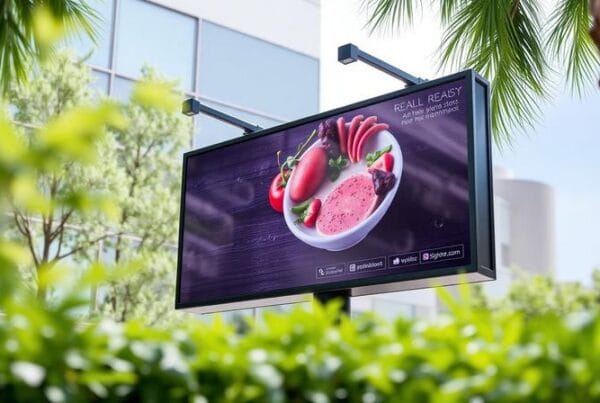
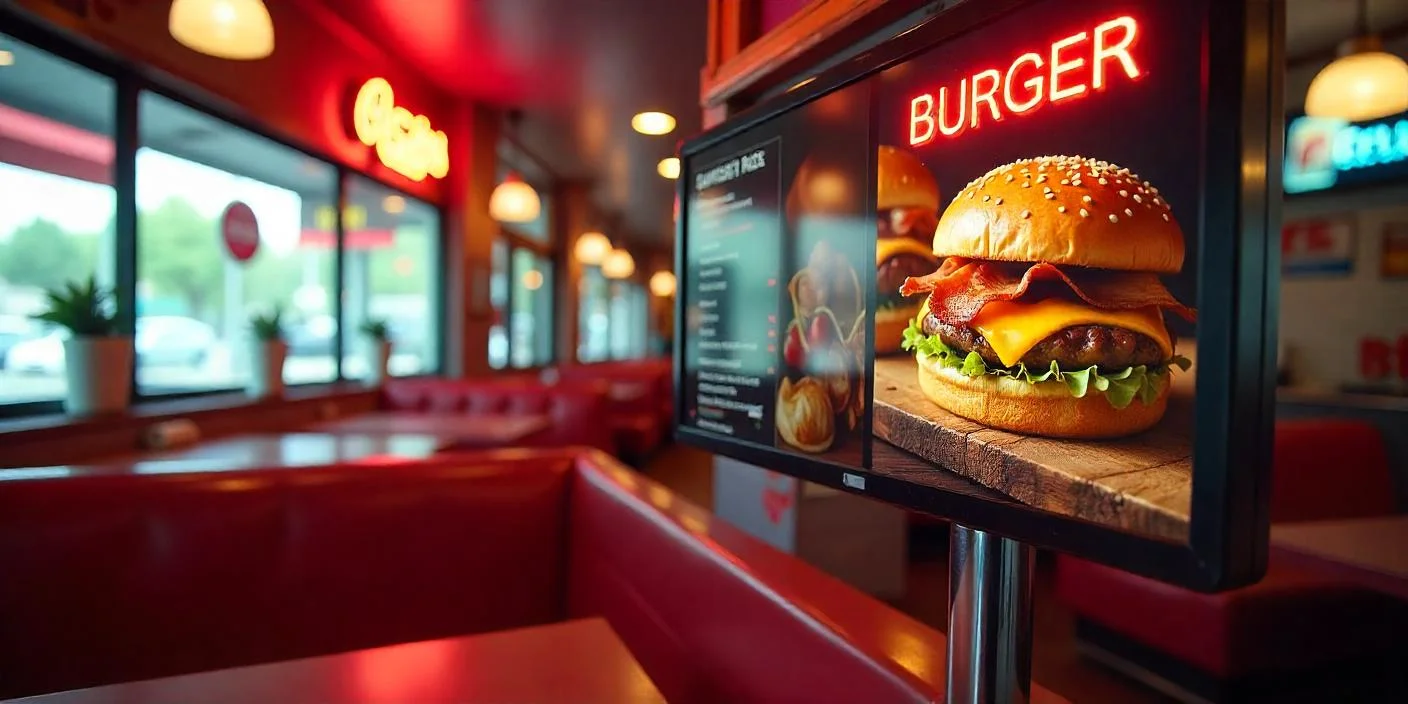
Restaurant menu screens are digital screens that are used to display menu items, prices, promotions, and real-time updates on screens placed where decisions are made over the counter or in the dining area, pickup areas, or in drive-thru lanes.
Performance and reliability are the main differences between the basic TV screens and commercial digital menu screens used in restaurants. Consumer TVs are designed to be viewed at home, rather than run for long hours, deliver high brightness, or be centrally managed by the same control system on more than one display. Commercial screens are built for long duty cycles, consistent brightness, remote monitoring, and monitoring without being present.
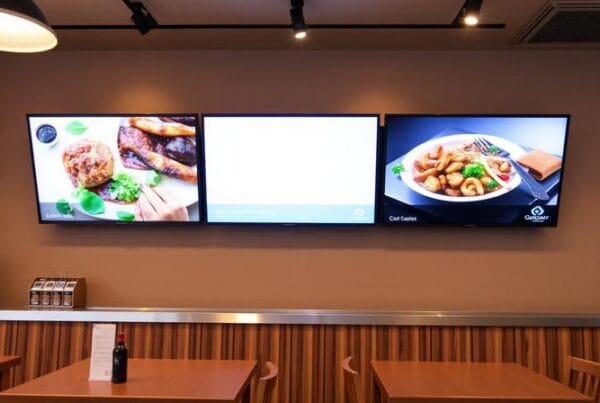
Types of common restaurant menu screens on display include wall-mounted menu screens, countertop screens to display specials or desserts, and outdoor/drive-thru systems designed to be legible in sunlight.
“A real menu screen isn’t just a TV—it’s an operational tool.”
How to Choose the Best Signage Screens for Menu Boards in Restaurants
Selecting the best signage screens for menu boards in restaurants comes down to four performance factors.
Under real lighting conditions, readability depends on brightness. What appears as a good screen in a showroom can appear washed out in hard indoor lighting or by the windows. Low resolution creates hesitation, and hesitation slows service.
Durability is important as restaurants run screens for long hours, and in some cases, it may face heat, humidity, or greasy conditions. The unspoken demand is remote management: without the ability to update menus via a dashboard, you will have to do some manual fixes that will recreate the same problem as a fixed board.
The hardware provided by Nento is chosen and tested to perform during high-traffic periods and high-uptime requirements. Commercial restaurant screens generally offer longer life, enhanced brightness stability, and reduced failures when used continuously in comparison to consumer TVs.
“The cheapest screen becomes expensive when it fails during a rush.”
Still have questions? Contact Nento’s team for a personalized demo.

LSI Applications: Matching Screen Types to Restaurant Needs
Restaurant menu app
A restaurant menu application can also be used to supplement in-store screens, as the customers can browse on their phones and stay aligned with what’s on screen. This minimizes ordering friction and promotes uniform pricing and item availability.
Tablet menu for restaurants
A restaurant tablet menu facilitates handheld ordering, wine lists, tasting menus, and upsell prompts without delaying service. Tablets are also able to save on menu printing costs and update instantaneously.
Restaurant menu walls screens
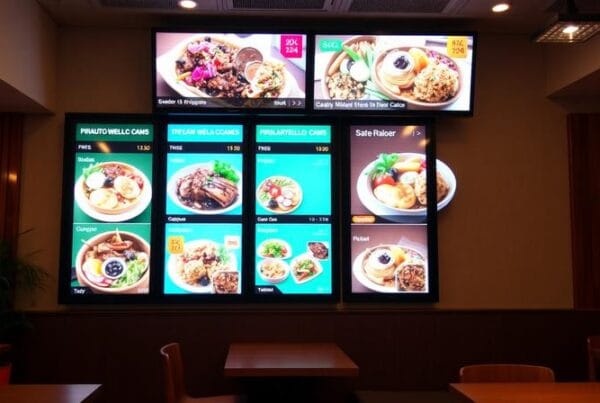
Wall screens (usually large-format screens or video walls) are effective with fast-casual brands that require extensive visibility as well as clear separation of categories. The formats assist in handling complex menus by using more screen space without reducing the text.
Restaurant menu screen design
Good restaurant menu screen design is designed to scan quickly: it has a good hierarchy, high contrast, and it is not cluttered. Animation must be managed—it should be used to emphasize specials or combos and not to pull focus from the menu.
“Design isn’t decoration—it’s decision speed.”
Restaurant menu screen software
Keep screens up to date with reliable restaurant menu screen software. Cloud control enables real-time updates across locations, daypart scheduling, and fast removals when items sell out.
Restaurant menu on TV screen, free
The concept of a restaurant menu on the TV screen for free can be attractive, but often free products have some trade-offs: they are feature-limited, include hidden fees, are advertised, or lack support. Practically, free tools can be costly in labor and errors compared to a clear paid plan with true reliability.
Software & Design: Making Your Digital Menu Work
The display is just the surface. Software and design are the real value of operation.
Restaurant menu screen software allows real-time updates when prices change, items sell out, or a promotion must be activated immediately. The absence of software control means that restaurants are once again re-creating the same maintenance burden with printed boards, as they are required to re-upload static images by hand.
Design is important since menus are decision engines. High readability (large fonts, clear categories), a strong brand consistency (color, typography, images), and motion used sparingly to draw attention to high-margin items are best practices. Nento’s platform supports these requirements with templates, scheduling, and integrations that keep the menu in accordance with the actual operations.
Nento is also integrated with POS and kitchen display workflows to ensure that content stays up to date with what’s available and what is on offer without having to manually adjust it.
“When software matches operations, the menu stays accurate automatically.”
Real-World Setup Examples
Quick Service
Restaurant menu screens in QSR settings are most effective with auto-upsell notifications and daypart scheduling. This maintains the menu right by time window and renders add-ons visible when making a decision.
Fine Dining
Remove the stray words and keep the heading as “Fine Dining.” Restaurants frequently use a tablet menu as an approach to wine lists, seasonal tasting menus, and premium upsell narratives. The idea is to be controlled and classy—menus remain up-to-date and contribute to a high-end experience.
Coffee Shops
Coffee shops tend to compare free menus on TV and paid options. Practically, Nento’s affordable plans can be a professional alternative, with no advertising, improved scheduling, and high-quality support, so updates are simple and regular without any concealed restrictions.
“For small menus, speed of updating is the biggest ROI driver.”

Frequently Asked Questions (FAQ)
What is the average cost of restaurant menu screens?
It depends on screen size and software; Nento offers flexible pricing.
Can I use a regular TV as a restaurant menu screen display?
Yes, but commercial best signage screens for menu boards in restaurants last longer and offer better brightness.
Does Nento provide hardware, software, or both?
Both are complete solutions for digital menu screens for restaurants.
Can I update menus remotely?
Yes – Nento’s restaurant menu screen software allows cloud updates from any device.
What’s the catch with “restaurant menu on TV screen free” options?
Often limited features, hidden fees, or third-party ads. Nento provides transparent, ad-free plans.
Conclusion
Restaurant menu screens can increase income, minimize mistakes, and update your brand since they ensure menus are legible, up-to-date, and strategically positioned to sell. Screen quality, software control, and menu design work best as one system—not separate parts.
Nento provides the most effective signage screens on menu boards in restaurants by integrating commercial-grade hardware with cloud software and the support teams required to maintain the stability of the screens during peak times.
Transform your restaurant today—shop Nento’s menu screen bundles now.