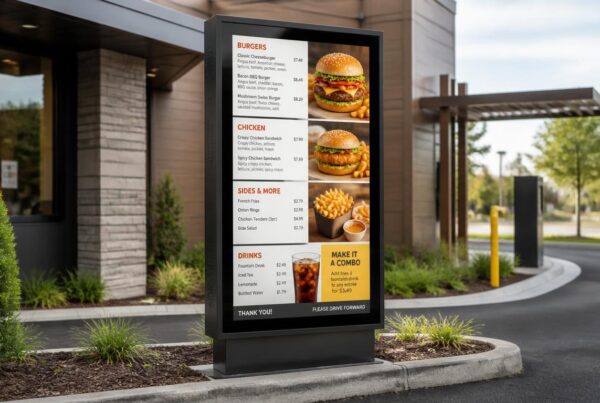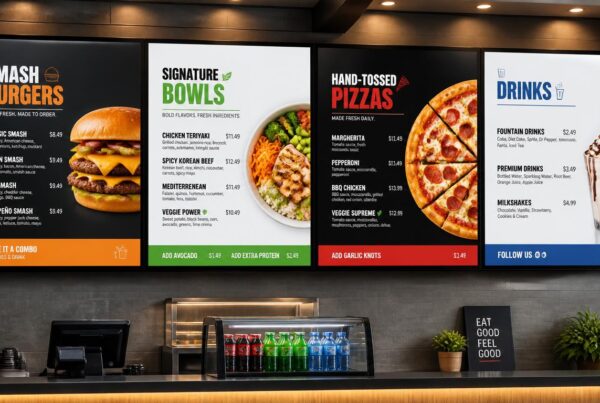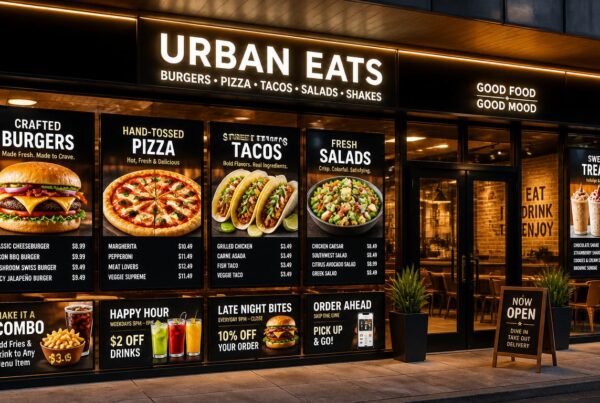
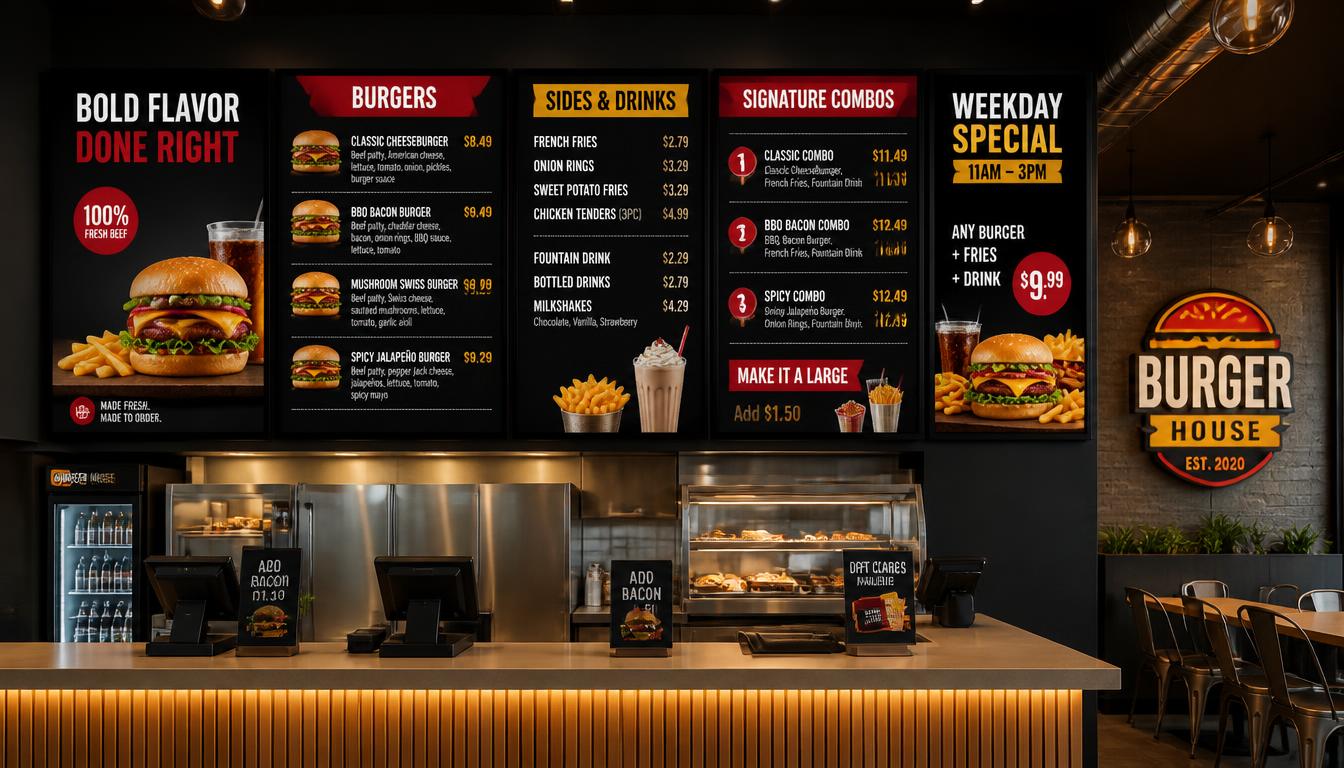
Enter any restaurant today and you will most likely see the screens before you get to the counter. Burgers are displayed in high quality, lunch specials change during the day, and the numbers of the orders appear when food is ready. It is quite unlike the old days when there were printed menus, handwritten signs, and chalkboards that remained the same over a period of weeks.
But how effective is digital signage when it comes to actually improving restaurant performance?
It is a reasonable question, particularly for those restaurant owners operating with slim margins. Purchasing screens and hardware, along with software subscriptions, can be costly. The investment must not only make the dining area look modern.
The worth of digital signage is what restaurants can accomplish. They are able to adjust prices in real time, advertise profitable menu products, interact with their waiting customers, and run multiple displays at a single location. Screens may also be linked to ordering and inventory systems, in certain instances.
The potential benefits of digital signage are significant, yet the outcomes will depend on how the technology is used. The positioning of the screens, the design of the menu, the reliability of the software, and even the nature of the restaurant matter.
This paper examines what digital signage is and where it adds value and how restaurants can select a system that enhances the customer experience without adding to employee workload.
Ready to modernize your restaurant? Discover Nento’s cutting-edge solutions today.
What Is Digital Signage? Understanding the Basics
It is a good question to answer before the discussion of results: what is meant by digital signage?
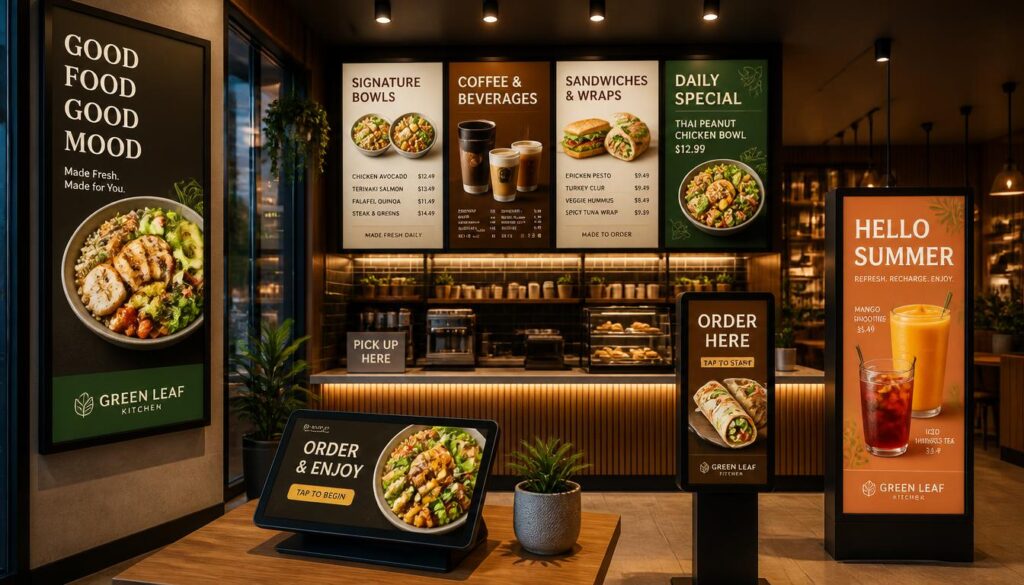
To define digital signage in practical terms, it is the use of electronic screens to show information, advertisements, menus, announcements, or other visual materials. As opposed to the conventional printed signs, electronic displays can be refreshed every time the business has to alter its message.
One screen may be above the counter in a restaurant, and a large fast-food chain may have hundreds of screens in various locations.
What is digital signage used for in restaurants?
Digital signage can have various uses, depending on the location of the screen.
- Electronic menu board: Show food items, prices, combinations, and specials of the day.
- Promotional screens: feature seasonal beverages, desserts, loyalty deals, and time-sensitive deals.
- Queue management: Display order numbers, pickup instructions, or service updates.
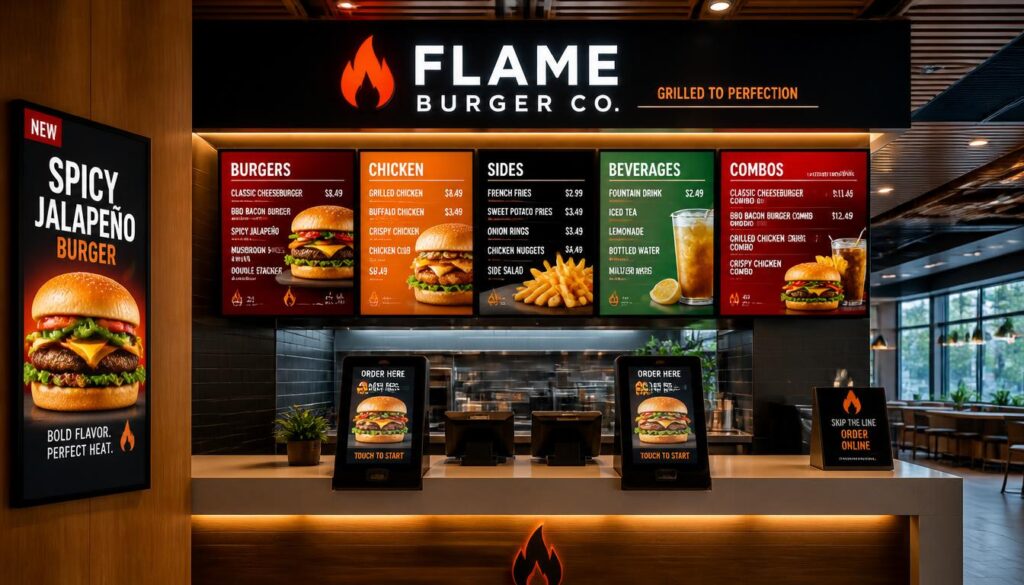
- Self-ordering kiosks: Customers are able to browse the products, create their own meals, and order them.
- Drive-thru signboards: Show on-site menus and promotions to drive-thru customers.
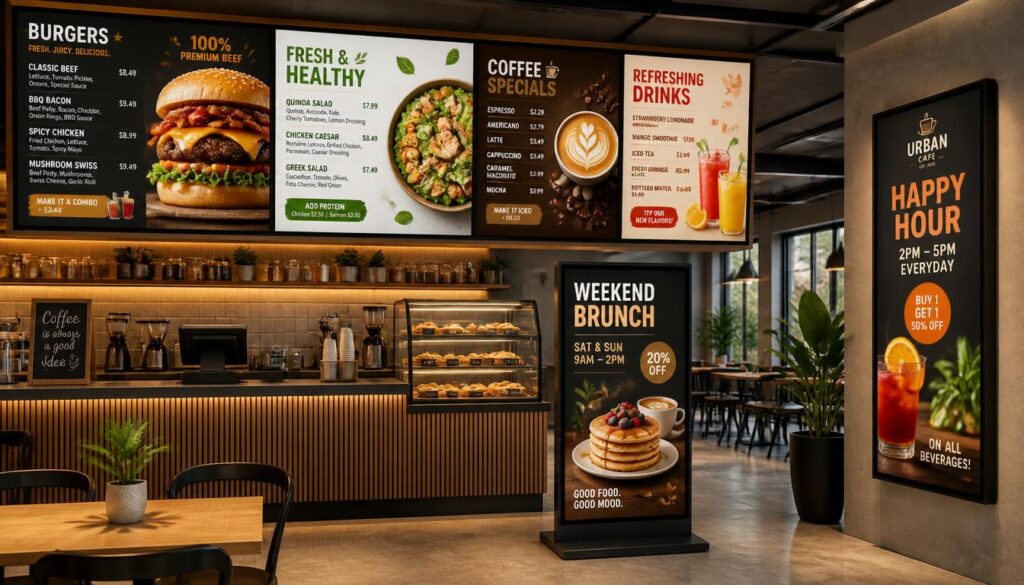
As an example, a coffee shop would have two larger screens to serve its regular drinks and a smaller screen to serve seasonal drinks. A burger shop may have multiple menu boards, a promotional screen, and a pickup order screen.
The general technology used by both businesses is the same, albeit with different purposes.
How Do Digital Signage Systems Work?
The three predominant parts of most modern digital signage systems include a display, a media player or a compatible built-in player, and software that manages the content.
It is the display that the customers see. The content is delivered by the media player, and the software enables the staff to modify menu items and add pictures and promotions.
Digital signage software solutions that run on a cloud platform make management easier, as screens can be updated remotely.
A manager is able to adjust a price in the office, delete a sold-out product, or arrange a breakfast promotion tomorrow without accessing the display.
It is that flexibility that distinguishes digital signage as opposed to merely displaying a menu image on a TV.
How Effective Is Digital Signage? What the Research and Experience Tell Us
No single percentage can tell every restaurant how much additional revenue a digital screen will bring.
A busy fast-service restaurant can benefit from quicker menu updates and clearer ordering information. Promotional displays, wine suggestions, or event notifications may be more valuable to a fine dining restaurant.
Nevertheless, the studies indicate that digital signage can affect buying behavior in the appropriate context.
What Does the Research Say?
A study published in the Journal of Marketing examined 237 digital signage advertising campaigns involving approximately 30 million shoppers.
The researchers found that exposure to in-store digital signage advertisements increased the likelihood of purchasing advertised products by 8.1%.
It is an interesting finding, but there is a key difference that must be noted: the study was carried out in retail outlets, rather than restaurants. It measured purchase probability rather than an increase in restaurant revenue.
Nonetheless, it can provide valuable evidence that digital screens can affect the purchasing behavior provided that the adverts reach the customers at the appropriate time.
The outcomes of restaurants will be restaurant-specific, based on menu, promotions, and customers.
Why Visual Presentation Matters
Human beings tend to make choices on food in a visual manner.
A customer intending to order a regular coffee may see a seasonal iced latte on the screen. A customer who orders a burger can choose to order fries after viewing a meal combination.
Restaurants can showcase those products on digital displays using photographs, short video clips, and clearly visible prices.
It is not merely to make food look good. It is to assist customers to observe pertinent products as they make decisions on what to order.
A well-thought-out board may have a featured meal placed either towards the center or upper part, and the rest of the menu should have clear categories.
But there is no general rule that will ensure that customers will view one corner first. It is better to test the various layouts rather than to make an assumption.
Dayparting Makes Promotions More Relevant
Dayparting, or modifying the contents of menus based on time of day, is one of the most powerful practical benefits.
A restaurant will be able to show breakfast in the morning, lunch in the afternoon, and dinner in the evening.
The changes are automatic and take place on a schedule.
This is especially useful in restaurants where menus are changed a number of times a day. Employees do not need to swap signs and manually change presentations when there is a rush.
Can Digital Signage Improve Waiting Times?
Digital signage has the potential of enhancing the customer experience of a queue, although it does not necessarily reduce wait time.
Customers are provided with order status screens that provide information on their food. Display of the menu assists individuals in making decisions even before they get to the cashier. Something to watch can also be offered by promotional content.
However, screen design is important.
A display that changes content too quickly or hides important prices can actually slow down ordering.
The answer to “how effective is digital signage?” is therefore straightforward: it can be highly useful for menu communication, promotions, and operational efficiency, while its effect on sales needs to be measured rather than assumed.
Five Key Digital Signage Benefits for Restaurants
Digital signage is more than just better visibility of the product. To most restaurants, the benefits of business in terms of operations are as significant as the possible sales effect.
1. More Opportunities for Upselling
Customers are often encouraged to order beverages, desserts, sides, or meal upgrades within restaurants.
This process can be assisted using digital screens, whereby the relevant offers are presented whenever customers are making their decisions.
An example of this is a restaurant that offers pizza and sells a drink and garlic bread as an add-on to the main menu. A bakery may have a coffee-pastry offer during breakfast time.
Small animations and short videos can attract attention to these offers without distracting customers from the menu.
Their effect on increasing average order value is dependent on the products, pricing, and design. Restaurants ought to compare the sales prior to the introduction of the promotion and after introducing the promotion.
2. Faster Menu and Price Updates
A printed menu is not able to react fast to the unavailability of an item.
The person has to replace the board, cover the item, or tell the customers about the issue again and again.
Updates are a lot easier with digital signage.
The content management system can be used to change prices, product photographs, seasonal offers, and availability information.
In restaurants that have more than one location, this also minimizes the effort that would be needed to coordinate menu changes.
3. Lower Recurring Printing Costs
Menus do not live long.
New dishes are introduced, ingredients are pricier, and advertising campaigns are altered. Another print cost can be associated with every update.
With digital signage, there is less physical replacement of menu boards and posters.
An initial investment in hardware and software, along with ongoing electricity and maintenance expenses, is still required. However, restaurants with regular printouts of new materials might consider digital signage to be more cost-effective in the long term.
4. More Consistent Branding
A restaurant chain can be situated in various neighborhoods or cities, and the customers must be aware of the brand.
Through centralized digital signage management, companies are able to have the same colors, typography, menu formats, and promotional materials across the stores.
The selected information can be allowed to be updated by local managers, whilst the overall branding is controlled.
This minimizes variations amongst locations and assists the customers to get more consistent information.
5. A Better-Looking Restaurant
The screens also affect the ambience of a dining area.
Restaurants can be made to look more organized by bright food photography, a coordinated menu, and well thought-out promotions.
A contemporary coffee shop may have minimalist displays in light colors, whereas the quick-service restaurant may favor the high contrast and more vivid images.
The trick is to align the signage with the restaurant and not to turn all the screens into an advertisement.
A Practical Restaurant Example
Consider a small burger restaurant which is currently using printed menus.
It varies prices a couple of times a year, has special lunch and dinner deals and is out of stock of some products on popular weekends.
Once digital menu boards are installed, the manager will be able to mark unavailable products, plan various menus, and offer meal combinations without having to reprint new materials.
The restaurant will then monitor the printing costs, order time and average order value to determine whether the change was worth it.
It is not a documented customer case study, but an illustrative example of how the benefits of the operations can be converted into quantifiable business results.
Want to see what digital menu boards could do for your restaurant? Explore Nento’s solutions and request a personalized demo.
Digital Signage Pros and Cons: An Honest Assessment
Digital signage is not automatically the right investment for every restaurant.
The advantages of digital signage are attractive, but businesses should also consider the costs and additional responsibilities involved.
| Advantages | Potential Disadvantages |
| Menu prices and promotions can be updated quickly | Hardware and installation require upfront spending |
| Food photography and videos improve product presentation | Poorly designed content can distract customers |
| Menus can change automatically throughout the day | Screens and media players require maintenance |
| Multiple locations can share consistent content | Software may involve recurring subscription fees |
| POS integration may improve menu accuracy | Integration depends on system compatibility |
| Printing and manual signage work can be reduced | Content still needs regular management |
The Initial Investment
A digital signage system can consist of commercial displays, media players, mounts, cabling, installation and software licenses.
These costs may be huge to a small restaurant.
This cost should thus be weighed against projected savings and improvements in the operations in a number of years and not just the initial few months.
Technical Problems Can Happen
Screens may crash, networks may go dead and media players may require some care.
These risks can be mitigated by using reliable systems with remote monitoring, offline playback and appropriate technical support.
The offline playback feature is especially handy since compatible systems are able to keep on displaying previously downloaded content even in the event of an internet disconnection.
Content Management Still Takes Work
An online menu containing out-of-date promotions cannot be much better than a tattered printed sign.
Someone must update prices, review campaigns and product images, and delete expired offers.
This is where software helps simplify and coordinate these tasks.
Is the Return on Investment Worth It?
Whether the investment pays off depends on the value the restaurant gets relative to its total expenditures.
A convenient point of departure is to quantify:
- Average order value before and after installation.
- Sales of items promoted.
- Savings on printing and design costs.
- Staff time spent updating menus.
- Customer complaints about incorrect menu information.
- Hardware, software and maintenance costs.
The overall evidence concerning restaurant technology also gives the reasons why expectations must be kept down to earth.
According to the National Restaurant Association’s 2025 State of the Restaurant Industry report, 69% of operators who had invested in additional restaurant technology reported improved efficiency and productivity. However, only 28% said those technology investments improved profitability.
Such numbers are an indication of restaurant technology in general, not digital signage in particular.
They depict a significant fact: technology can help to make operations more efficient but does not necessarily provide a huge financial payout.
Choosing the Right Digital Signage Solution for Your Business
After making the decision of installing screens in a restaurant, the next issue arises on the type of system to install.
The appropriate digital signage for business use must suit the size, layout, operating hours, and menu requirements of the restaurant.
Consumer TVs vs. Commercial Displays
A small indoor display can sometimes be achieved using a regular television.
Nonetheless, commercial-level screens tend to be more appropriate in restaurants which have displays that are open longer hours.
They can be brighter, have longer specified operating schedules, greater remote-management features, and commercial-appropriate warranties.
Outdoor displays need more protection against the weather and better sunlight readability.
The questions to ask before buying include where customers will be, how much light enters the space and how many hours the display will be used daily.
Choose Software That Staff Can Actually Use
One of the most significant factors is software usability.
Teams in restaurants should not have to go through complex technical processes to update prices, post product photos and amend promotions.
Some features to look for include an easy content editor, scheduling, reusable templates and remote management.
Multi-location control and user permissions are also useful to larger businesses.
Check Integration Requirements
Certain restaurants would like their menu screens to be linked to POS systems, inventory data and loyalty systems.
These features have the ability to enhance consistency, although compatibility is not always universal.
Enquire about the compatibility of the system with the software you currently have and what functions can be synchronized.
Do not think that all integrations will automatically update inventory.
Think About Future Growth
A small café can start with one or two displays.
It may later include promotional screens, pickup information or displays at other locations.
The digital signage software solutions can be based on the cloud, which can simplify the expansion process since the content can be centrally managed.
Nento offers restaurant-based signage solutions, menu templates, scheduling and cloud-based management for businesses interested in managing single displays or larger screen networks.
Don’t settle for generic screens. Explore Nento’s digital signage solutions for restaurants and ask about compatibility with your existing POS system.
Future Trends in Restaurant Digital Signage
Digital signage is increasingly becoming integrated with other technologies in the restaurant.
Future developments will probably focus on making screens more responsive to customers, operating conditions and available products.
Interactive Ordering Screens
Many quick-service restaurants already have self-ordering kiosks.
They enable customers to view menus, customize products, preview their orders and in some cases pay without going to the main cashier.
The allergen information, product information, and multilingual menus can also be presented with the help of interactive screens.
Nevertheless, they ought to be user-friendly, especially to the less tech-savvy customers.
AI-Assisted Promotions
Artificial intelligence can assist restaurants in determining products to be featured.
For example, software might suggest advertising iced beverages when it is hot outside or featuring specific combinations based on sales trends.
In case the system is linked with the inventory data, it can also prevent the promotion of unavailable products.
These functions are based on the platform selected and its integrations and they still need to be monitored by staff.
More Contactless Options
QR-based menus, contactless ordering, and online payment systems remain options for restaurants to serve customers.
These tools have the potential to decrease the use of common printed resources and simplify some of the interactions.
But they must not take away choice. There are customers who still like to talk to the personnel or read a paper menu.
More Personalized Content
Connected loyalty systems and customer preferences can also help to enable restaurants to make more relevant offers, especially on personal ordering devices.
A returning customer might see a loyalty reward or a familiar meal combination.
In the case of public menu boards, though, restaurants must be sensitive to privacy and not put personal information of a customer on display.
The future of signage does not lie in simply adding more screens. It is about making the content on those screens more helpful.
Frequently Asked Questions
What does digital signage mean for a small restaurant?
In the case of a small restaurant, digital signage will involve the use of screens to post menus, prices, pictures of food, and promotions among other information.
The printed menu board can be substituted with a single screen, and the cloud-based software enables the owner to update the menu board without having to reprint materials.
Small restaurants can start with a simple setup and add more later when the need arises.
How effective is digital signage for upselling?
Digital signage can support upselling by making meal upgrades, beverages, desserts, and specials more noticeable.
Studies in retail settings have shown measurable increases in the likelihood of purchases following digital signage advertising. Nevertheless, not all restaurants have the same percentage growth.
The outcomes are determined by the menu position, relevance of the offers, screen layout and customer behaviour.
What are the main advantages of digital signage?
The key benefits are faster menu updates, less printing, better product presentation, centralized management, and more flexibility in promotions.
Digital displays can also be used by restaurants for order pickup information and communication with customers.
Do I need special software for restaurant digital signage?
Any screen can be used to show a simple image without any special software, but a specialized signage platform is far more convenient to use on a regular basis in a restaurant.
It enables users to plan content, manage prices remotely, operate multiple screens and design menus to be reused.
Nento offers digital signage software solutions that have restaurant-specific content management and scheduling capabilities.
What is digital signage used for in fast-food restaurants?
Digital signage is widely used in fast-food restaurants for menu boards, drive-thru displays, promotional offers, order pickup screens and self-service ordering.
Such displays enable customers to locate information faster and also allow managers to have greater control over menus and promotions.
Conclusion
So, how effective is digital signage in the modern restaurant experience?
This depends on what the restaurant expects it to do.
Digital signage has definite practical benefits in updating the menu, flexibility in promotions, brand consistency, and communicating with customers. It is able to minimize repetitive tasks, make products more visible and enable customers to know more about menus prior to ordering.
It has a less predictable effect on revenue. Good menu design, appropriate promotions, suitable software and regular performance measurement can support upselling, but attractive screens alone do not guarantee a meaningful return.
The most powerful systems do not have to be the most costly. The most effective systems are those that solve day-to-day restaurant problems without making staff work more complicated.
With the increasing interconnectedness of restaurants, digital signage will have a greater role in coordinating information of menus, ordering systems, promotions and customer interactions.
An effective screen ought to be more than merely contemporary. It ought to be deserving of a place in the restaurant.
Are you ready to see how effective digital signage can be for your restaurant?
Contact Nento today for a free demo of our advanced digital signage systems and software solutions. Let’s turn your screens into profit centers.