Introduction
A cafe is a place with its own rhythm. The espresso machine is on, people are waiting in line, new orders are received through mobile phones, and a person is deciding whether to take a cappuccino or the special of the season. Amidst all this, the menu must be able to perform its task within a short time.
This becomes more difficult when customers are straining their eyes to read a scribbled paper board or attempting to interpret a menu that has taped-on prices added to it. In some cafes printed menus might be appropriate, but they are not very versatile. Prices fluctuate, ingredients run out, and seasonal beverages come and go, and each time a change is made, it requires a new round of design or printing.
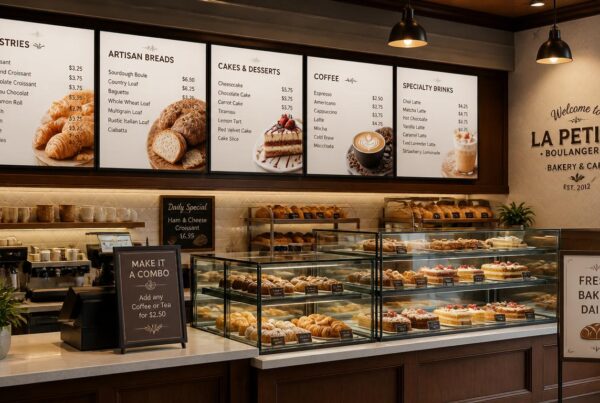
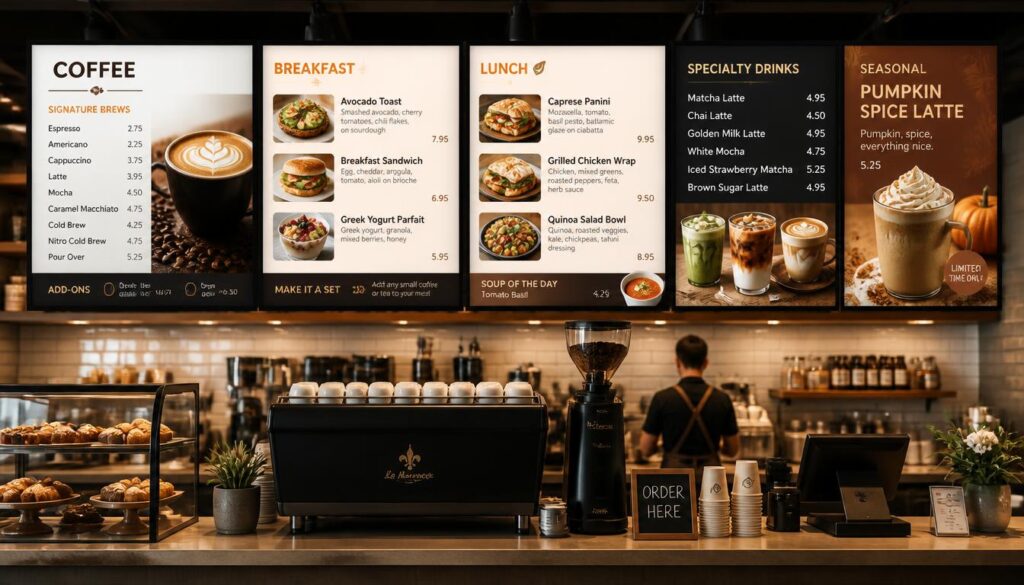
A digital menu board for cafe owners will provide a more viable solution. It provides the business with an opportunity to revise prices, advertise high-margin products, alternate breakfast and lunch menus, and display food and beverages in a more attractive way.
It alters the role of the menu too. It is not a fixed price list but is incorporated in the marketing of the coffee shop. The same display that assists a customer to locate an Americano can also present a new pastry, an afternoon combo, or a reminder to loyalty members about an offer.
For coffee shops that want to enhance not only their operations but also their appearance, the trend of abandoning paper and going paperless is proving to be a viable business choice. Nento focuses on assisting cafes in that transition with digital signage systems that are based on real food-service settings.
Why Upgrade? The Shift From Paper to Pixels
Digital menus offer more than just a modern-looking screen. For most cafe owners, the more practical benefits are fewer printing headaches, faster updates, and considerably more control over what customers view.
Lower Printing and Replacement Costs
Coffee shop menus are not as constant as some people think. Seasonal beverages are released every few months. Pricing is influenced by the supplier costs. New sandwiches are tested. Certain products are no longer available.
Even the slightest price change with printed signage can cause additional work. An updated menu must be created, approved, printed, distributed, and placed.
A cafe digital menu board eliminates much of that process. After the system has been set up, the contents of the menu can be edited digitally. It is not necessary to reprint an entire board because a single beverage has gone up in cost or a seasonal latte has been introduced.
In the case of cafes with a regular change of menus, these small savings may accumulate.
Change Prices When the Business Changes
Coffee shops are businesses in which prices of ingredients change over a short period.
Margins are influenced by coffee beans, dairy products, alternative milks, chocolate, syrups, and bakery ingredients.
Digital signage also provides managers with more freedom to act without having to wait until printed materials are available.
Promotions can also be managed the same way. An example would be a cafe that offers an afternoon promotion between 2 PM and 5 PM. The system can only display the offer in the most appropriate hours as opposed to displaying it throughout the day.
This can make the menu more useful because it shows what the cafe is selling at that particular time.
A Cleaner Look Behind the Counter
Printed posters have a tendency to multiply. One of the primary menus is accompanied by a seasonal sign, followed by a loyalty poster, and a handwritten poster indicating that one of the products is out of stock.
Soon enough, the counter space becomes cluttered.
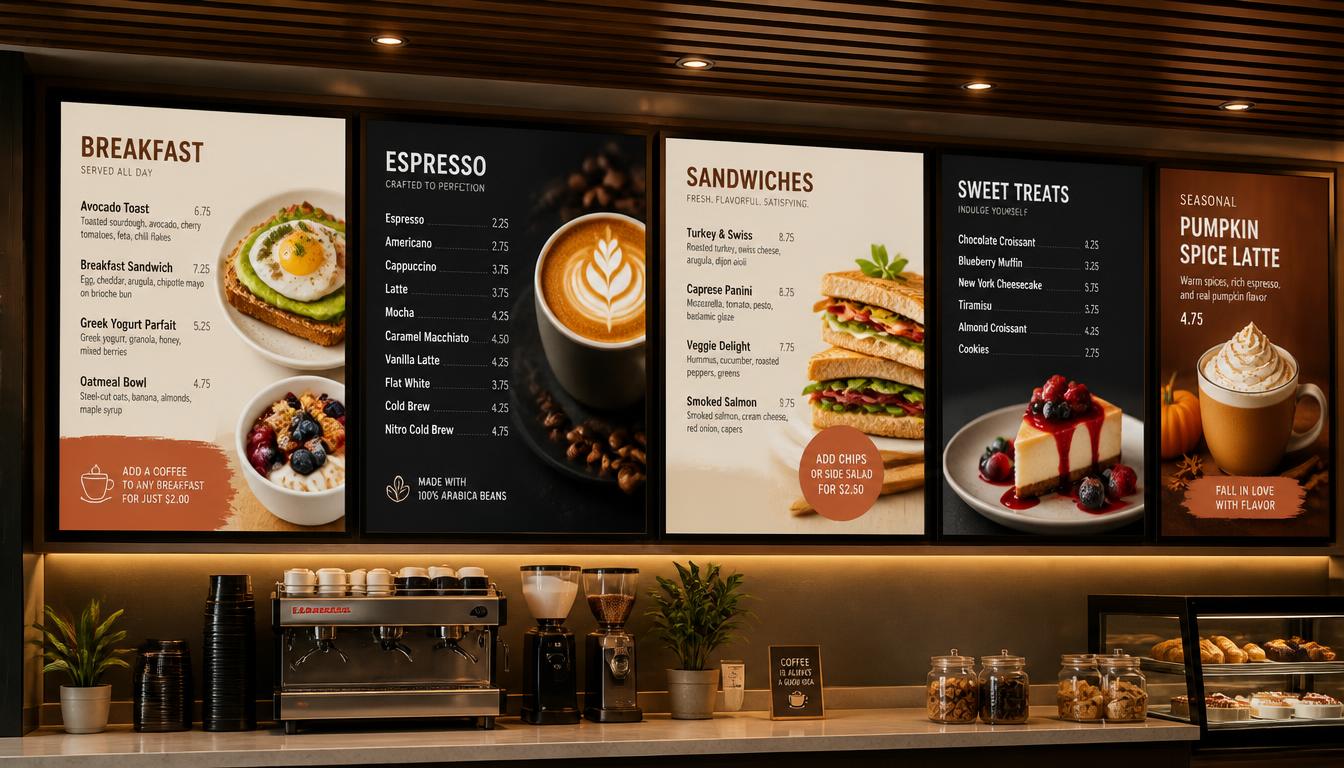
Most of that information can be combined on a single or multiple synchronized screens through the use of a menu digital display. The outcome can be more purposeful and clean.
That is important in cafes since ambiance is an ingredient of the product. Customers observe lighting, furniture, cups, music, packaging, and even the menu above the counter.
Mastering the Art of Cafe Menu Board Design
The easy part is purchasing screens. The problem many cafes have is designing them well.
There is no direct one-to-one correspondence between a printed menu and a digital screen. The customers can see the screen at a distance of a few meters and do not have much time to scan the screen. A few seconds are usually sufficient to do so and then continue the queue.
Good cafe menu board design needs to account for that.
Use Visual Hierarchy
The amount of attention given to each item does not always have to be the same.
A cafe is likely to have items that it wants to be the first thing that a customer sees: high-margin beverages, lucrative food selections, daily specials, or top sellers. These ought to be in more prominent visual locations.
The center and top of the screen are natural focal points; thus, the most important products may be located in the upper part of the screen, and the less significant information may be in the secondary positions.
This does not imply concealing lower-priced alternatives. It merely involves the design of the screen in a way that the customers know what is important without having to search.
Make It Readable From the Queue
A menu board digital layout may appear fantastic on a laptop and not work on a display over a counter.
Font size should be based on the customer’s actual viewing distance. The prices must be readily recognized. Coffee, tea, cold drinks, breakfast, and bakery should be visually differentiated.
It is also important to have contrast. Small writing on a close-up food image can appear fancy and cool at close range but will be illegible at the end of a line.
Clarity generally wins over style.
Use Food and Drink Photography Carefully
Coffee is very visual. And so are pastries, sandwiches, iced beverages, and cakes.
Good photography can make customers notice products that they had no intention of purchasing. An iced latte or warm croissant is a more convincing close-up than a line of text.
Short video loops may be effective, too, but there is a balance. When too much is going on, the menu gets distracting. A single featured drink with a slight movement is typically more effective than a number of competing animations.
Change the Theme Without Rebuilding the Menu
Seasonal menu styling is much easier with the digital menus.
The addition of warm autumnal colors when pumpkin beverages come back, the holiday festivities, and more vivid graphics on summer iced beverages do not require redesigning the whole menu framework.
The overall design may remain the same but with some elements varying depending on the season.
That will provide customers with something new that they can notice without confusing the menu every few months.
Key Features of High-Performing Cafeteria Menu Boards
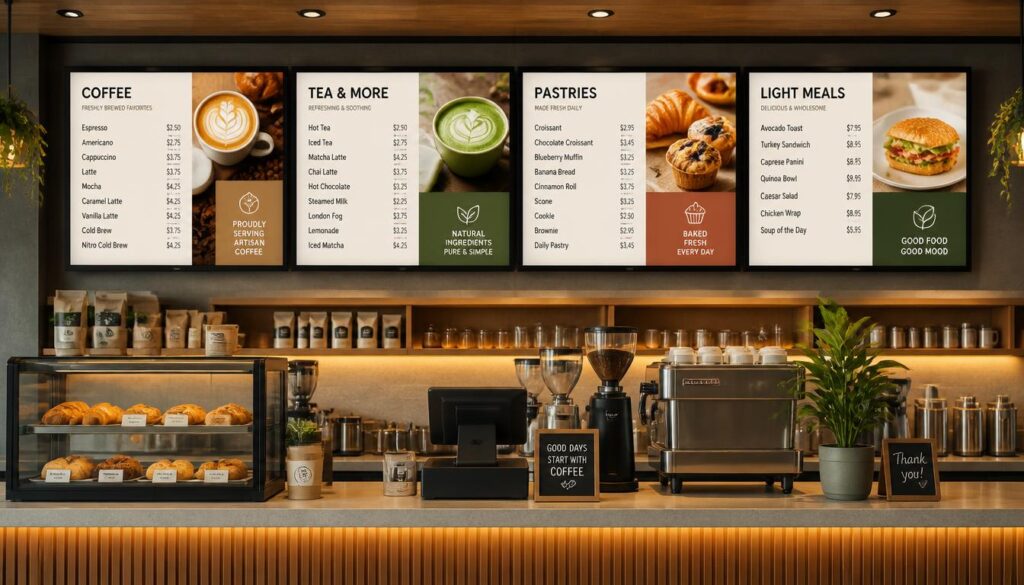
Good cafeteria menu boards are more than just a design. The software and hardware behind the screen will dictate the usefulness of the system in the day-to-day service.
Automatic Dayparting
Not all cafes sell all their products throughout the day.
Breakfast can be centered on coffee, pastries, and breakfast sandwiches. Lunch might include sandwiches, salads, and cold beverages. Cakes, desserts, and specialty beverages might be more applicable later in the day.
Dayparting enables the display to alternate these menus.
The breakfast menu can fade at a specific time, and the lunch one can replace it without a manager touching the screen.
This is a minor thing, but it eliminates another task from an already hectic shift.
POS and Inventory Integration
One of the worst customer experiences is deciding on something from the menu, and the response you receive is that it is sold out.
Availability can be displayed faster when menu displays are linked to appropriate POS or inventory systems. The sold-out products can be removed or marked unavailable instead of being displayed on the screen throughout the day.
It can also assist in maintaining consistent prices between the display and checkout system.
Choose Hardware for the Actual Environment
A cafe screen can be used for 10, 12, or even more hours a day. This means that hardware quality is important.
Important factors include:
- Brightness
- Screen resolution
- Viewing angle
- Daily operating hours
- Heat exposure
- Mounting location
- Glare from windows
A screen at the front of a bright shop will require a different brightness than a screen that is embedded in a darker cafe.
Commercial-grade displays can also be more applicable where displays are run continuously.
Place Screens Where Customers Actually Look
Coffee shop menu boards can be placed in a variety of locations.
The conventional location is over the ordering counter, where the customers can read as they wait.
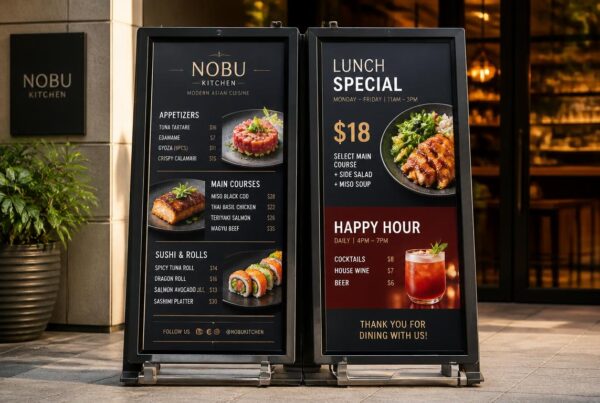
Outdoor displays may be required in drive-through cafes. Self-service can be handled through digital kiosks. The bigger coffee shops will be able to have a main menu and another promotional screen.
There is no universal setup. The appropriate configuration will be determined by the flow of customers.
Always stand at the position of the customer before anything is installed. If the menu is not easily readable at that point, the configuration should be reevaluated.
Design Trends and Best Practices
Digital screens enable us to do more, but more is not necessarily better. Certainly, some of the most impressive cafe displays are very basic.
Use Animation Sparingly
Motion attracts attention, and thus animation can be applied in advertising.
A summer beverage image may fade in. A coffee image can be created with a small steam effect. A limited-time offer may be temporarily featured, and then it will go back to the regular menu.
However, constant motion can be tiring. When multiple sections of the screen are in motion simultaneously, the customers can have difficulty locating the information that they need.
Animate to guide, not to distract endlessly.
Think About Color and Appetite
Coffee shops frequently do well with warm colors since brown, cream, deep red, and lighter neutrals are naturally associated with coffee, bread, chocolate and baked goods.
This does not imply that all cafes should have the same palette.
A contemporary specialty coffee bar could be in black and white. A juice-and-coffee concept can use brighter colors. A family cafe might be more inclined toward softer and friendlier tones.
It is better to be consistent with the brand rather than to follow a trend.
Grid or Artistic Layout?
A board cafe menu may use either a straight grid or a more imaginative design.
The grid layouts are effective when the menu is large as customers can locate the categories and prices within a short period of time. They can be used in situations requiring speed.
Artistic layouts provide more space for photography, promotions, and branding. They are especially effective in cafes that have smaller menus or have visually appealing seasonal items.
Others mix the two: one screen has a structured menu on the main screens, and the other one is more expressive, being a promotional display next to the menu.
Do Not Forget Accessibility
Cafe menu display boards should work for as many customers as possible.
Accessibility is enhanced by readable fonts, adequate contrast, reasonable mounting height, understandable language and simple layouts. Color alone should not be relied on for important information.
Small type on the menu should also be avoided since it compels the customer to come nearer to the menu to be able to read the price.
Accessible design generally turns out to be design that works better for everyone.
Implementing Your System With Nento
A full cafe signage system typically has three standard components: displays, media players or compatible screen hardware, and cloud-based software.
The menu is presented on the screens. The content is delivered by the media player. The software enables the cafe to control everything.
Update Menus From One Place
A modern digital menu board system should not require a USB drive each time an update is to be made.
Through cloud-based management, a cafe owner or manager will be able to edit the pricing, upload images, schedule promotions and edit menu content using a laptop or other compatible devices.
In the case of one coffee shop, it saves time.
It is especially important to a business that operates multiple locations. A core team will be able to implement a campaign across a number of cafes and maintain flexibility in individual stores where necessary.
Keep the Technology Simple
Restaurant technology can only be effective when it is utilized by staff.
There should be no need to have a graphic designer to adjust a price or an IT technician to replace a product image on the dashboard. The daily menu activities should be simple enough to be handled by daily management staff.
Nento offers a bundle of hardware, software, content management and support to build cafe-oriented digital signage systems.
Ready to upgrade? Nento provides end-to-end digital signage solutions. Contact us today for a free consultation on your cafe’s digital transformation.
Conclusion
A digital menu board for cafe owners is not the same as a paper menu. It provides coffee shops with a faster process for updating menus, a cleaner method of displaying products and a more adaptable platform to advertise what is important at various times of the day.
The financial gain may be attributed to various sources: a reduction in the number of reprints of menus, the reduction of staff time in switching signage, better marketing of profitable items, and the reduction of errors made due to out-of-date information.
The other benefit is on the customer side. An easy-to-understand menu facilitates ordering. Good photography enhances the attractiveness of products. Pricing and availability are up-to-date, minimizing counter questions.
To most coffee shops, such a blend of improved branding, easier operations, and increased selling options is the reason the move is worth the cost.
Your menu is one of the hardest-working salespeople in the cafe. It should look the part.
Frequently Asked Questions
How much does a digital menu board for a cafe cost?
Prices vary depending on the quantity and size of screens, commercial-grade displays or other hardware used, the installation needs and the software package.
The initial cost is greater than simply printing a menu, but savings over time due to less printing and less time and effort spent on content management can be used to offset the initial expense. The payback period will actually depend upon the cafe and the efficiency with which the system is utilised. Nento provides a variety of options for businesses of different sizes.
Can I update the menu myself?
Yes. The latest cloud-based technology enables approved users to update prices, swap pictures, add new products and schedule content via computer or other compatible devices.
That is to say that routine changes do not necessarily have to become a design project each time.
What happens if the internet goes down?
Well-designed digital signage systems are able to store the published content in the local media player. In case of a temporary loss of internet connection, the cafeteria menu board can still show the most recently downloaded content.
As soon as the connection is restored, it is possible to synchronize new updates.
How many screens do I need for my coffee shop?
It is determined by your space, menu size and the distance from which your customers will view it.
Sometimes only one screen might be required in a small kiosk. A bigger cafe can have different displays for drinks, food and promotions. An extended board cafe menu setup may consist of multiple screens or a video-wall-like setup.
The aim is not to install as many screens as possible. It is to ensure that the menu is easy to read and comprehend.
Is a digital menu board better than a traditional backlit board?
Digital signage is more versatile. A classic backlit board will still require physical changes to the content, whereas a digital menu can be updated remotely, schedule different content, remove sold-out products, have animation or video, and change the appearance of a menu to fit seasonal campaigns.
A backlit board might still be appropriate for a business that does not change its menu very often, but with the digital display, a frequently changing cafe can have a lot more control.
Ready to Modernize Your Cafe?
Do not let a static menu hold your business back. Whether it is a simple cafe digital menu board or a full menu board digital makeover, Nento has the know-how to bring your vision to life. We assist coffee shops to design beautiful cafe menu boards that support sales and please customers.