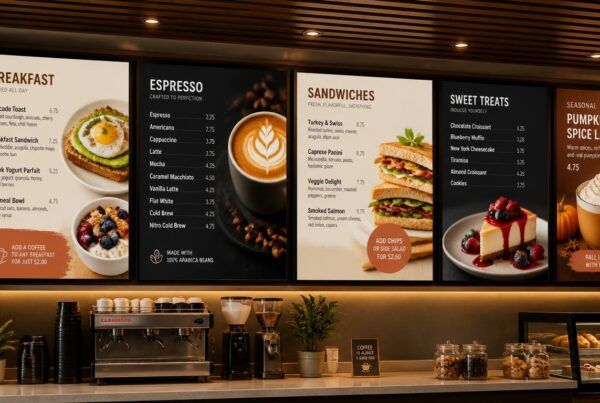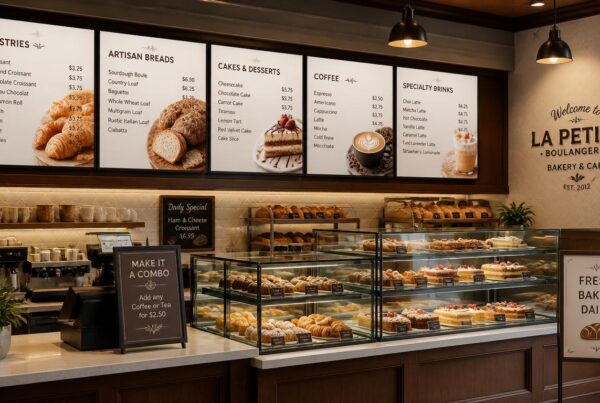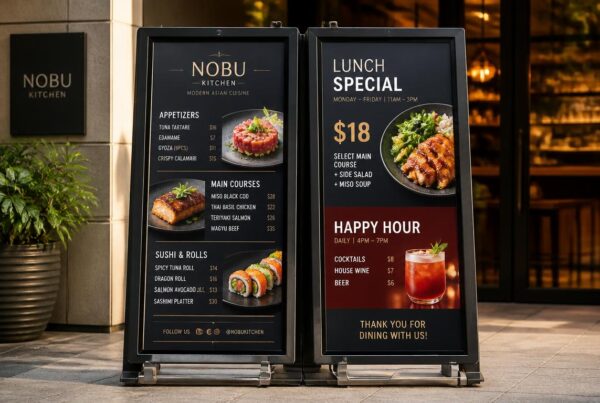
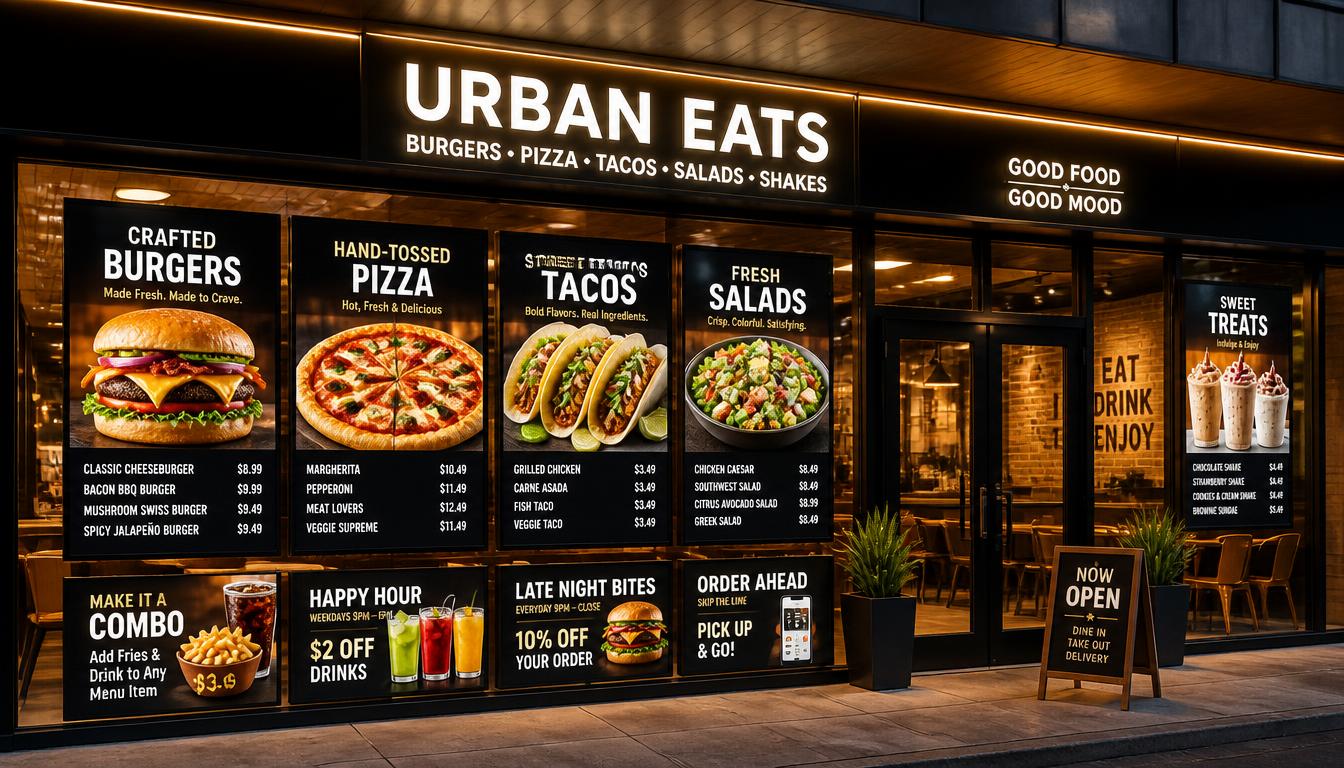
Go past a crowded restaurant during lunchtime, and what you will see is interesting. There are those storefronts that you notice at the first sight, and there are those that nearly fade into the background. The difference in most cases is the way they package their food, offers, and menu.
A tattered poster or a chalkboard with the special of yesterday can perhaps get the job done, but there is a limit to it. Customers want to see prices, beautiful pictures of the food, and up-to-date information. This is among the reasons why restaurant owners are increasingly seeking the best digital storefront display for restaurants as opposed to solely using traditional signage.
With digital displays, breakfast deals can be displayed in the morning, lunch deals can be displayed at noon, and dinner deals can be displayed later in the day. It is possible to alter the prices without having to print new posters, and it is also possible to plan seasonal promotions.
The best digital menu boards provide the restaurant owners with greater control over the customer experience. The appropriate display can be a helpful element of daily operations by improving visibility or helping to speed up the ordering process.
Nento provides digital signage solutions for restaurants and other foodservice businesses considering an upgrade.
Ready to modernize your restaurant’s exterior? Contact Nento today to find the perfect display solution for your business.
The Evolution of Restaurant Displays
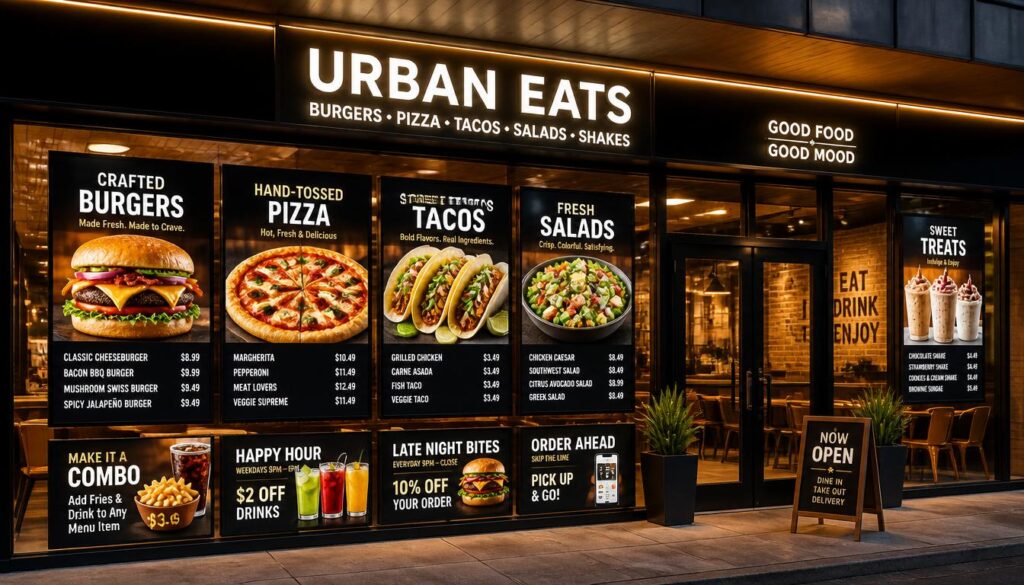
The signage of restaurants has evolved significantly. Once, the standard methods of displaying food and pricing information were printed menus, illuminated boards, and chalkboards. They were well known, comparatively easy, and did not need a lot of technical expertise.
The problem was keeping them current.
Restaurants needed to change printed material when prices went up, or a new menu item was introduced. Advertisements could remain on display after they had gone out of date, and sold-out dishes could stay on the menu until someone manually changed it.
Digital signage alters the manner in which such updates occur.
The modern screens are capable of showing high-quality images, videos, offers, and menus, which can be automatically changed during the day. A cafe is able to advertise hot beverages on a cold morning, and a quick-service restaurant can advertise meal offers during its peak hours.
Why Digital Signage Is Important Today
Restaurant customers are surrounded by visual information. There is competition from storefronts, mobile applications, advertisements, and social media.
This is the reason why digital signage is significant to businesses that are located in busy business environments. Placed strategically, a screen will provide restaurants opportunities to interact with their prospective customers prior to entering the premises.
The difference is particularly noticeable with window-facing displays. A restaurant will be able to display new content and change the offers depending on the time of the day instead of displaying the same printed promotion over weeks.
There exist practical benefits as well. The best digital menu boards for restaurants are both attractive and user-friendly so the staff can concentrate on serving and not always changing the menu boards.
Naturally, screens are not enough to ensure the increase of customers. The combination of location, visibility, content, and relevant offers matters.
Key Features of the Best Digital Storefront Display for Restaurants
Not all digital screens are suitable for restaurants. A display in a dark dining room will need other specifications than one on a sunny street or a drive-thru location.
Restaurant owners must be aware of what features they want to see visible, reliable, and useful on a daily basis before making a decision on hardware.
Brightness and Outdoor Visibility
One of the initial considerations is brightness.
A screen that appears clear indoors might not be readable in direct sunlight. Window-facing displays and outdoor units can often need a lot more brightness than a typical indoor television.
Brightness is measured in nits. In high-performance outdoor settings, commercial displays with about 2,500 nits or higher can be suitable, but again the real need will be determined by sunlight exposure, positioning of the screen, and protective glass.
Strong contrast and anti-glare treatment are also important. During the daytime, customers should be capable of reading prices and offers without having any difficulties with viewing the information.
Weather Resistance and Durability
Outdoor displays are exposed to rain, dust, changes of temperature, and long-term sunlight. Ordinary indoor televisions are not designed to withstand these conditions.
A restaurant intending to install an outdoor menu should look for weather-resistant construction, suitable enclosures, and clearly defined environmental ratings.
Commercial displays tend to be more appropriate for longer operating hours.
This is especially significant to drive-thru restaurants that are open late at night.
Dynamic Content and Dayparting
An excellent digital menu must evolve with the restaurant.
Dayparting enables restaurants to schedule various menus for breakfast, lunch, dinner, and late-night services. Instead of requesting personnel to change displays manually, the software will take care of the transition.
As an example, a breakfast menu can be removed at 11 AM and be replaced by lunch. Limited-time offers may also be set to be displayed at the appropriate times.
This makes information up-to-date and saves redundant efforts.
POS Integration
Another feature that is worthwhile is point-of-sale integration.
With available compatible integrations, a restaurant can coordinate menu prices, item availability, and promotional information between its POS and digital signage software.
In case a product is out of stock, the display can be updated automatically or by a management system that is connected to it.
Not all POS providers are compatible with every platform, and therefore compatibility must be verified prior to purchase.
Easy-to-Use Software
An electronic display is as useful as the system that drives it.
The best software for digital menu boards in restaurants should enable employees to update prices, add images, schedule promotions, and operate screens without advanced technical skills.
The centralized management is particularly applicable in restaurants that have multiple branches. A single team is able to create a promotion and post it in various places without going to each store.
This is the reason why hardware and software must be thought of as a combination.
Benefits of Digital Signage in Restaurants
To the owners of restaurants, the importance of digital signage does not only lie in the appearance of a storefront. The greater benefits are usually seen in the day-to-day operations, menu handling, and customer interactions.
Better Food Presentation and Upselling
Food photography helps customers notice products.
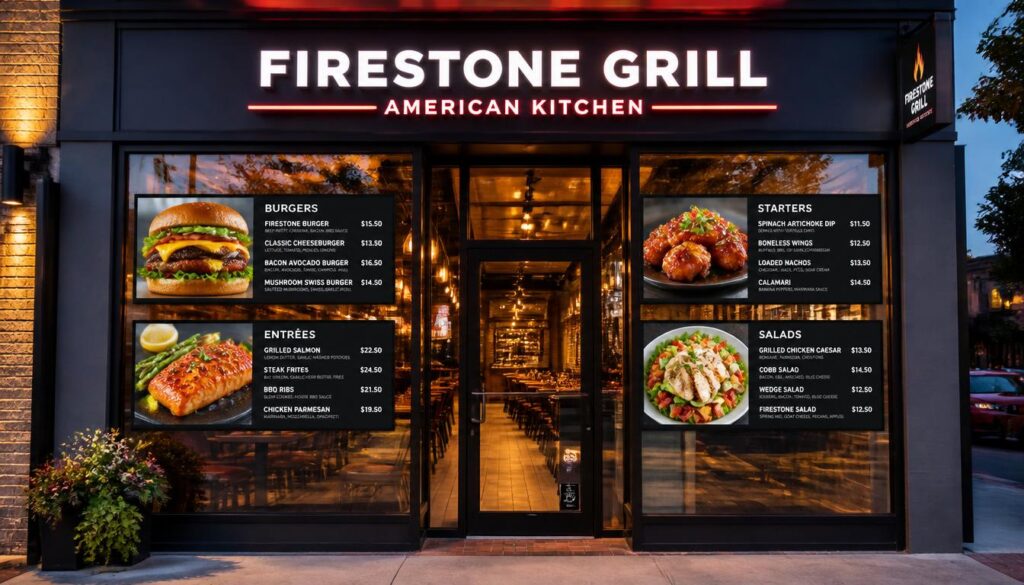
A vivid picture of a hamburger, pizza, iced coffee, or dessert can help attract attention to something that would otherwise be ignored. It comes in handy, especially with seasonal items, combo meals, and add-ons of superior quality.
Digital displays also enable restaurants to switch featured products during the day.
As an illustration, a cafe could feature breakfast sandwiches in the morning and pastries in the afternoon. A hamburger shop may advertise an upgrade or a new limited-time product.
These are some of the most applicable advantages of digital signage in restaurants, particularly when the screen is designed around how customers actually order.
Reduced Costs of Printing and Menu Replacement
Printed signage generates recurring costs.
Each price change, seasonal sale, or new product can demand new posters or menu boards. Restaurants that frequently change their menus can take a lot of time to organize the changes.
With digital signage, the initial equipment costs may be higher, but regular content updates will not need new printed material.
This would ultimately save on printing costs and man-hours of staff time in changing signs.
More Accurate Information
Few things frustrate customers as much as ordering a product only to find that it is out of stock.
The electronic screens enable employees to remove sold-out products, change prices, and rectify errors much faster than with paper menus.
This is especially effective at the busy times when the inventory and availability may vary rapidly.
Hygiene and Reduced Contact
Digital signage also has the ability to eliminate the use of common printed menus.
Rather than serving customers with paper or handheld menus, restaurants can use overhead screens or allow customers to access menu information via QR codes.
This may make cleaning routines easier, as fewer printed menus need to be handled regularly, though it does not substitute regular food safety and hygiene measures.
Marketing Beyond the Menu
One of the advantages of digital display technology is that screens are not limited to displaying food prices.
Additional items that can be displayed in restaurants include loyalty offers, promotional videos, customer reviews, social media content, event announcements, and seasonal campaigns.
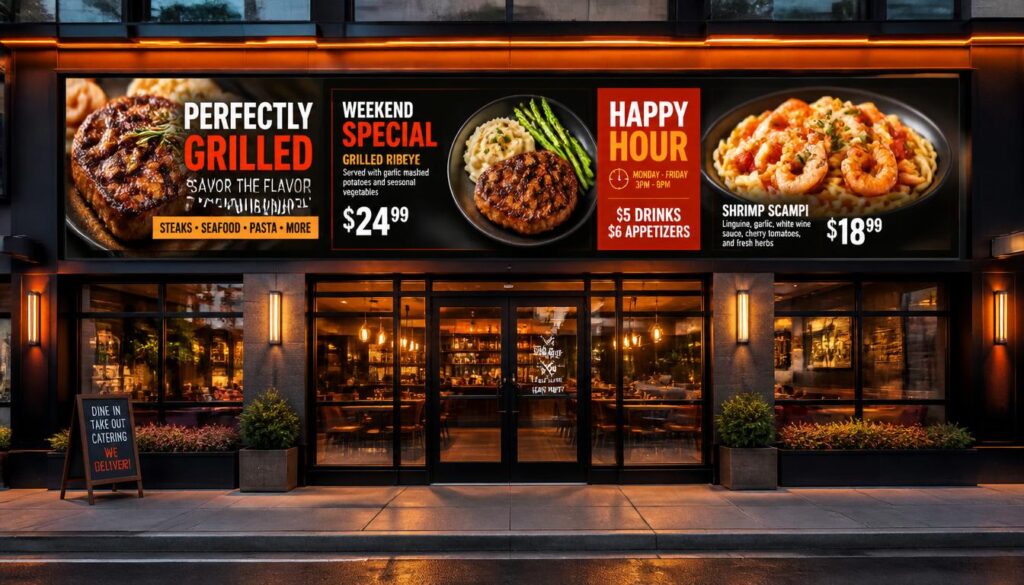
During the day a storefront display can advertise a new lunch deal and later in the evening advertise an event.
This versatility allows the identical display to be used in a variety of ways.
Experience the benefits of digital signage software firsthand. Schedule a demo with Nento to see how easy it is to manage your menu.
Software: The Brains Behind the Screen
Purchasing a screen is just a start. The software determines how easily the restaurant can run it.
A company can possess great displays, yet if managers have difficulties updating prices or promotions, much of the investment may be wasted.
Cloud-Based Content Management
Cloud software enables authorized personnel to handle content on a laptop, tablet, or other compatible mobile device.
This is particularly handy when there are a number of restaurants in a group.
A head office may develop a promotional campaign and send it to the desired restaurants and local managers may make any changes that are allowed to suit the availability of the products.
Scheduling and Automated Updates
The possibility to plan the content is one of the primary advantages of digital signage software.
Restaurants are able to schedule breakfast menus, happy-hour, weekend and holiday offers without manually updating the displays every time.
This will limit the unnecessary duplication of work and aid in making sure that promotions are displayed at the intended time.
How Does Digital Signage Enhance Facility Management?
The people in charge of maintaining the restaurant facilities can also use digital signage.
A centralized dashboard can enable managers to check the online status of screens and media players. The supported systems can give warnings when a display is no longer connected or does not report as expected.
Scheduling features can also turn screens on and off at designated hours, reducing electricity use when they are not needed.
In the case of multi-location businesses, it becomes easier to coordinate equipment monitoring and routine maintenance.
Consistency and Quality Management
Multi-unit restaurants tend to have problems with maintaining menus, promotions, and branding.
An old price can be used by one branch. The other one may indicate an expired offer. A third might use different menu graphics.
This is where digital signage business quality management comes in. Centralized control assists businesses in keeping branding consistent, improving information accuracy and reducing the chances of showing outdated information.
The outcome is a more consistent customer experience, even in cases where the restaurants are located in other cities.
Weighing the Options: Digital Signage Pros and Cons
Digital signage offers plenty of advantages, but it is worth considering the limitations before making an investment.
A balanced look at the digital signage pros and cons helps restaurant owners understand what they are paying for and what responsibilities come with the technology.
| Advantages | Potential Drawbacks |
| Prices and promotions can be updated quickly | Initial hardware and installation costs |
| High-quality images improve menu presentation | Screens and media players require maintenance |
| Menus can switch automatically throughout the day | Software may require subscriptions |
| Printing expenses can be reduced | Technical problems may temporarily interrupt content |
| Multiple locations can be managed centrally | Content still needs regular reviews and updates |
| Offers and featured products can change easily | Poor screen placement can reduce visibility |
How to Reduce the Drawbacks
These issues can be addressed with the help of proper planning.
The reliability can be enhanced by selecting commercial-grade hardware that is suitable in the environment. Offline playback, if supported, can keep previously downloaded menu content available when the internet goes offline.
Another consideration is to select a system that the staff of the restaurant is comfortable with using.
Ask questions regarding technical support, hardware warranties, compatibility with software, installation fees, and periodic subscription charges before committing.
The lower cost screen is not necessarily the lower cost one in the long run.
For many restaurant owners, the ideal solution is to calculate the total cost of ownership instead of looking at just the purchase price.
Digital Signage in Retail and Beyond
Restaurants are not the only businesses benefiting from digital storefronts.
The retailers have taken advantage of digital displays to promote their products, seasonal offers, new arrivals and special offers. Most of these techniques are applicable in foodservice.
What Restaurants Can Learn from Retail Displays
One of the greatest benefits of digital signage to retail is the fact that it can be used to capture attention prior to customers entering a store.
A clothing store could put its latest line in a window. The same concept can be used by a restaurant to display its signature dishes, lunch specials, or limited-time desserts.
The same principle applies: present people with something relevant when they are near enough to do something about it.
In the case of restaurants in shopping streets, malls and commercial centers, screens that are facing the window can assist in communicating what is offered without having to walk into the restaurant.
Dynamic Pricing and Limited-Time Offers
Retail companies tend to use time-based promotions to attract consumers to buy.
The same can be applied to restaurants that offer lunch promotions, afternoon beverage promotions, happy-hour, and seasonal menu offerings.
These offers are simplified by digital screens that facilitate the scheduling and removal of the offers when they expire.
There is also a possibility of dynamic pricing, but restaurants need to use it with caution. Customers may get frustrated with frequent or sudden changes in prices when the information is not clear.
Easy to understand pricing and regular communication must be priorities.
Selecting the Appropriate Display Strategy
A restaurant is not necessarily required to have numerous screens connected.
One display in the front window of a small cafe can be of use. A fast food restaurant may have a number of menu boards over the counter. High-brightness outdoor units might be needed in a drive-thru operation.
The best digital storefront display for restaurants is not necessarily the biggest or the most costly one. It is the one that fits the physical space, customer behavior and operational requirements.
Conclusion
Restaurant signage is no longer limited to printed posters and traditional menu boards.
Digital displays in modern times allow a business to be more flexible with updating prices, marketing products, enhancing menu visibility and offering information that is similar across various locations.
The most desirable digital menu boards are appealing to look at and have features like scheduling, cloud-based management, POS compatibility, and reliable commercial hardware.
They also assist restaurants to borrow effective visual merchandising strategies used in the retail businesses especially in terms of storefront promotions and limited time offers.
Nevertheless, to make the correct configuration, it is not enough to purchase a bright screen. Restaurant owners need to look at the usability of the software, viewing distance, outdoor viability, maintenance, and the cost of operating the system over the long term.
Digital storefront signage can be a worthwhile investment for foodservice businesses planning for long-term operations. When it is done correctly, it can result in the restaurant being easier to notice, easier to manage and even more convenient to customers.
Don’t get left behind. Upgrade your restaurant with Nento and create a customer experience that sells itself. Get a quote now!
Frequently Asked Questions
What is the best digital menu board for a drive-thru?
The most effective drive-thru menu board depends on the position of the screen, viewing distance, exposure to the sun and weather.
Find bright commercial displays, appropriate weather protection, and anti-glare protective glass. Displays with approximately 2,500 nits or higher can be suitable in challenging outdoor lighting conditions.
Nento also provides outdoor digital signage solutions that are intended to be used in restaurants.
Are digital menu boards worth the investment?
They can be, especially in the case of restaurants that often change their prices, have promotions or operate multiple locations.
The reduced printing costs and time of the staff, as well as the better presentation of the menu, may lead to savings, and upselling opportunities can be supported.
The payback period however, is based on equipment cost, software subscription, operational savings and actual sales performance. Restaurants are advised to determine their anticipated payback as opposed to having a given payback period.
How difficult is it to update menu content?
Regular updates are typically easy with easy-to-use digital signage software.
Restaurant managers are able to modify prices, post pictures, label items as out of stock and even plan promotions using a computer or a compatible mobile phone.
The simplicity of updating will be determined by the platform, and it is worth requesting a demonstration before selecting a provider.
How does digital signage enhance facility management?
The digital signage software may assist facility managers to control interconnected screens with a single dashboard.
Managers can receive alerts when screens go offline, schedule automatic power-on and power-off times, and manage content remotely, depending on the system.
This saves the time of having to go to each display one at a time and can streamline the process of maintenance.
What are the advantages of digital signage for retail environments?
Digital signage assists retailers in marketing their products, showcasing temporary deals and refreshing campaigns without replacing printed signs.
The same is advantageous to restaurants. They are able to show the combo meals, daily specials, new products and promotions to the customers in line or passing by the storefront.
The most significant advantage is the flexibility: the business will be able to change what the customers see without having to redesign the physical display.