Introduction
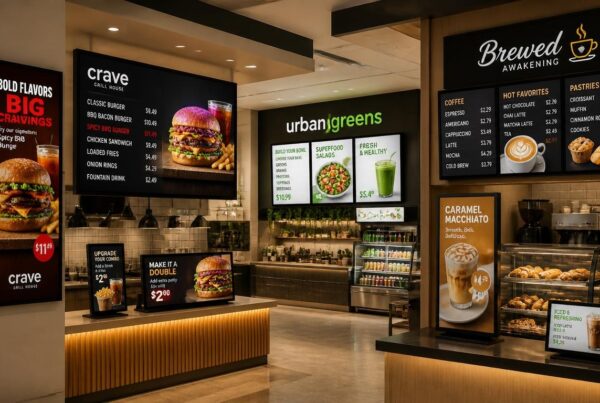
Enter a crowded cafe on a Monday morning. The air is filled with the aroma of freshly brewed coffee, the people are conversing as they wait to receive their orders, and there are digital menu boards with breakfast combinations and seasonal drinks above the counter.
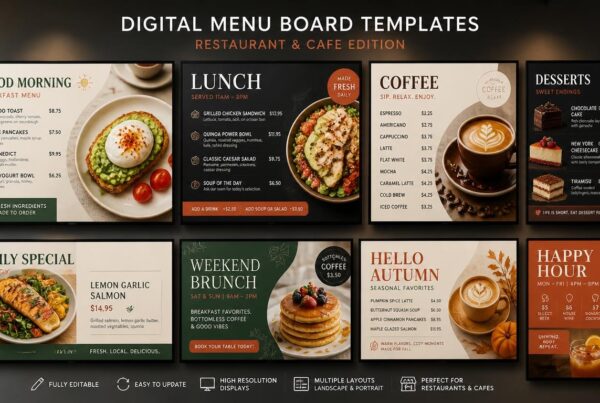
By lunchtime, the same screens can be advertising sandwiches and meal bargains. Later in the afternoon, they may feature desserts, cold drinks, or an event that is coming up.
This is what the digital signage of today adds to the hospitality experience: the possibility to communicate with customers all day long without having to replace the printed signs all the time.
So what industries use digital signage, and why has it become such a useful tool for restaurants and cafes?
The majority of individuals think of digital displays as Times Square advertisements, shopping malls, or big retail stores. As a matter of fact, companies in many sectors utilize screens to interact with their customers, do promotions, share information, and carry out their daily activities.
Restaurants and cafes are especially interesting because they must help customers make quick choices while also making the space inviting.
It is there that digital signage for hospitality becomes more than an advertising tool. It assists companies in maintaining menus, interacting with customers, marketing, and updating information.
This guide discusses the digital signage industries and takes a closer look at how restaurants and cafes can utilize the technology to enhance their operations, aid sales, and provide a more customer-focused experience.
Before we dive in, if you’re looking to upgrade your venue, check out Nento’s cutting-edge digital signage solutions.
What Industries Use Digital Signage? The Big Picture
Digital signage is used in many industries, including retail, healthcare, and education.
The fundamental aim is the same: to present information on electronic screens that can be updated without replacing physical signage.
The nature of content and its management, however, is dependent on business.
Major Industries Using Digital Signage
| Industry | Common Applications | Main Purpose |
| Retail | Promotional displays, product launches, window advertising | Attract shoppers and highlight products |
| Healthcare | Patient information, queue displays, wayfinding | Improve communication and navigation. |
| Education | Campus announcements, event schedules, information screens | Keep students, staff, and visitors informed. |
| Transportation | Arrival and departure information, directions, safety notices | Provide timely information to travelers. |
| Hospitality | Digital menus, guest information, promotions, entertainment | Improve guest communication and service. |
| Corporate | Meeting schedules, internal announcements, dashboards | Support workplace communication. |
Each industry benefits from the ability to change content quickly.
Waiting-room information may be updated at a hospital. An announcement of a campus event could be made at a university. A retailer can substitute a weekend promotion by a new product campaign.
Knowing these various uses, it is clear why digital signage for industries has become far more than electronic advertising.
Why Hospitality Is Different
There is an added challenge to restaurants, cafes, hotels, and bars.
They are not just selling goods or giving information. They are also developing an experience.
The lobby of a hotel must be friendly. A coffee shop might desire a cozy ambiance. A fast-food restaurant needs customers to find menu information and place orders without unnecessary delays.
All these can be facilitated with the help of digital signage.
The contents should be appealing to the eye, yet they should be helpful when the appropriate time comes.
In the case of restaurants and cafes, it usually involves having visible menus, updated prices, applicable promotions, and details that assist the customers in the ordering process.
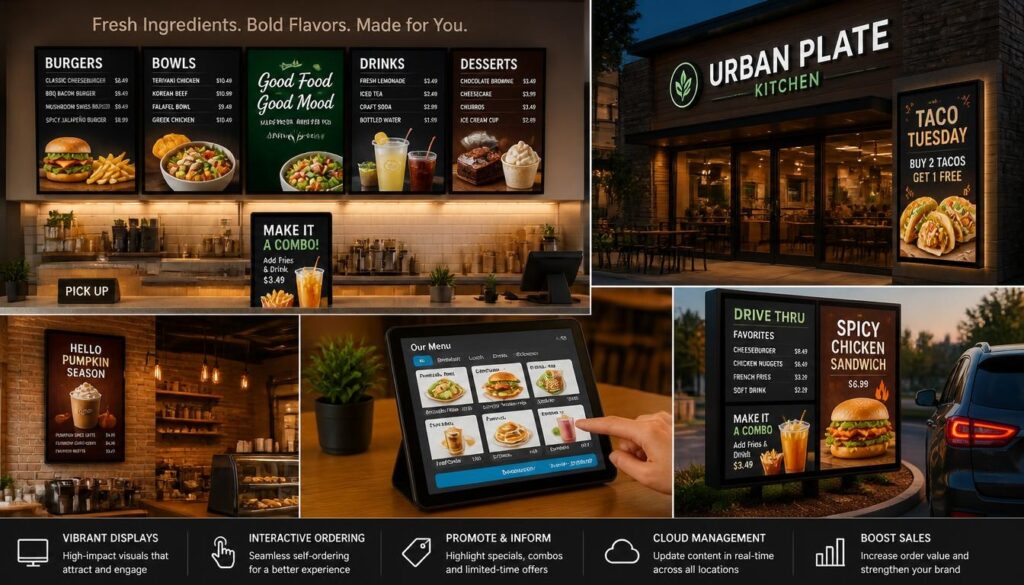
The Rise of Digital Signage in the Hospitality Industry
Hospitality is not only limited to restaurants.
Digital displays are used in various ways in hotels, resorts, bars, stadiums, food courts, conference centers, and entertainment venues.
A hotel may display check-in details and events. Food menus, directions, and promotional messages can be shown in a stadium. A bar can use screens to display drink deals and entertainment.
In the case of restaurants and cafes, this is especially handy since menu items and customer demands might vary multiple times during the day.
More Than a Television on the Wall
The digital signage hospitality industry uses interconnected displays for communication rather than simply playing videos on television screens.
A restaurant will be able to plan the content, change menu prices, arrange promotions, and control numerous displays using compatible software.
Rather than manually updating the information on each screen, the staff can update it in a central dashboard.
This flexibility is even more beneficial to the businesses that have multiple branches.
Setting the Right Tone
Hospitality is directly related to the sense of a space.
A tiny cafe can be warm in terms of color scheme, calm backgrounds, and pictures of fresh-baked goods. A modern burger shop may prefer flashy graphics and vibrant promotional videos.
A hotel bar can have fancy visuals in the evening, whereas a breakfast place can have more straightforward content in the morning.
Digital signage enables any business to modify their visual display without having to modify the space.
An example would be a cafe that would serve a clean breakfast menu in the morning and a warmer design in the evening with desserts.
This can be done with planned changes in the content, which is often referred to as dayparting.
Unity in More Than One Place
Hospitality companies that have many branches must have uniform branding.
The same logo, colors, and menu structure should be familiar to the customers regardless of which branch they are at.
Centralized digital signage management makes this easier.
A restaurant chain can post approved promotional materials across all its restaurants while allowing individual branches to update local prices or product availability.
This assists in maintaining brand identity without rendering each location reliant on printed materials.
Transforming Restaurants and Cafés: Real-World Applications
There are multiple ways in which restaurants and cafes can utilize digital signage other than a mere menu.
The most helpful applications are those that address the daily issues: to alter the information, assist customers in picking the products, and save the employees the needless work.
Digital Menu Boards for Quick-Service Restaurants
One of the most common hospitality signage applications is digital menu boards.
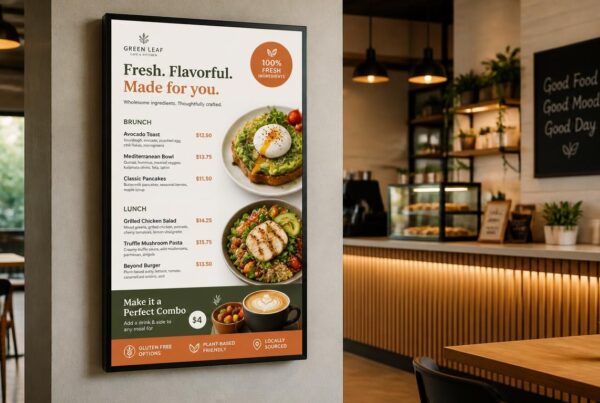
They substitute printed menus with screens that show food categories, prices, pictures, and promotions.
A fast-food restaurant could have individual screens to display main meals, beverages, and a combination of meals.
Flexibility is an advantage.
When breakfast service ends at 11 AM, a properly scheduled digital menu can automatically switch to lunch. In case of unavailability of a product, employees are able to delete or edit it using the content management system.
Restaurants are also able to point out limited-time offers, or products that they wish their customers to look at.
As an example, a burger restaurant might have on one screen a meal combination and on the other a large screen with the main menu.
This creates opportunities for upselling without requiring cashiers to explain every promotion.
Dynamic Pricing and Seasonal Offers
Seasonally, cafes tend to switch the products.
Cold drinks can be included in the summertime, and hot chocolate and specialty coffees will be more applicable in colder seasons.
The digital signage enables the business to make such changes ahead of time.
It may also aid in planned promotions like happy-hour packages or lunch specials.
Offers and prices must be kept straight and precise, especially with the various promotions at varying times.
Flexible pricing can be useful, but businesses should not confuse customers with unannounced or unclear price changes.
Ambiance and Entertainment
Not all displays should have menu prices displayed.
A cafe could display a screen with local photography, a short video on how coffee is made, or the history of its products.
A restaurant could display selected food preparation footage or information about upcoming events.
These displays add to the ambience and offer something of relevance to the customers to view.
Some businesses also display curated social media content, customer photos, or community events.
Nevertheless, social media content should be moderated, and businesses should obtain appropriate permission before displaying customer photos and follow applicable privacy requirements.
This is to aid the atmosphere and not to bombard customers with competing messages.
Behind the Counter Operational Efficiency
Digital signage may also be applied in areas that are staff only.
A restaurant can display staff announcements, training information, kitchen safety notices, or shift updates.
These displays can be used to convey information without necessarily using printed notices fully.
Order pickup screens can be used in customer-facing environments to display order numbers and collection instructions.
This can decrease the number of questions that are asked at the counter, and it can make customers know when their food is ready.
Reduced Administrative and Printing Expenses
A practical advantage of hospitality digital signage is that menus and promotional materials can be updated without reprinting them.
In the case of restaurants where new products are always introduced or prices are changed, printed signage can be a recurrent cost.
Digital displays have a high initial cost and operating expenses, yet the display can be used in numerous campaigns.
Less manual labour is also required to replace the posters or menu boards.
The economic benefit will be based on the current printing costs, hardware costs, software costs, and the rate of content replacement in the restaurant.
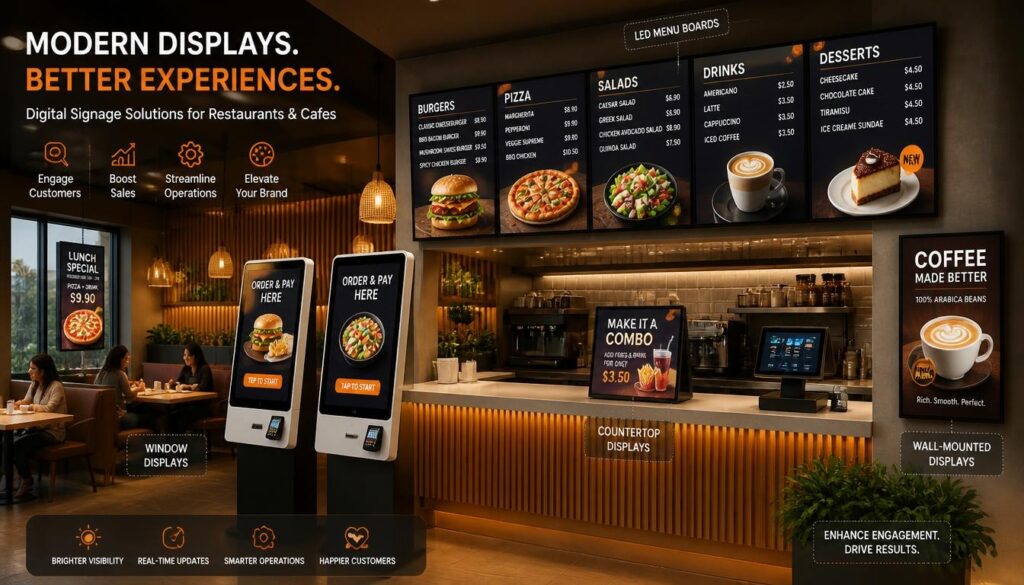
The Power of Interactive Digital Signage in Hospitality
Conventional signage is used to show information to customers.
Interactive signage takes it a notch higher by enabling customers to choose, get more information or perform certain tasks directly on a screen.
This opens up new possibilities to restaurants, cafes, hotels and bigger hospitality establishments.
Self-Service Ordering Kiosks
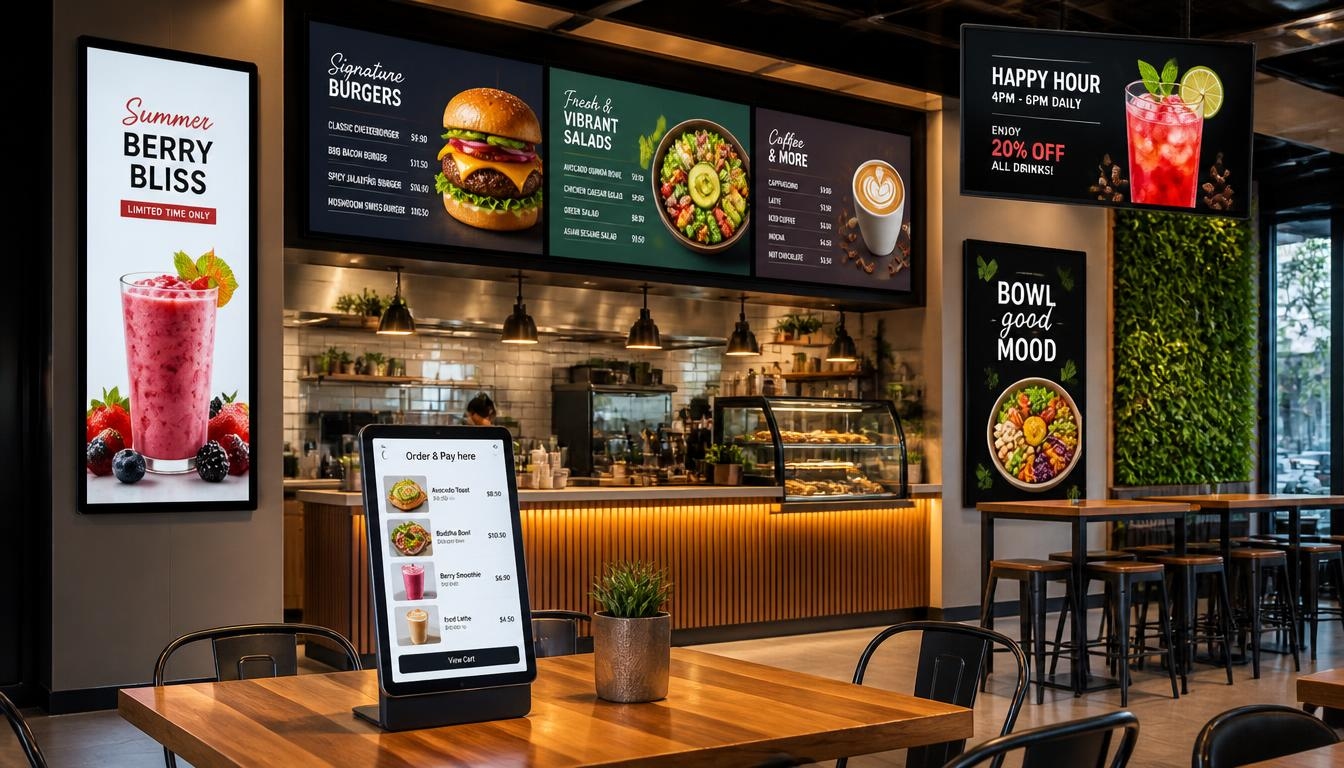
Self-ordering kiosks enable a customer to browse menus, customize meals and order them using a touchscreen.
When a customer orders a burger, say, he or she may decide on the size of the meal, the toppings, and the drink to add then confirm the order.
When connected to a compatible ordering system, the kiosk can send the order to the restaurant’s workflow.
This can eliminate certain standard operations at the counter and provide the customers with greater flexibility in personalization.
Nevertheless, kiosks need to be properly programmed, integrated with payment, accessible, and maintained.
They must be an addition to the service model of the restaurant, and not complicate the ordering process needlessly.
Interactive Wayfinding
Larger hospitality settings may have to assist guests in locating their way.
The hotel can consist of multiple restaurants, event halls, meeting rooms, and leisure facilities. There are also several restaurants in the food courts and stadiums.
Interactive directories and maps enable visitors to search and see directions.
As an illustration, a touchscreen might assist a hotel guest to find the breakfast restaurant or a conference room.
They can be particularly helpful at places where fixed signs are not able to be detailed enough.
Digital Customer Feedback
Digital screens can also be used by restaurants to gather feedback.
A basic touchscreen survey near the exit could ask customers to rate their experience or suggest improvements.
Guests can also access a feedback form on their phones through QR codes displayed on digital signage.
It must be a fast and optional process.
When the questions are not complex, and do not interfere with the visit, customers will be more likely to participate.
A More Connected Guest Experience
The growing use of interactive digital signage hospitality industry solutions reflects a wider move toward connected guest experiences.
The guest is now faced with technology in various aspects of their stay, as they read menus and place orders, seek directions and give feedback.
Usability is the key factor to consider.
The experience should also be easier with interactive features and not make customers go through complex interfaces to perform simple tasks.
Choosing the Right Digital Signage Partner for Your Café or Restaurant
After making up the mind to implement digital signage in a restaurant, the next hurdle is to select an appropriate provider.
Display, media player, software and design services are available in numerous companies.
Nonetheless, not all solutions are as practical to a busy restaurant.
A suitable hospitality digital signage solution must be user-friendly, compatible with the chosen hardware and flexible enough to support changing menus and promotions.
Why Cloud-Based Content Management Matters
With cloud-based software, the authorized users can remotely control the content of the screens.
Take the case of a business that has five coffee shops.
The manager does not have to go to each location to update a menu, but he can create the update on a single laptop and push it to the chosen screens.
Local adjustments may also be allowed to individual branches.
Businesses looking for the best cloud-based digital signage CMS for hospitality should compare how each platform handles multiple locations.
Content scheduling, remote update, templates, user permissions, multi-location management, and offline playback are important features that should be compared.
Reliability When Busy in Service
When customers are placing orders, the restaurant screens should be operational.
A frozen menu screen during lunch can cause confusion, particularly when it is the main source of price information.
Some of the issues that businesses should put into consideration are the performance of the system in case the internet connection goes down.
Some digital signage systems store downloaded content locally, allowing previously published menus to continue playing during temporary network outages.
Remote monitoring and reliable technical support could also be handy, especially to businesses with multiple locations.
Choosing Suitable Hardware
The environment in which a restaurant operates is important.
Screens around kitchens can be subjected to heat, grease, humidity or cleaning. Displays placed close to large windows might require extra brightness to be legible.
A hospitality digital signage supplier should assist businesses in choosing suitable equipment.
Commercial-grade screens may be appropriate for long operating hours, but restaurant owners should verify the model’s operating temperature, cleaning requirements and duty rating.
Not all commercial displays are intended to be placed in a hot or greasy kitchen.
Software That Employees Can Use
It should not be a sophisticated technical system that will demand high technical skills to perform daily functions.
Employees must be in a position to update their prices, change menu items, plan promotions and upload photographs without complex processes.
These tasks can be simplified with the help of a clear dashboard and reusable templates.
This is particularly relevant to restaurants where the managers already have many responsibilities.
Comparing Hospitality Digital Signage Vendors
In the case of hospitality digital signage vendors, consider the compatibility of the system with your operating requirements.
Ask whether the provider’s software works with your current screens, offers cloud management, provides restaurant templates and includes installation and technical support.
Compatibility with existing POS or ordering systems is also worth checking when required.
Nento offers cloud-based digital signage software, restaurant templates, content scheduling and multi-location control.
These attributes enable cafes and restaurants to handle menus and promotions through a central platform.
Ready to modernize your restaurant? Nento offers cloud-based CMS solutions tailored for the hospitality industry. Contact us today for a demo.
The Benefits of Digital Signage for Hospitality
Digital signage can bring value in a number of aspects, yet businesses need to consider the advantages based on their specific needs.
Four of them are beneficial to restaurants and cafes.
More Opportunities for Sales
Good food photography and prominent promotions can make customers see the things that they would not have otherwise noticed.
Menu boards allow restaurants to showcase meal combinations, high-end beverages, desserts, and specials.
Such displays create upselling opportunities, but sales increases are not guaranteed and should be measured using real sales data.
Quick and More Adaptable Updates
The software can be used to update menu prices, product descriptions and promotional messages.
In the case of restaurant chains, coordination of changes can be made across various locations.
This saves the hassle of having to print new materials or manually change signs whenever there is a change in information.
Better Customer Communication
Clearly defined menu screens enable the customers to know what they are getting before they get to the cashier.
Waiting customers can be informed by order status displays.
Waiting areas can also be made more entertaining with promotional or informational screens, but these displays do not necessarily reduce food preparation time.
Stronger Brand Consistency
The visual identity of a restaurant must be familiar in the different locations.
Centralized management and digital signage templates allow keeping colors, fonts, logos, and promotion designs consistent.
The approved changes can still be made by the local teams without sacrificing the overall presentation of the brand.
All these benefits of hospitality digital signage can enhance communication, reduce repetitive administrative tasks and give businesses greater control over the customer experience.
The best outcomes are achieved by means of integrating the right technology with concise content and considerate placement of screens.
Conclusion
Digital signage is applicable in various industries, such as retail, healthcare, education, transportation, and corporate setting.
But hospitality is a particularly fascinating usage since screens affect more than the information that customers get.
They also influence how a restaurant, cafe, hotel or bar looks and feels.
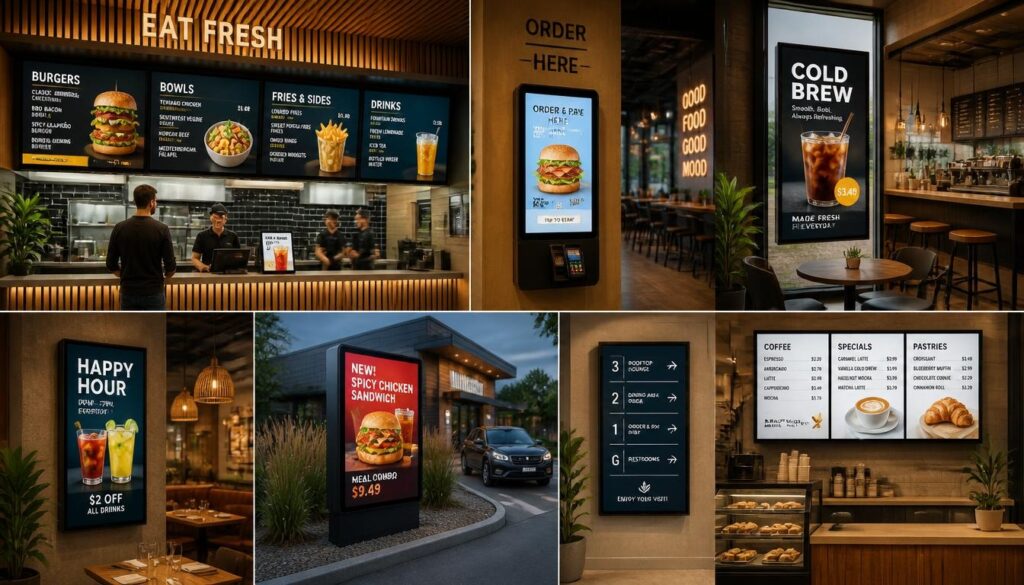
In restaurants and cafes, digital menu boards can help update prices, promote selected products and assist customers with their ordering decisions.
Interactive screens provide more opportunities to do self-service ordering, navigation, and feedback, and cloud-based management allows it to be simpler to coordinate content across multiple locations.
The technology, however, can only be effective when businesses select appropriate hardware, reliable software and content that suits their customers.
One digital menu board can be used at a small coffee shop, whereas a restaurant chain can require a network of digital menu boards that are connected at multiple locations.
The most effective method is to begin with a clear objective and build up as the business expands.
Digital signage involves more than just substituting printed signs with televisions. It is about developing a more flexible way to communicate with customers and manage information.
Don’t let your competitors outshine you. Transform your restaurant or cafe with Nento’s digital signage technology.
Frequently Asked Questions
Is Digital Signage Expensive for a Small Café?
The price is determined by the quantity of screens, hardware, software license, and installation needs.
A small café can start with one compatible display and expand later.
Digital signage can reduce repeated printing costs. However, the payback period depends on the initial investment and the net cash savings or additional cash flow generated by the system. The comparison of the total investment and the current menu and promotional costs of the cafe is worthwhile.
Can I Use Digital Signage to Reduce Wait Times in My Restaurant?
Waiting experience can be made more organized with the help of digital signage.
Menu boards can be used to preview the choices before ordering and order status displays can be used to indicate when food is ready to be picked up.
These features can minimize the confusion and duplication of questions at the counter. Nevertheless, they do not necessarily reduce the time of food preparation and remove queues.
Do I Need Technical Skills to Manage the Content?
Not necessarily.
The current cloud-based signage solutions offer easy-to-use editing and scheduling features.
Nento provides template customization and drag-and-drop content management tools, enabling restaurant managers to edit menus and promotions without advanced design knowledge.
Basic training can still be useful, particularly in those businesses that operate multiple screens or locations.
What Types of Hardware Are Best for a Commercial Kitchen?
Displays for commercial kitchens should be selected according to the conditions they will face.
Take into account heat exposure, humidity, grease, cleaning needs, and working hours per day.
Commercial-grade displays designed for the specific environment may be more suitable than consumer TVs, but their environmental ratings must still be checked.
Before the installation of equipment, a trusted hospitality digital signage provider must ensure that the equipment has the appropriate environmental ratings and maintenance needs.
How Does Digital Signage Help With Menu Updates?
Digital signage enables restaurants to update menu details using a content management system.
For example, when a cafe runs out of croissants, the manager can remove the item or mark it as unavailable without reprinting the menu.
Companies also have the opportunity to plan seasonal deals, modify prices and post new menus in linked locations.
The speed of appearance of changes is determined by the software, player connectivity and configuration.