Introduction
Speed and accuracy are all that matters in the fast-paced worlds of quick-service restaurants (QSRs) and food manufacturing. A held order in the kitchen, or a misunderstood order, can cost you a lifetime customer, and the operational harm is usually not just one transaction. Interrupted order flow wastes labor, increases wait times, and increases errors.
Paper tickets, verbal shouts, and queues at printers are some of the traditional methods of order processing that pose unnecessary friction. Lost tickets, jammed printers, misreading of handwriting by the staff, missing critical modifiers—all of it during the peak rush.
“In high-volume environments, the smallest delay becomes the biggest problem.”
Digital signage is the solution to this by filling the gap between the point of sale and the production line. Rather than the use of weak, manual handoffs, orders are transferred electronically, displayed immediately, and remain in sight until they are finished. This guide explains the benefits of using digital signage to enhance order processing, the streamlining of operations through the integration of digital signage POS (point of sale), and the reliability of Nento digital dining POS support to make the systems available when you need them the most.
The Evolution of Order Processing
The Old Way
Paper tickets and handwriting were meant for slower settings. They cause predictable points of failure in the contemporary QSRs and production environments: printers become jammed, tickets get lost, and employees waste time searching for what should be obvious. Despite successful prints on tickets, they may be misread, damaged, or handled out of order under pressure.
The Digital Shift
Businesses have shifted to centralized digital displays as they eliminate the guesswork, as well as dependence on fragile hardware workflows. Orders are reflected immediately, are organized, and can be routed to the right station without any employee needing to read and re-enter information. This change does not imply replacing people; it is the elimination of the manual processes that lead to errors.
The Food Order Screen as the New Hub
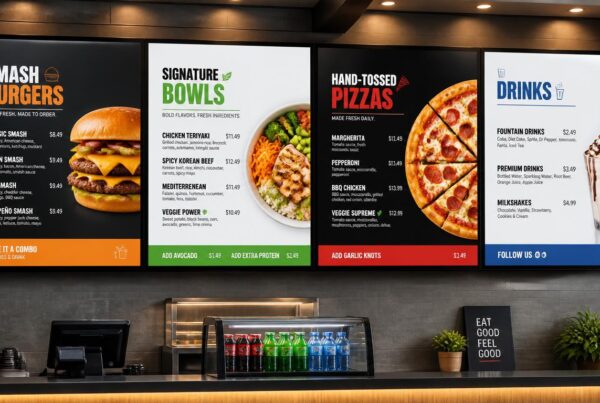
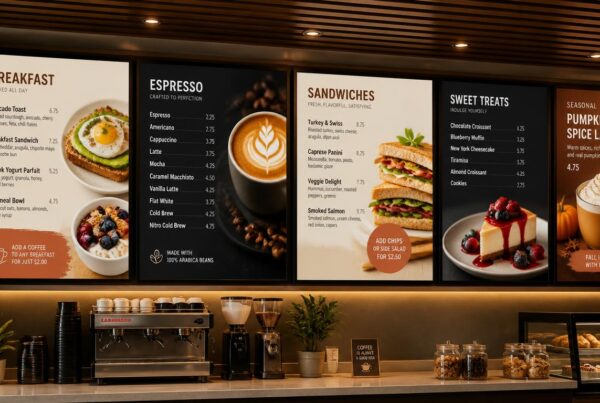
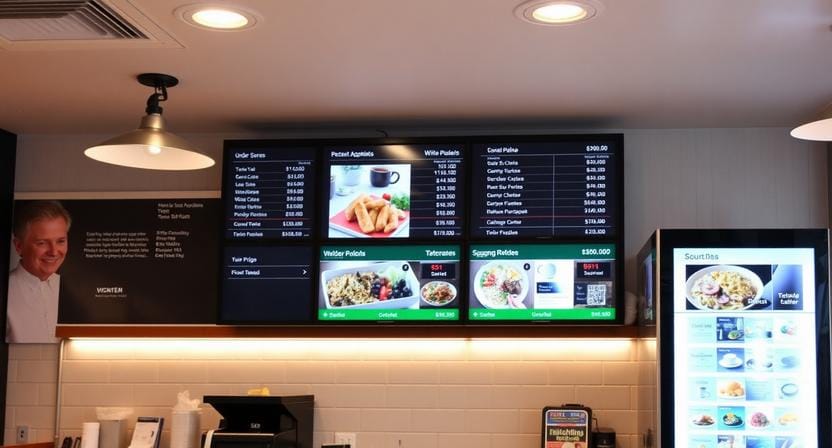
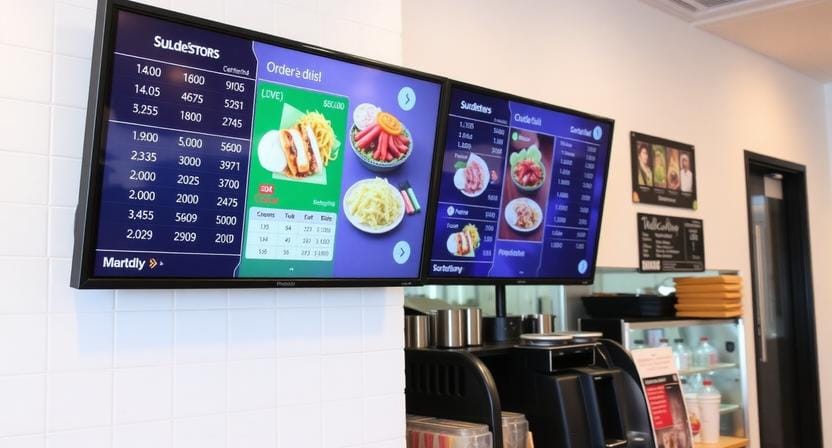
A food order screen is the core of the operations in the modern context, as it displays live orders, modifiers, and priorities all in one location. A fast-food order screen is used in high-volume configurations when kitchen teams need to work in sync, as all of them can see the queue at the same moment. A digital display in the manufacturing environment will be equally clear in the batch activities, the production phases, and the real-time status.
“When everyone sees the same order of truth, coordination improves instantly.”
The Core Benefits of Digital Signage in Order Processing
Reduced Wait Times and Increased Speed
The fast-food order screen shows the orders as soon as they are placed in the kitchen, so staff can begin preparing as soon as the customer pays. This eliminates the bottleneck where orders are waiting to get a ticket printed or to be called back by someone. When the order is visible immediately, work can start sooner and idle time drops.
Handoffs are also enhanced through digital visibility. Prep, assembly, and expo can organize what to do next instead of reacting under pressure. In the long run, this reduces the fulfillment times and enhances throughput without additional labor.
Elimination of Human Error
The most famous of these is fried vs. grilled. error, when one hears something wrong, reads something wrong, or writes something in a state of stress. Transcription errors are virtually eliminated when digitally sent orders are sent to the screen via the POS. There are clearly shown modifiers, customizations, allergies, and special requests without having to depend on the quality of handwriting or memory.
This is one of the clearest answers to how digital signage improves order processing: people repeat information less often and spend less time copying, interpreting, or restating it.
“Every manual handoff is a chance for the order to change.”
Enhanced Kitchen Organization
Digital systems support structured workflows—not just faster displays. Orders can be routed automatically—drinks to beverages, burgers to the grill, desserts to prep, and so on, with special displays and rules. A food manufacturing digital display can be used in production environments to split tasks by the line, product, or compliance requirement, enabling execution to be more predictable.
Visual prioritization (like time-elapsed color coding) is also common in many setups so that teams can easily see what is approaching time limits. This makes the process of handling rushes more orderly, since what is urgent is on display rather than argued over.
The Technical Backbone: POS Integration
The Engine: POS Integration for Digital Signage
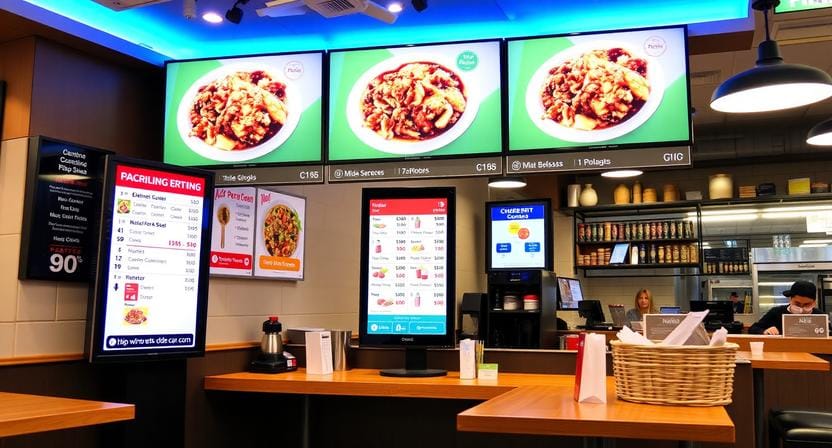
The system that links ordering activity with what is on screens is known as POS integration of digital signage. Order items, modifiers, timing, and station routing are sent to the displays in real time by the POS; therefore, the kitchen is immediately aware of orders. This lays the basis of digital signage + POS (point of sale) workflow since it maintains front-of-house and back-of-house integration.
Bi-directional communication particularly comes in handy. Status can be updated to expo, runners, or pickup screens when items are marked complete on the kitchen screen. Such a feedback loop eliminates confusion, enhances pacing, and also makes the staff aware of what to focus on next.
The Hardware
Kitchen hardware should be constructed to withstand harsh conditions, heat, moisture, oil, and constant washing. A food order screen or kitchen production display must be sturdy, stable, and placed so it can be viewed across the stations. Rugged displays are commonly needed in manufacturing to allow continuous operation and to be able to withstand more severe conditions.
Digital ordering systems also come in handy in the front of house. Touchscreen ordering kiosks that are used in fast food restaurants have the potential to alleviate the pressure on the queue and enhance precision by allowing customers to verify their choices prior to payment. When kiosks are linked to the same POS system and kitchen display process, the order goes through the system without additional human actions.
The Support: Why Reliability Matters
Hardware is not enough to be successful. There should be consistent connectivity, monitoring, and rapid troubleshooting, which is the key to peak-hour performance. That’s why digital dining POS support is essential: systems should stay online when they’re needed most, and minor integration problems should be addressed before they interfere with orders.
Nento focuses on stability and support because lost processing time leads to lower revenue and damaged customer trust.
“Order systems don’t get judged on normal days—they get judged on rush hours.”
Real-World Applications Across Industries
Quick Service Restaurants (QSRs)
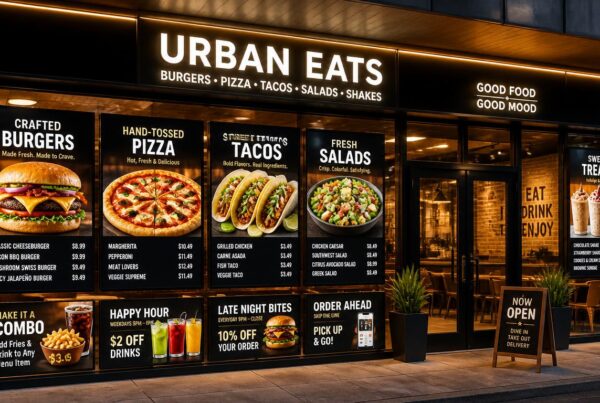
Digital speeds up and enhances accuracy in QSRs by linking counter, kiosk, and kitchen displays with a single flow. The touch screen ordering system in the fast-food industry can decrease the friction of the ordering process, and the display in the kitchen will make all items and modifiers visible immediately. Digital confirmation screens are also helpful in drive-thru processes to minimize miscommunication and make corrections quicker before the order is sent to the window.
This is where the visibility advantage is multiplied: there are fewer repetitive questions and fewer remakes and faster assembly since the queue is clear.
Food Manufacturing & Processing
A food manufacturing digital display can be used in manufacturing to control batch orders, manufacturing priorities, and compliance actions. This can be displayed on screens to provide work instructions, line assignments, and tracking of progress to ensure teams perform uniformly. Real-time visibility aids in pacing better, as the supervisors are able to identify the bottlenecks in time and divert labor before delays accumulate.
Digital displays are also more effective in enhancing accountability through making status visible. The ability to monitor progress in real time makes it easier to identify delays and better plan and respond to demand peaks without having to use verbal communication.
Full-Service Dining
Digital dining support is essential in full-service settings when the orders are taken through various channels, including servers, tablets, bar stations, and online ordering. Integrated systems have orders flowing to the expo line without a runner to serve as the connection. This minimizes waiting, safeguards precision, and enhances timing between kitchen and service.
Is your current kitchen setup causing delays? Nento specializes in robust POS integration for digital signage that keeps your kitchen moving. Contact Nento for a Free Consultation
Why Choose Nento for Your Digital Signage Needs?
The Company Intro
Nento is a cloud-based signage company designed to be used in an operational setting where all that is needed is reliability and clarity. Nento is not thinking about screens as mere displays but rather as a working system that can support speed, accuracy, and measured performance.
Seamless Integration
Nento’s platform integrates with major POS systems to provide reliable POS integration for digital signage. The objective is simple: orders flow seamlessly from front-of-house to production without manual re-entry of orders, delays, and misunderstandings.
Superior Support
The least considered aspect of order processing is what happens when something fails. The digital dining POS support Nento has constructed is designed to troubleshoot fast and stay online during high-traffic times. This support layer protects throughput, since, with stable systems, staff can remain execution-focused.
Hardware Agnostic
Nento supports flexible deployment whether you require a rugged food manufacturing digital display to be used in production or a sleek front-office customer-facing food order screen. It becomes simplified to embrace the digital workflows without being tied to a single hardware style that doesn’t fit your venue requirements.
“The best systems fit the operation—not the other way around.”
Frequently Asked Questions (FAQs)
Can digital signage really speed up my kitchen during a rush?
Absolutely. With orders instantly shown on a fast-food order screen, kitchen employees will be able to begin preparing items the moment an order comes in, instead of waiting for a ticket to print—cutting fulfillment time by as much as 30%.
Does Nento’s system integrate with my existing POS system?
Yes, Nento offers professional POS integration for digital signage with the majority of major POS systems, and your front-of-house and back-of-house stay in sync.
What is “digital dining POS support,” and why do I need it?
Digital dining POS support is the technical support that makes sure that your ordering systems (tables, kiosks, and kitchen screens) are synchronized. With Nento, 24/7 support is available to fix any connectivity problems so that you do not lose any order.
Are these screens suitable for a hot and greasy kitchen environment?
Yes. Nento sells rugged food manufacturing digital display units that are resistant to high temperatures and moisture, as well as wear and tear of a busy commercial kitchen.
Can customers use these screens to order?
Yes. We also offer smooth fast-food touch-screen ordering kiosks for the front of house, which are also linked to your POS and kitchen display systems.
Conclusion
Order processing has moved from paper-based guesswork to digital accuracy. Orders that are displayed immediately on a screen, stay visible until completion, and automatically route to the appropriate stations become more precise and reduce delays. The practical answer to how digital signage improves order processing is fewer handoffs, more accurate execution, and better collaboration.
The restaurants and factories that process the orders the fastest will be the winners in a competitive market. Assuming the need to be fast and not sacrificing accuracy, one of the most direct operational upgrades you can perform is to have digital signage linked to your POS.
Ready to upgrade your order processing? Trust the experts at Nento.