Introduction
A cafe menu was something that you printed, framed, and left unattended until prices were adjusted. If a seasonal drink was introduced or a pastry ran out, somebody would have to change the chalkboard or a poster or tell all the customers in line about the change.
That method still applies to certain cafes, but it is inconvenient when the menus are frequently changed.
E-signage is now a more adaptable means of communicating with customers. Cafes do not have to rely on printed materials totally but can use digital screens to show menus, promotions, food pictures, and information that can vary during the day.
Consider a coffee shop that offers breakfast pastries in the morning, sandwiches during lunch, and specialty beverages in the afternoon. With scheduled content, digital signage can display the correct menu at the right time without employees having to change it manually.
There are also prospects of advertisement of products through the technology. A picture of a croissant that has just been baked can draw attention where a simple list of prices might not.
But one of the greatest benefits happens in the background. Using e-display digital signage software, the owners of the cafes will have the ability to remotely manage their content, schedule updates, and have consistent menus in multiple locations.
These features are worth considering in businesses that are experiencing increased operating costs and competition.
This tutorial will describe the functionality of e-signage, the savings, and how digital displays can enhance the customer experience in cafes.
Ready to modernize your establishment? Discover Nento’s cutting-edge solutions today.
What Is E-Signage and Why Does It Matter?
E-signage, also known as electronic signage, uses digital screens to display information, advertisements, menus, and promotional material.
Businesses do not print a new sign each time something changes but update the content electronically.
These electronic displays are sometimes referred to as e-signages by some product descriptions, but the industry term is digital signage.
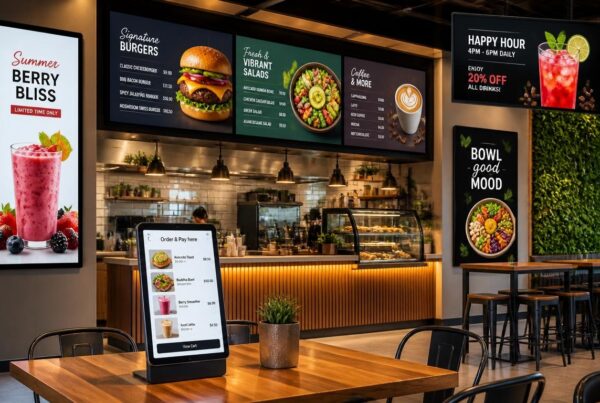
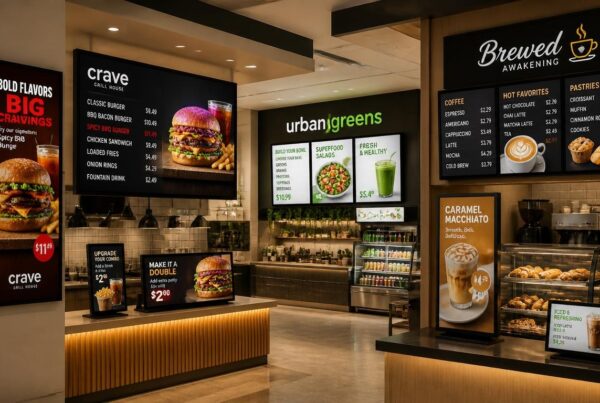
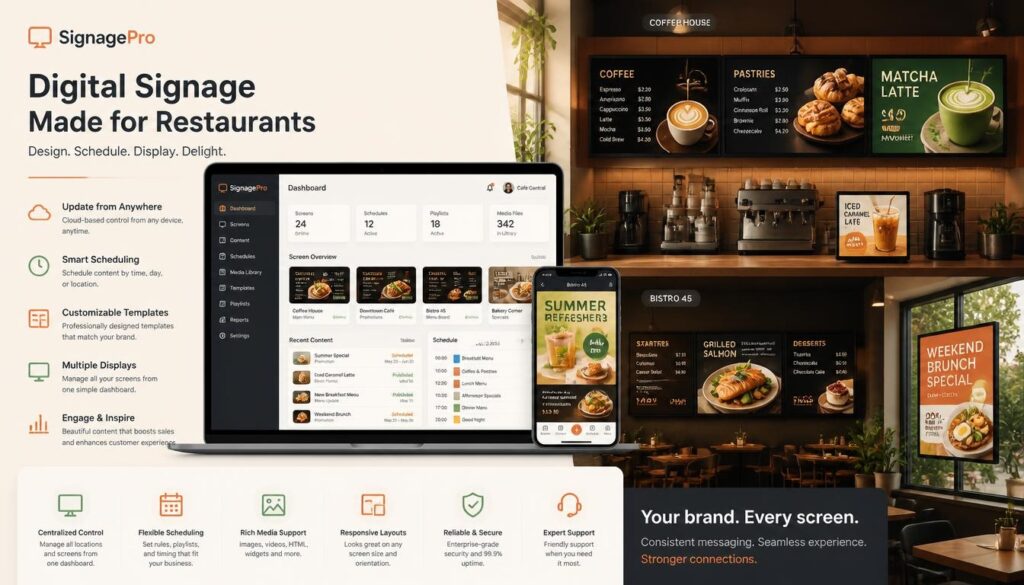
In a cafe, a digital signage e-display can be a screen above the counter, connected to a media player and menu-management software.
Bigger companies can interlink multiple screens at different sites.
From Static Screens to Smart Digital Signage
The early digital signage systems were used to show basic slideshow or video adverts in repetition.
There is much more that can be done by modern systems.
Using smart digital signage, companies can schedule content, arrange promotions, and integrate displays and supported external data sources.
An example is that a coffee shop can automatically change breakfast to lunch menus at a given time.
More sophisticated systems can use weather data to suggest promoting iced drinks or hot drinks.
These features are based upon the software and integrations one has, yet they demonstrate how digital signage has advanced to be more than a normal television display.
Why Does It Matter for Cafés?
Cafes are reliant on fast communication.
Customers should be able to see what is on offer, check drink sizes and prices, and decide whether to add anything extra.
The confusing menu may slow that process.
Digital signage will assist owners to provide information in a clear manner and make modifications without substituting the physical signs.
It can also provide a more coordinated look, especially when a similar design is used across multiple screens.
That flexibility can be handy in the case of a cafe that has to deal with daily specials, alterations in stock availability, and seasonal goods.
Is Digital Signage Worth the Investment?
When you look up digital signage news today, you may find discussions of AI-assisted content, connected menu boards, interactive ordering, and cloud-based management.
Such advances are intriguing, though they do not necessarily make any digital signage installation profitable.
The actual issue is whether a given system will resolve issues that will cost the café time or money.
A company that reprints menus frequently can possibly save on the cost of printing.
Another cafe may benefit from faster updates or the ability to coordinate offers across multiple locations.
The possible payoff will be based on the utilization of the displays, rather than on the technology.
Key Benefits of E-Signage for Restaurants and Cafés
The technology behind digital signage is not as important as the practical benefits of digital signage to many café owners.
The system must simplify the management of menus, make them easier to comprehend for the customers, and minimize redundant work.
Instant Menu Updates
Think about a bakery cafe, which runs out of almond croissants by lunchtime.
The item can be left on the board, with a printed menu, until it is changed by someone. Employees then have to repeatedly explain that it is out of stock.
Using a digital menu, the manager can update the display and either remove the item or mark it as sold out.
The same is the case with price variations, new products, and short-time promotions.
In the case of cafes that switch over their offerings, this saves time and helps to avoid confusion.
More Attractive Product Display
Food and beverage products are visual products.
A customer will go to a cafe and have intentions of ordering a regular coffee but will see a photograph of a seasonal iced latte on the menu screen.
An image in a strategic position can help customers notice that product.
Digital signage gives companies the ability to employ high-resolution photography, brief video clips, and slight animations to emphasize items of choice.
The trick is to be moderate.
With a screen full of moving images and competing offers, it can be hard to read.
The right digital signage templates will have a balance between appealing visuals and proper product names, prices, and categories.
To illustrate, a cafe could use a large portion of the screen to show its regular menu and only a small portion to showcase one of the drinks of the season.
Simpler Control Over Sites
Operating a single cafe is challenging. Managing multiple locations brings additional challenges.
Branches may vary in terms of prices, promotions, and brand presentation unless there is someone to coordinate the changes.
Using digital signage remote management, users can remotely update connected displays using a central dashboard.
A cafe group might work out a seasonal campaign and distribute it throughout the chosen areas without sending new posters to each branch.
Local alterations can also be allowed in individual stores when it is necessary.
This will assist in ensuring consistency and also minimizing redundant administrative tasks.
Reduced Printing Costs
There are recurring costs to printed menus.
New materials might be required in a café every time the prices fluctuate, new seasonal beverages come, or there is a special promotion.
Digital signage will minimize such replacements.
It, however, adds other costs such as screens, subscriptions to the software, electricity, and maintenance.
The economic value depends on how the costs of digital signage compare with the cafe’s current printing and design expenses.
As an example, a cafe that reprints the menu only once a year can save comparably small amounts of money on printing.
A cafe that frequently changes menus, advertising posters, and seasonal deals will have more chances to save those expenses.
Measuring the Savings
A simple comparison can help café owners evaluate the investment.
| Cost or Benefit | Printed Menus | E-Signage |
| Menu changes | May require reprinting | Managed digitally |
| Seasonal promotions | New posters or inserts | Scheduled content |
| Multi-location updates | Physical coordination | Centralized publishing |
| Initial equipment expense | Generally lower | Screens and player hardware |
| Ongoing costs | Printing and replacement | Software, electricity, maintenance |
| Product photography and video | Limited by print format | Can be changed and scheduled |
To estimate the financial benefit, compare the costs of each option over the same period.
Begin with printing and design costs (annual). Next, think of the time that employees use to switch materials.
In the case of digital signage, the initial hardware cost, software subscriptions, installation, electricity, and maintenance should be included.
The costs should also be compared over a realistic period that takes into account the expected life of the equipment.
The payback period is not universal, but this method assists owners to make a decision depending on their own business.
See how much you can save and earn. Request a demo with Nento to calculate your ROI.
Leveraging E-Signage to Boost Sales and Engagement
Digital signage is not merely a substitute for printed menus.
It is also capable of assisting cafes to display products better and inform their customers at various stages when they are visiting.
Menu Boards That Encourage Additional Purchases
A customer ordering a cappuccino might consider adding a pastry after seeing a picture of a fresh croissant next to it.
That is what menu-based upselling is all about.
Digital screens can be used by cafes to showcase combinations, high-end drinks, desserts, and specials.
For example:
- Cappuccino with a butter croissant
- Iced latte with a chocolate brownie
- Breakfast sandwich with fresh orange juice
- Seasonal coffee with a slice of cake
These combinations may be presented in addition to the usual menu without the staff having to state all the offers.
Nevertheless, displaying a promotion does not necessarily lead to a sale. The product, its price, and customer demand still matter.
One advantage of digital signage for hospitality is that cafes can test different offers and make changes without reprinting promotional materials.
Promotions That Match the Time of Day
Not all products are as relevant during the day.
Morning patrons might be interested in coffee and breakfast pastries. Visitors in the afternoon might be more attracted to iced drinks, desserts or light snacks.
Using planned e-signage messages, cafes will be able to modify their advertising messages.
An example of this is a screen may show:
Morning: Fresh coffee and breakfast options.
Afternoon: Pastry and ice drinks specials.
Evening: Hot chocolate, desserts and takeaway offers.
This is referred to as dayparting.
It also makes the displayed content more relevant without someone having to change the menu manually.
Offers With Limited Time, No Additional Printing
Digital signage is particularly appropriate to seasonal products.
A cafe could offer pumpkin-flavored beverages in the fall, festive desserts during the holidays, or cold drinks in summer.
Staff can choose a template and update the details to schedule the campaign without having to create a new poster each time they need to promote something.
If an expiration time has been scheduled, the promotion can be removed automatically when the offer ends.
This will ensure that old promotions are not up on display.
Making the Wait More Comfortable
Waiting is part of the cafe experience, especially during busy mornings.
A computer screen next to the counter could be a good source of information as the customer waits to have his or her order fulfilled.
It could be short videos on how to prepare coffee, events, loyalty, or pick up updates.
There is also a chance that a cafe would have trivia or news that one would find interesting.
Interesting material can make the wait experience more enjoyable, but does not necessarily help decrease the real time that is taken to make an order.
The most helpful screens are those that provide useful information, including order status and pickup details.
The Tech Behind the Scenes: Software and Management
One of the parts of the system is a digital menu screen.
The software determines how easily staff can create content, modify prices, schedule promotions and manage displays.
The selection of the appropriate platform is of special importance to cafes lacking specific technical employees.
What to Look for in E Display Digital Signage Software
The routine tasks should be made easy with the use of good e display digital signage software.
Menus should be updated by the owner and managers without complex design processes.
Useful features include a content editor, scheduling, reusable templates, remote publishing and multi-screen management.
User permissions and centralized management are also useful to cafes that have multiple branches.
This is aimed at cutting down work and not implementing another system that the employees are not familiar with.
Content Management Systems
A content management system, also known as a CMS, is the platform that is used to arrange and publish screen content.
With the CMS, the cafe managers will be able to post photos of their products, update menu details, design playlists, and organize promotion campaigns.
As an example, a weekend special can be prepared on Thursday and set to automatically appear on a Saturday morning.
This is more practical than having employees remember every content change.
Why Templates Matter
Not all cafes have a graphic designer.
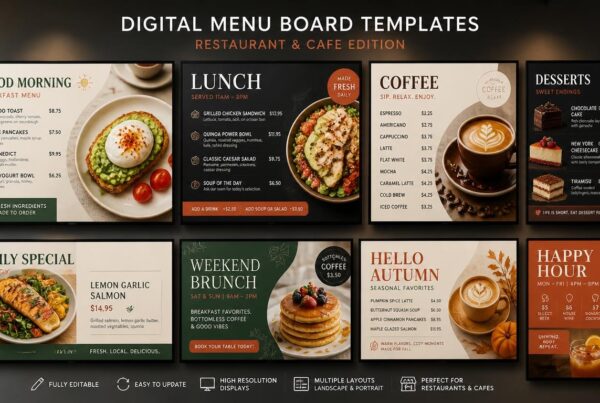
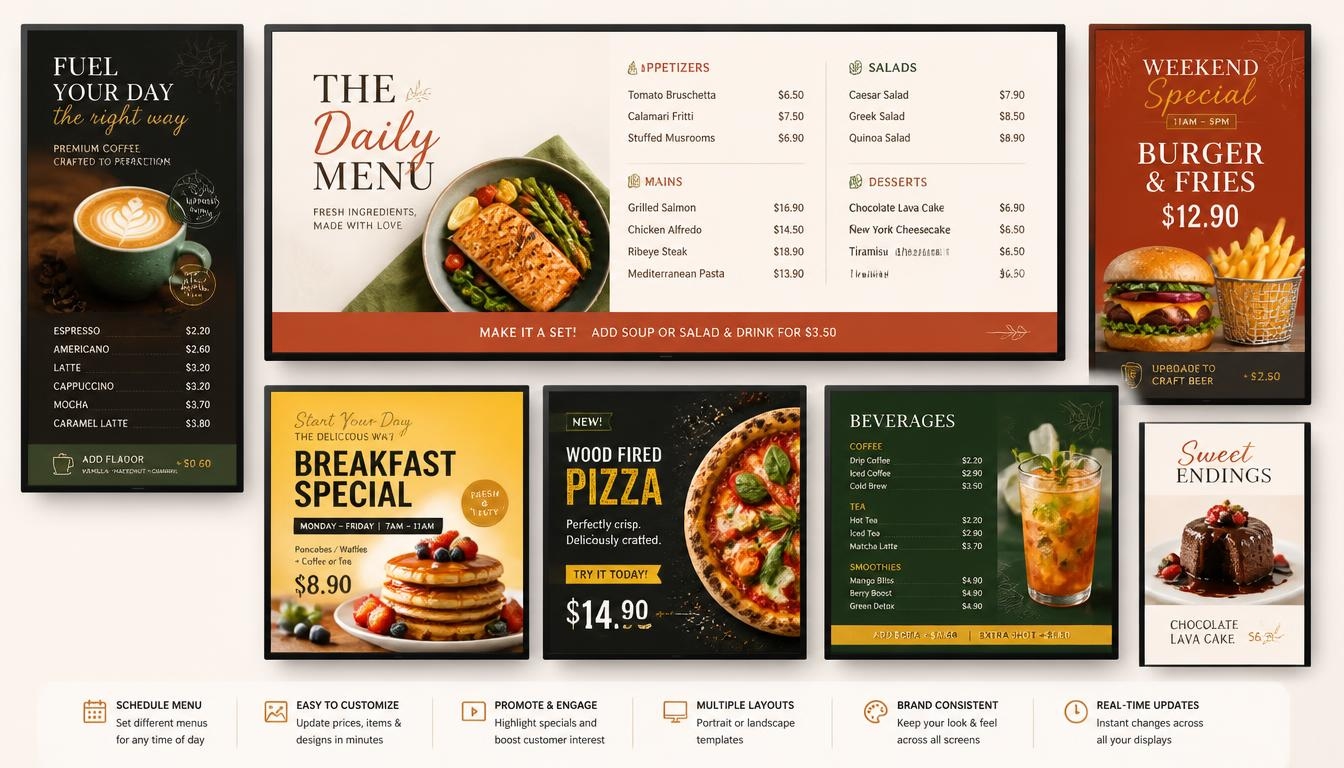
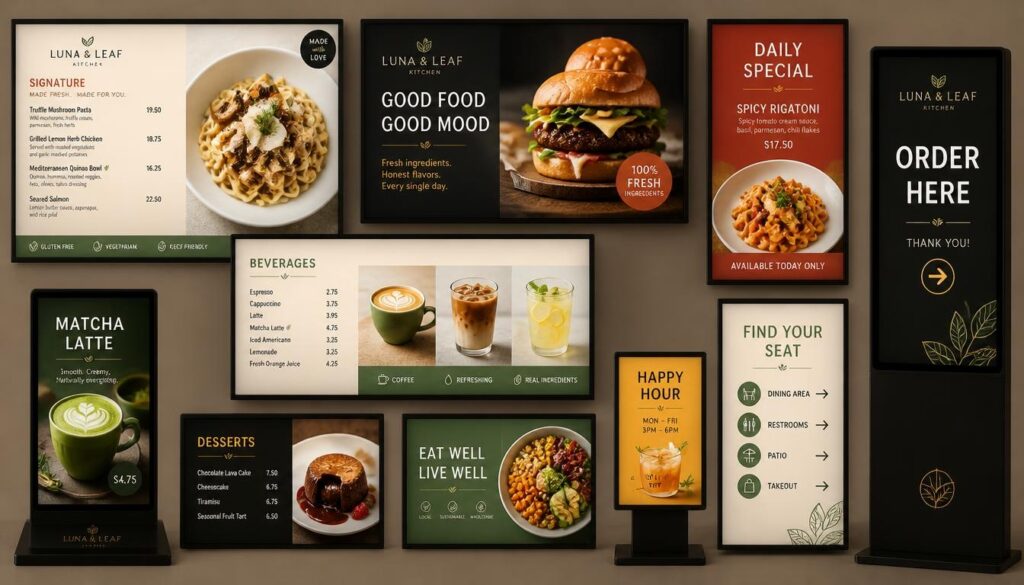
With digital signage templates, it is easier to create professional-looking displays without designing everything from scratch.
A template can contain an area of menu categories, price, photos, logos, and promotional text.
The staff is able to substitute the information without altering the overall design.
In the case of a tiny coffee shop, this could be having a single menu format with a change in the seasonal beverages.
In the case of a chain of cafes, a common set of templates can be used to maintain the branding across the stores.
Nento offers businesses customizable menu templates, drag-and-drop design tools so that they can manage their content without having to create every graphic by hand.
Remote Screen Management
Digital signage remote control enables companies to update the attached screens without necessarily having to access the screens.
The cloud-based platform allows a manager who is not present at the location to publish a new promotion, make corrections or update a menu.
Some systems also show device status and warn users when a player is offline.
The capabilities of remote troubleshooting are different by each provider, and businesses need to ensure that they know what problems can be addressed using software and what maintenance is necessary.
What Happens When the Internet Goes Down?
This is a significant question to any café that is using screens as its primary menu.
Some signage players store downloaded content locally for offline playback.
The menu that was posted earlier might still be displayed, in case the internet connection is temporarily unavailable.
Nevertheless, remote updates and live online information may be unavailable until the connection is restored.
Nento writes about offline playback support of compatible player configurations, which is why it is worth considering this option when selecting the hardware and software solution.
Digital Signage Trends Shaping the Café Industry
Digital signage is increasingly getting intertwined with other technologies in restaurants.
The trends in digital signage today are convenience, automation, interactive experiences, and relevance of the screen content.
In the case of cafes, the developments that enhance the daily activities without complicating the customer experience are the most useful developments.
Contactless Ordering and QR Codes
A QR code can be displayed on a digital display, which links the customer to an online menu, an online ordering page or a loyalty program.
As an example, a cafe could display a QR code that customers can scan while waiting to join its rewards program.
There is another screen which could give a connection to online ordering to the takeaway customers.
These features will be handy when they provide real convenience.
Nevertheless, QR codes should not replace every other method of accessing the menu. Customers should still be able to place orders at the counter.
AI-Assisted Menu Promotions
Artificial intelligence can be used to assist businesses in determining the products to advertise depending on the sales pattern, time of the day or any other data.
Sales data can be used to determine what drinks are popular in the afternoon or what combinations are popular in the season in a cafe.
More sophisticated systems can be linked up with inventory and weather data to modify promotional content.
As an illustration, an automated campaign could have iced coffee in hot weather and warm drinks in cold weather.
These characteristics demand appropriate software, dependable data and integrations.
Staff should also review these recommendations to ensure that prices and availability information are correct.
More Interrelated Menu Systems
Smart digital signage is now being thought of in conjunction with POS systems, ordering systems and inventory management.
In cases where there are compatible integrations, a cafe can potentially maintain consistency in prices and product availability across systems.
If an item goes out of stock, a compatible linked workflow may update the digital menu.
Such possibilities are based on the software and integrations chosen.
Not all digital signage systems can automatically interact with an existing POS system of the cafe.
Going Greener and Reducing Paper
Electronic signage can be used to minimize the use of promotional materials that have to be printed frequently.
This can be useful to cafes, which have regular seasonal deals or fluctuating menu prices.
But digital displays also consume electricity and may eventually need replacement.
Responsible practices comprise energy-saving devices, proper screen brightness, predetermined working time, and proper disposal of electronic waste.
The added value of the system to the environment is based on the entire lifecycle of the system and not merely on the substitution of paper with screens.
Best Practices for Implementing E-Signage in Your Café
The effectiveness of digital signage installation relies on the suitability of the screens in the space of the cafe and its daily activities.
A plain, conveniently placed display can be more effective than a big one with an overload of information.
Choose the Right Screen Placement
The menu should be visible to the customers in their natural position.
The most common way of doing this in most counter-service cafes is to place the main menu above or close to the order area.
Smaller advertising boards can also be a good idea near entrances, in waiting areas and beside pastry displays.
Take into account the viewing distance, screen height, lighting, and reflections prior to installation.
The brightness of a screen or the position of the screen can be changed to ensure that the display is legible.
Make Content of Menus Simple
A digital menu cannot be regarded as a brochure.
Customers should be able to find product names, prices and categories quickly.
Have large fonts, good contrast and spacing between sections.
Do not put long descriptions or excessive number of photographs on a single screen.
The short animations can be used to emphasize a promoted product, but the standard menu must be easy to read.
Take High-Quality Food Photography
A bad picture can turn a good product into a bad product.
Use bright, well-illuminated pictures that are a true reflection of the food and beverages being sold.
A cafe does not require professional photography of all products, but it should have featured products that are shown regularly.
For example, a seasonal latte promotion could use one strong image instead of several smaller images competing for attention.
Develop a Basic Content Timetable
The unnecessary updates are minimized by a planned schedule.
A cafe may design a weekly content calendar that will include breakfast deals, lunch, and drinks of the season, and weekend offers.
The staff would then simply have to make modifications when prices, availability or any other details need to be taken into account.
This is especially handy in those businesses that have multiple locations.
Maintain the Screens Properly
Cafes may incorporate heat, dust, steam and the occasional splashes.
Screens should be placed away from unsuitable sources of heat or moisture and cleaned according to the manufacturer’s instructions.
Display equipment used commercially might be suitable in long hours of use, but the equipment should be selected to suit installation conditions.
The employees are also to learn how to check whether the menu is showing properly, and whom to call in case of a technical issue.
Test the System to See Whether It Is Functioning
Once digital signage has been installed, monitor its effectiveness in providing desired benefits.
The measures that are useful are printing costs, time wasted in updating menus, average order value, sales of featured product and customer feedback.
These measures can be compared over time, helping owners evaluate the content and decide whether promotions need improvement.
Having beautiful screens is not the point. It is in order to make them useful to the business.

Frequently Asked Questions
What Is the Difference Between E-Signage and a Regular TV?
An ordinary TV is mainly intended to show entertainment or related media.
E-signage is a business presentation system that involves the appropriate hardware and e signage software to control menus, promotional materials and information.
The software enables users to schedule playlists, remotely update content and control multiple screens.
Certain televisions may be used as digital signage screens with the aid of appropriate software or media players.
Can I Update the Menu During Business Hours?
Yes.
Authorized users can use cloud-based digital signage remote management to edit prices, change photographs, remove sold-out items and publish promotions during business hours.
It is possible to make updates using a compatible computer or mobile device.
The duration it takes to see the changes is determined by the software, network connection and setup of the players.
How Much Does It Cost to Start Using Digital Menu Signage?
The price will be based on how many screens, quality of display, media players, installation, and licensing of software.
A small cafe can start with a single display and grow in the future.
A cost comparison should include equipment, software subscriptions, electricity and maintenance.
Digital signage would help save on printing costs, although the actual costs and outcomes of the cafe would determine whether or not it is worth the investment.
Do I Need Technical Skills to Use E-Signage?
Not necessarily.
Modern e signage software usually includes simple editors, templates and scheduling features.
Nento offers drag-and-drop content editing and customizable menu templates for cafes.
Basic training is sufficient to allow staff to manage most of the routine updates, but installation and more complicated integrations might need technical support.
How Do I Find the Latest Digital Signage Trends?
You may subscribe to industry magazines, manufacturer news, and well-known digital signage vendors.
To follow digital signage news today, focus on updates relevant to your business, including cloud management, interactive ordering, menu automation and compatible POS integrations.
Other articles about restaurant signage, menu boards, and the new trends in digital signage can also be found in the blog of Nento.
Conclusion
E-signage provides cafes with a more dynamic means of displaying menus, promotions and interacting with their customers.
Rather than printing materials every time the prices or products are modified, businesses can refresh their screens using software.
The benefits go beyond convenience.
Digital menu boards can highlight seasonal beverages, promote selected food items and help customers find information more easily. It is also easy to have similar menus in multiple locations due to centralized management.
Nevertheless, the technology is best when it is used to address a business issue.
One well-developed menu screen can be used in a small cafe, whereas a larger chain can require several displays that are linked together and have the central content management.
The most effective method would be to choose reliable hardware, develop straightforward content and select software that employees feel comfortable using.
With the right setup, digital signage can reduce repetitive work and make the cafe experience more appealing and convenient.
Don’t get left behind. Partner with Nento today and bring your restaurant’s walls to life with the power of digital signage.