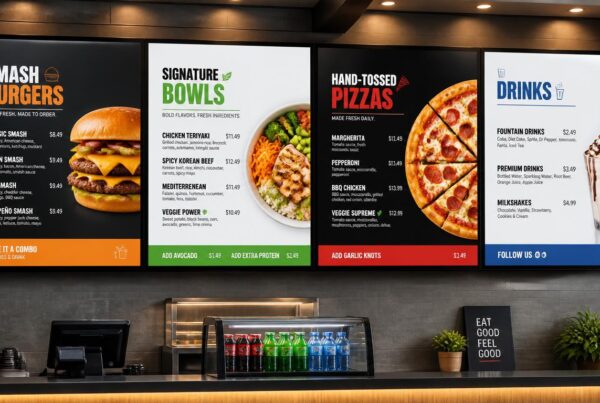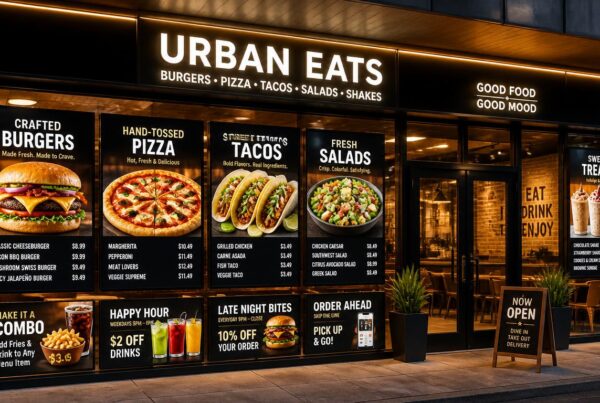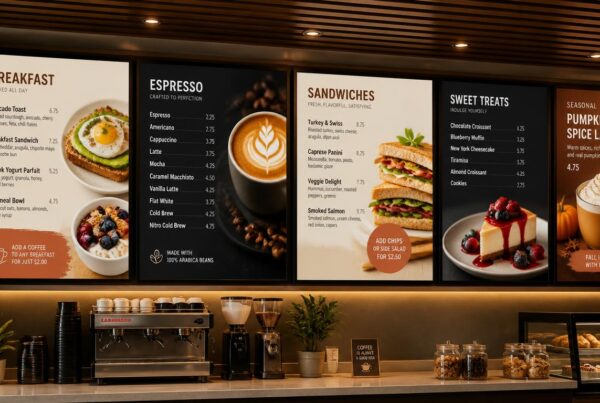
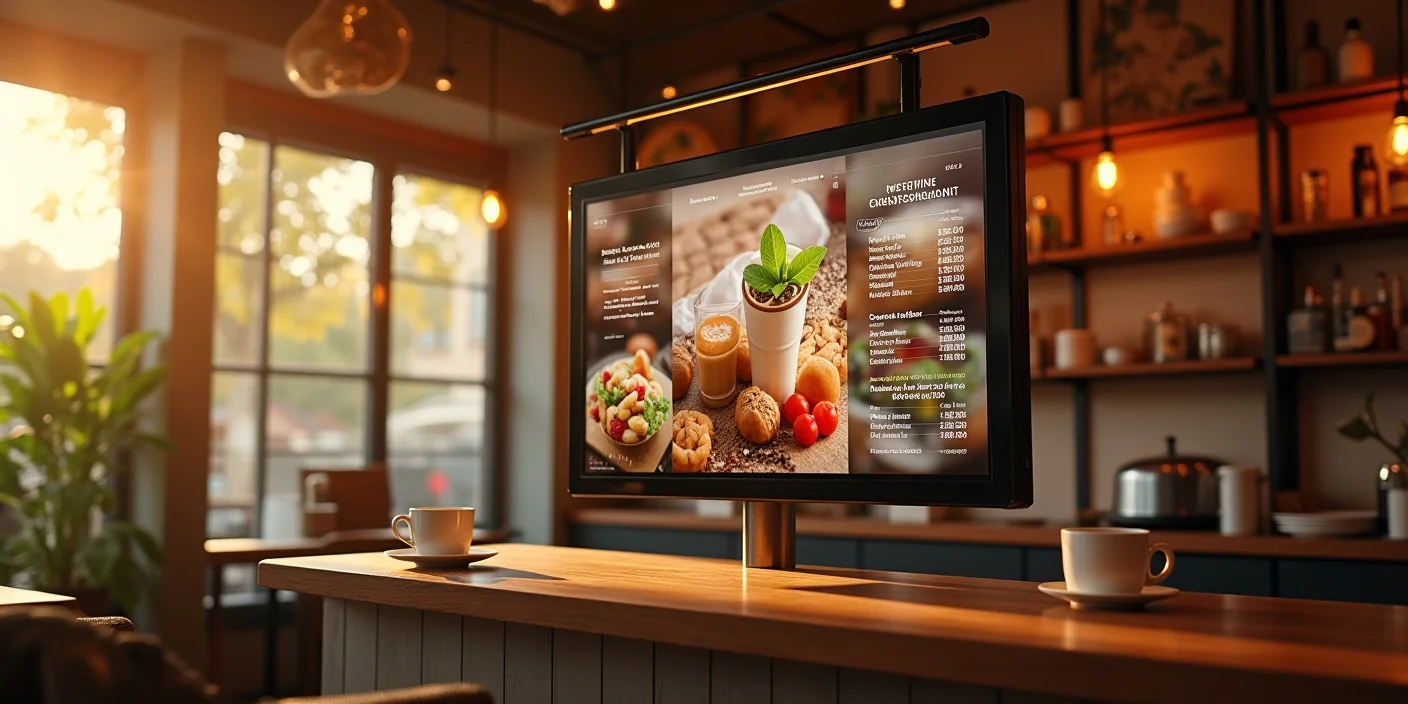
Introduction
When a customer is viewing your menu, every second counts. When they are unable to scan fast, comprehend prices in a moment, and identify what is worth ordering, they hesitate—and hesitation slows lines and reduces add-ons.
“A menu board is only effective if it helps people decide fast.”
Commercial menu boards are designed for high-traffic business settings where durability, readability, and speed of updating are important. They are not ordinary signage since they are designed to be in constant use, can be read under harsh lighting conditions, and change without the need to reprint.
Outdated boards confuse customers, cause pricing conflicts, and reduce profits when your highest-margin products fail to shine. The answer lies in strategic restaurant menu board ideas that are a blend of design and psychology—so your menu board is a sales tool and not a list.
Nento assists in making that transition by transforming fixed menus into dynamic, measurable digital signage that is simple to update and is designed to sell.
See how Nento can transform your menu board. Start a free trial.
What Is a Menu Board?
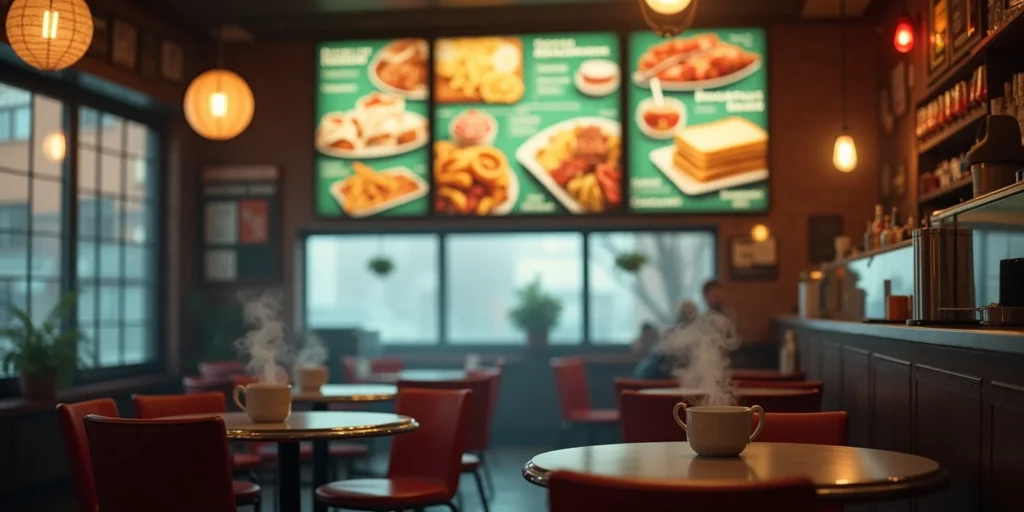
A menu board is not a list, but rather a purchasing decision engine. It guides customers to decisions through attention control, easy comparisons, clear pricing, and scannable categories that can be scanned easily.
Types of business menu boards
There are three types of business menu boards:
- Static (chalk, acrylic, lightbox): cheap, but slow to change and inconsistent across locations.
- Digital (LED, LCD): quicker changes, more visibility, and greater control over what customers are attracted to initially.
- Self-service kiosk integration: enables customers to browse and make orders without counter friction and enhance accuracy.
Store menu boards vs. restaurant boards
Store menu boards and retail menu boards tend to emphasize product discovery and price anchoring as well as promotions close to the point of sale. The boards in the restaurants should not only do that but also assist in speed and clarity in the ordering process, where the customer is given seconds to make a decision, not minutes.
“Retail boards can browse; restaurant boards must convert.”
7 Restaurant Menu Board Ideas That Increase Sales
1. The Eye-Track Layout
Menus are scanned in predetermined areas by customers. Locate profitable products in the first-scan locations (top-left, center, and top-right based on layout). Don’t bury your highest-margin items under long lists—have them be the first thing that the eye catches.
2. Remove Dollar Signs
Removing $ can make spending feel less painful and more item-focused. Display prices in a neat, consistent, and clutter-free way that does not evoke price sensitivity.
3. Use Visual Cues (Icons, boxes, emojis)
Visual cues reduce thinking time. Spicy, popular, vegetarian or new icons can also be used to enable customers to filter and make decisions faster, particularly in busy QSR settings.
“Less reading equals faster ordering.”
4. Daily Specials + Expiration Timers
Urgency is effective when it is believable. Daily specials, limited time, countdown-type timers, and other offers compel customers to buy today rather than next time. This is one of the biggest digital advantages since it is difficult to undertake regularly using fixed boards.
5. Combo Meal Highlighting
Combos enhance the average order value since they package choices. Make your combo structure easy to read and visually prominent, and place add-on prompts next to the combo block (drinks, sides, and upgrades).
6. Dietary Filters (Vegan, Gluten-Free)
Food indicators foster confidence and speed up decisions for guests with dietary needs. Clearly defined filters will decrease menu anxiety and decrease staff inquiries, particularly during peak times.
7. Social Proof Badges (“Chef’s Choice,” “Bestseller”)
Social proof makes decision-making easier. When a customer is not sure, a badge of a ‘Bestseller’ or ‘Chef’s Choice’ is a recommendation—it guides the customer to the items that perform well without being pushy in terms of sales.
Cafe vs. Quick Service vs. Retail: Industry-Specific Ideas
A. Cafe Menu Board Ideas
The best cafe menu board ideas include those that are warm, seasonal, and scan-friendly. Digital templates in the form of chalk keep a handwritten feel without the need for rewriting. Changing seasonal beverages makes the menu dynamic, and warm vs. cool color psychology can be used to affect a decision: warm drinks in winter when people need comfort and cool beverages in summer when people want refreshing.
B. Menu Boards for Restaurants (Full service)
Multi-column category layouts, such as appetizers, mains, desserts, and beverages, are often useful on full-service restaurant menu boards. Upsell banners such as “Add a side” would be effective only when they are placed beside the mains and not at the bottom of the board where the customers stop scanning.
C. Retail & Store Menu Boards
Price anchoring techniques (presenting the premium option first) and the addition of a loyalty program where the next step is obvious are beneficial to retail and store menu boards. Basic QR reminders and price comparisons of members can boost checkout.
D. Commercial Digital Menu Boards
Digital menu boards are more likely to be effective compared to the traditional boards since they are capable of updating instantly and indicate the right products at the appropriate moment. Real-time inventory and price updates ensure that there are no customer disputes caused by lost trust, and time-based scheduling ensures that the dayparts are the same regardless of the shift.
Nento makes switching to digital effortless. Get a free demo.
Why Go Digital? Benefits of Digital Menu Board Commercial Solutions
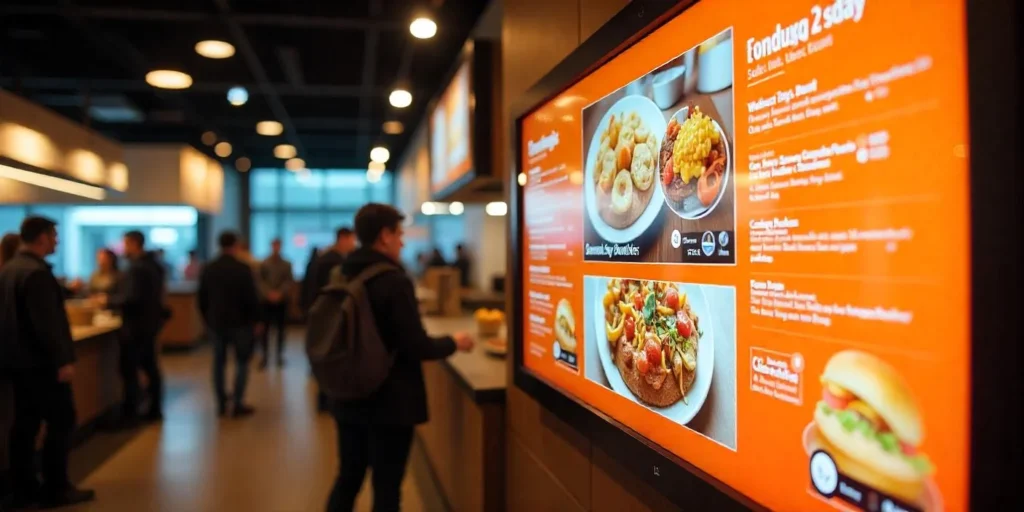
A commercial digital menu board system is built for high-volume operations.
- Quick menu updates (no reprinting expenses)
- Automatically schedule breakfast/lunch/happy hour.
- Connect to the POS for dynamic pricing.
- Include motion graphics and video to attract attention.
- Monitor item performance with data-driven menus.
The greatest advantage is that it allows control over operations: the menu remains up-to-date and consistent across all locations but does not require manual updates.
“Digital boards don’t just display—they execute your strategy.”
Join 5,000+ businesses using Nento. See pricing.
Restaurant Menu Advertising: How Your Board Becomes a Silent Seller
Psychological triggers that sell
The best restaurant menu advertisements employ less obvious psychology: scarcity (limited time), anchoring (premium option first), and decoy (making the desired option seem the best value). These are most effective when used consciously and regularly.
Cross-selling techniques
Visual cross-selling is the least challenging. Suggestions such as eating your meal next to the mains add on without the staff needing to recall scripts.
White space and the 3-second rule
White space isn’t wasted space; it is the reason that scanning is possible. Test your board with the 3-second rule: Do customers find what they want in 3 seconds? Otherwise, you should have fewer, more obvious categories or greater hierarchy.
“If customers can’t find it, they won’t buy it.”
Common Mistakes to Avoid with Business Menu Boards
Having too many products leads to slower lines and choice paralysis. The lack of contrast makes text hard to read at a normal distance. The boards without a hero item fail because they do not have anything special, and the old pricing or sold-out items create immediate mistrust. Such errors cost more than they appear since they have impacts on speed and satisfaction.
Frequently Asked Questions (FAQs)
What is the difference between a menu board and a digital menu board?
A typical menu board is a non-portable paper/plastic one. A digital menu board is a display board that has screens (LCD/LED) to display dynamic and changeable information.
How much do commercial menu boards cost?
Prices often range from $200 to $2,000 per screen and software. Nento has cheap cloud-based services with pricing that varies by plan and screen count.
Can I use digital menu boards for a small cafe?
Yes. Sales can be increased even with 1-2 screens. Ideas such as rotating specials on the cafe menu board are great options.
What is the best software for restaurant menu board ideas?
Nento offers convenient drag-and-drop templates, time schedules, and live updates; no code required.
How do digital menu boards help with restaurant menu advertising?
Motion graphics can be used to advertise LTOs (limited-time offers), upsells, and combos, whereas this is not possible with motion graphics on a static board.
Are digital menu boards for restaurants worth the investment?
Yes. ROI is achieved after 6-12 months by most businesses in the form of increased AOV and lower printing expenses.
How Nento Simplifies Commercial Digital Menu Boards
Nento makes going digital practical:
- Quick installation: Use the TVs that are available or select Nento-approved displays.
- Cloud-based control: Control all locations on a single dashboard.
- Templates: Designed to be used in cafes, restaurants, and retail menu boards.
- Integrations: POS, inventory, weather, social feeds.
- Customer care: 24/7 chat and free onboarding.
Stop losing sales to a static board. Start your 14-day free trial with Nento today. No credit card required.
Conclusion
The right commercial menu boards enhance speed, satisfaction, and expenditure because they help customers make quick and confident decisions. The most effective restaurant menu board designs are those that integrate psychology with digital flexibility in that your most profitable products will be seen and your advertisements will be updated.
Your cafe menu board ideas or complete commercial digital menu boards need to be fresh, quick, and easy to use: Nento keeps your board modern with templates, real-time updates, and centralized control that turns it into a sales tool.
Transform your menu boards now. Visit Nento to build your first digital menu in 10 minutes.