Introduction
A storefront may have only a few seconds to attract someone’s attention. Each day people pass restaurants, shopping malls, hotels, and retail outlets without even giving the printed posters that are usually attached to the outside a second glance.
Signs that are traditional may convey a message, but they are limited in one way: they are fixed in place so that once installed, the information remains constant until it is removed.
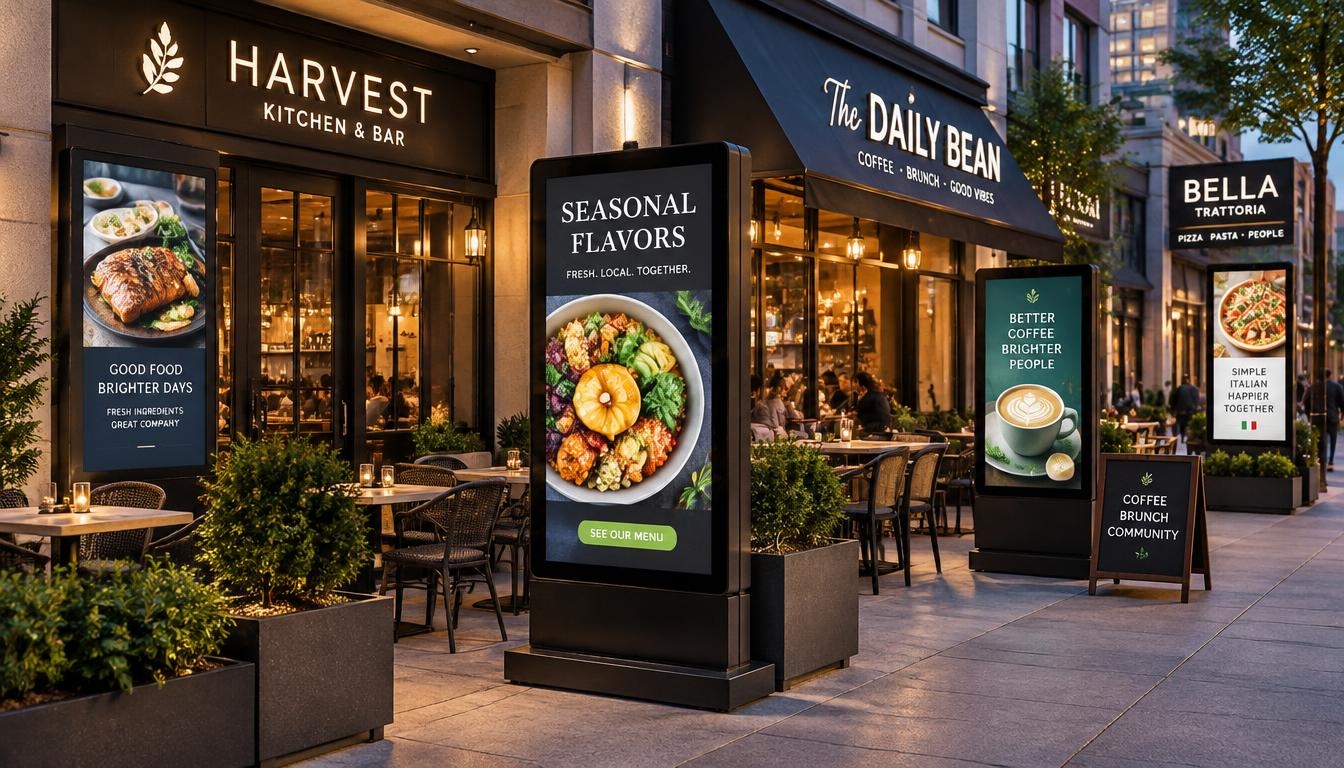
Commercial outdoor digital signage displays offer businesses a more flexible way to communicate with people beyond their walls.
Consider a restaurant that displays its breakfast menu in the morning, changes to lunch promotions at noon, and displays dinner specials in the evening. Or a shopping center with information about live events, directions, and promotion campaigns on screens that are not turned off during the day.
These are just some of the things that can be done by modern outdoor signage.
But it is not enough to install a television outside. Outdoor displays are exposed to direct sunlight, rain, dust, and temperature variations, which an average indoor device is not designed to withstand.
Businesses should also take into consideration the content management, placement of screens, cost of installation, and the kind of information that customers actually desire to be shown.
Whether it is huge outdoor LED display screens or small outdoor LCD monitors, the appropriate technology will vary according to the location of the display and what it will be required to convey.
This guide will explain how to select outdoor signage hardware, manage content, assess installation needs, and create campaigns that make the investment worthwhile.
Are you ready to upgrade your exterior branding? Contact Nento today for a consultation on the best hardware for your location.
Why Invest in Outdoor Digital Signage for Business?
Outdoor signage has never been insignificant in assisting businesses to attract customers and convey information.
The only difference is with the capability to update that information in a short period of time.
Rather than using fixed advertisements, companies can employ digital displays to display various messages at different times of the day.
Create Awareness in Busy Places
An outdoor screen placed in a strategic location can help a business stand out on a busy street or in an open shopping center.
For example, a bakery may display freshly made pastries on a screen close to its entrance. A clothing store might have a short video of its new lineup on display.
The flow and the shifting images provide a possibility to draw the eye of the passers-by.
That is one reason outdoor digital signage is used at storefronts, entertainment venues, and commercial properties.
But the visibility is not only determined by the screen.
Brightness on the display, viewing distance, image quality, placement, and content design are examples of features that determine whether the customers will perceive and interpret the message.
Change Promotions Without Replacing Signs
Electronic updating of content is one of the most feasible benefits of digital signage.
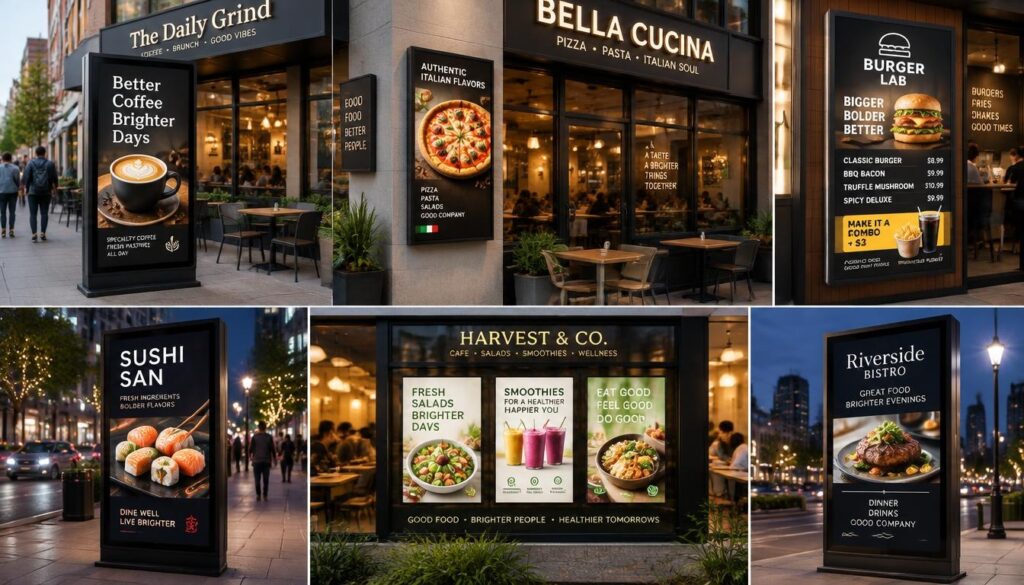
A restaurant will be able to alternate between breakfast and lunch promotions. A retailer may initiate a sale on the weekend. A hotel may publicize an event that is happening that evening.
These changes can be managed using compatible digital signage software.
Businesses do not have to print new materials and install them every time but can use the same display in many different campaigns.
Make Messages Relevant to the Moment
Outdoor signage is more applicable in cases where content is based on what the audience needs at that moment.
A coffee shop could promote cold drinks during a hot afternoon and hot drinks during colder seasons.
A shopping center may display information about parking in the high-traffic times or promote an event in the near future.
There are systems that can automatically change the content depending on time, weather, or related business information.
Such capabilities necessitate appropriate software and integrations, yet they show how flexible modern signage can be.
Enhance the Looks of Commercial Spaces
Outdoor screens may also be incorporated into a visual identity of a building.
A well-placed display can appear better organized than a number of posters stuck to windows or walls.
Outdoor signage displays are available in various sizes, shapes, and mounting options.
Others are built to be used in storefront windows, and others are built to use freestanding enclosures or huge building-mounted LED panels.
This should be aimed at supplementing the environment, rather than dominating it.
Want to see how dynamic content can boost your sales? Nento specializes in creating engaging strategies for outdoor environments.
Hardware Breakdown: Outdoor LED Display Screens vs. LCD Monitors
One of the major decisions in an outdoor signage project is to select the appropriate hardware.
There are two popular alternatives: direct-view LED displays and high-brightness LCD displays.
They both can provide appealing images, yet they work with various technologies and are applicable to different uses.
Outdoor LED Display Screens
A direct-view LED display uses an array of light-emitting diodes to form the image.
Instead of using a single, traditional television panel, large LED displays are often assembled out of smaller modules or cabinets.
This enables businesses to design big screens of various sizes.
This technology may appear on the front of shopping centers, event venues, stadiums, and roadside advertising displays.
Light and Sunshine Visibility
Outdoor LED displays have the potential to provide high brightness that is appropriate in difficult daylight.
As an example, LG releases outdoor direct-view LED products with brightness ratings of 5,000 nits, and other models have a brightness rating of 8,000 nits or higher.
These are not universal minimum requirements but manufacturer specifications.
The appropriate brightness is based on the place of installation, orientation of the screens, the ambient light, and the distance of viewing.
A display installed in a darker courtyard might require less brightness than a huge billboard in direct sunlight.
Understanding Pixel Pitch
Another specification is pixel pitch.
It refers to the distance between the centers of adjacent pixels, usually measured in millimeters.
A reduced pixel pitch typically permits more image detail with shorter viewing distances.
A bigger pixel pitch can be appropriate for displays that are going to be seen at a greater distance.
As an example, a big roadside display might not require the same amount of fine pixel pitch as an outdoor display that is near people.
The right pitch can assist businesses to save money on irrelevant resolution.
Lifespan and Maintenance
Outdoor LED displays are engineered to work over a long period, although the useful life of the product will vary depending on the product and the conditions.
Certain manufacturers even report lifetime ratings of 100,000 hours of certain LED models.
This does not mean that the whole display will not need any maintenance during the said time.
Performance can be impacted by brightness degradation, temperature, power supply failures, and maintenance of individual components.

Outdoor LCD Monitor Screens
A typical outdoor monitor screen uses an LED-backlit LCD panel.
Commercial LCDs with high brightness can provide images and text in detail, and so they can be used where the customers are relatively close to the display.
Common applications include:
• Drive-thru menu boards
• Outdoor directories
• Storefront displays
• Information kiosks
• Transportation information screens
LCD displays may be available as purpose-built commercial units for specific outdoor settings.
Indicatively, Samsung has already released outdoor LCD models with brightness ratings ranging between 2,500 and 4,000 nits, depending on the model.
Others have anti-reflection glass and auto-brightness.
Such characteristics may assist in keeping readable and controlling the brightness based on the conditions around.
Comparing Outdoor LED and LCD Displays
| Feature | Direct-View Outdoor LED | Outdoor Commercial LCD |
| Typical application | Large promotional screens, building displays, and event venues | Drive-thrus, directories, kiosks, storefronts |
| Screen size | Modular and suitable for very large installations | Usually available in defined panel sizes |
| Image detail | Depends heavily on pixel pitch. | Often suitable for detailed close-range text |
| Brightness | High-brightness models available for direct sunlight | High-brightness outdoor models available |
| Installation | Requires appropriate structure, power, and cabinet configuration | Integrated units or protective enclosures |
| Cost considerations | Module quantity, pixel pitch, structure, and maintenance | Panel size, brightness, enclosure, and installation |
Neither technology is automatically superior in every situation.
Direct-view LED can be a more suitable choice in the case of a big promotional display that is visible on the other side of a parking lot.
A reasonable outdoor LCD display might be a better solution to a drive-thru menu that is read over comparatively short distances.
Weatherproofing and IP Ratings
Electronics used outside must be resistant to dust and water.
An IP rating is a description of the ability of an enclosure to withstand the ingress of solid objects and water under prescribed test conditions.
To illustrate, IP65 implies that the enclosure is dust-tight and can resist jets of water.
Nevertheless, the IP65 does not necessarily imply that the equipment will be able to endure all outdoor conditions.
corrosion,It does not guarantee protection against excessive heat, cold conditions, ultraviolet light, corrosion or vandalism.
IP65 is not the only rating used outdoors. Some commercial outdoor LCD displays are rated IP56.
Never select equipment on a single rating and never compare equipment with other ratings without looking at the entire specifications of the environment.
Other Features to Consider
Anti-reflection or anti-glare protection, automatic brightness, appropriate thermal management, and impact-resistant front glass can also be applied to outdoor equipment.
The operating temperature of the display must be compatible with the climate in which it is installed.
Cooling or ventilation might be required in hot places to avoid overheating. Some enclosures might need heating or other temperature regulation in cold climates.
The most suitable outdoor digital display is one that integrates the right image performance and protection that fits its real-life environment.
Software and Content Strategy: Making Outdoor Screens Work
Strong display will only be beneficial when the content is up to date, legible and pertinent.
This is where digital signage display software is needed.
Rather than manually updating files on single monitors, companies can access a content management system that will enable them to store and publish information remotely.
What Does Digital Signage Software Do?
A content management system, also known as a CMS, is a system where authorized users can post images, videos, announcements, and promotional content.
It can also support playlists and schedules that determine when content is shown.
As an illustration, a restaurant chain may create a promotion on a weekend and schedule it on some outdoor displays of their choice.
If the content is scheduled, the system can automatically replace the campaign with the regular menu when it ends.
Businesses with multiple locations find this process easier with the help of cloud-based platforms.
Outdoor Digital Menu Boards
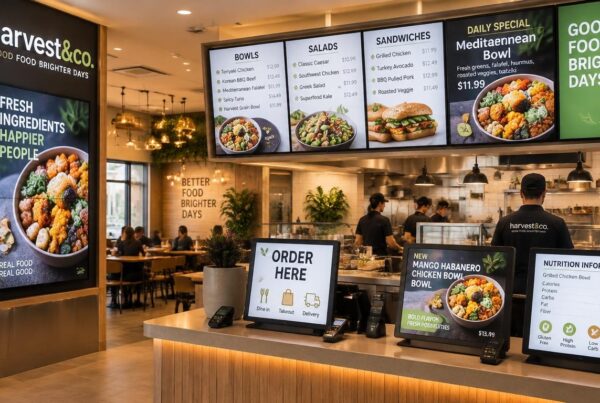
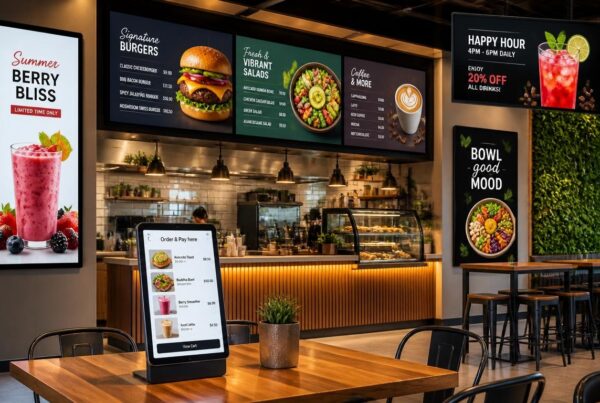
A digital signage menu board is especially handy for quick-service restaurants and drive-through systems.
It can display types of food, prices, meal deals, and specials.
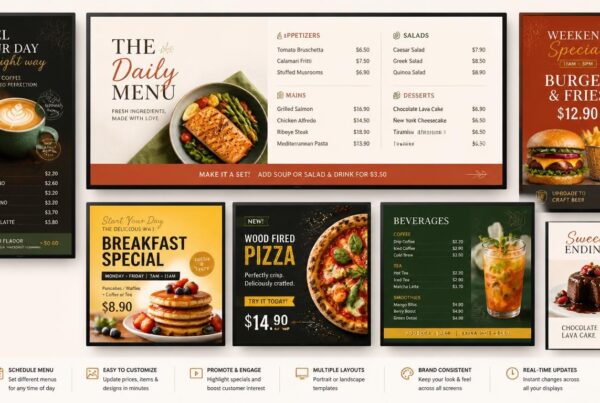
Instead of displaying the same information throughout the day, restaurants can schedule different menus.
For example:
| Time of Day | Suggested Content |
| Morning | Breakfast combinations and coffee |
| Afternoon | Lunch specials and meal upgrades |
| Evening | Dinner offers and family combinations |
| Selected promotional periods | Seasonal products and limited-time deals |
This approach, known as dayparting, makes the content more relevant without requiring employees to change the menu manually.
Good food photography can also assist customers to notice featured products.
Nevertheless, the main menu must be legible. Essential prices should not be hard to locate through the promotional video and animation.
Digital Signage Wayfinding
Marketing is not the only purpose of outdoor signage.
Digital signage wayfinding assists visitors in finding their way through large or complex environments.
Electronic directories can be used in shopping centers, hospitals, campuses, hotels and transport facilities to display the routes and key locations.
As an example, a huge shopping center can place a digital map close to the parking place.
It could be used by visitors to find entrances, restrooms, shops and restaurants.
Interactive wayfinding systems can also be used to enable users to search destinations on a touchscreen.
Such installations need appropriate software, accessible design and environmentally rated equipment.
Creating Content to Be Viewed Outdoors
Digital signage exterior content needs to be designed differently from a typical indoor presentation.
The individuals can look at the screen when walking, standing far or going through a congested place.
That is to say that messages must be concise and clear.
An effective outdoor promotional design could consist of one big product picture, a clear headline, the price or offer and a familiar brand logo.
Do not use crowded layouts, small fonts or multiple competing messages.
The high contrast is especially necessary when the screen is used during the changing daylight.
In the case of roadside displays, the content should also be in line with the local advertising and traffic-safety laws.
Control of Multiple Displays Remotely
The cloud-based signage system at Nento allows centralized scheduling of content, templates, remote updates and multi-location management.
This can assist businesses to organize campaigns without having to access each display manually.
Supported integrations may also allow content to use external data, but the exact capabilities should be checked for the intended setup.
Nento’s proprietary software makes managing your outdoor digital display network effortless. Book a demo to see it in action.
Applications of Outdoor Digital Signage
There are a lot of settings where outdoor digital signage is implemented, but the aim of each installation may vary.
There are businesses that desire to advertise products. Others should direct visitors or give them information which vary with the day.
When comparing outdoor digital signage solutions and commercial displays, it is useful to consider the intended application before choosing hardware.
Retail Storefronts
Outdoor screens and window displays can be used by retailers to feature seasonal collections, product releases, and time-limited promotions.
As an illustration, a clothing store may display a new collection on a screen facing the main shopping street.
A grocery store might advertise some of its weekend deals at its door.
The screen should be placed where customers can see the information without blocking entrances or causing unnecessary glare.
Transportation Facilities
Transport facilities like bus and train stations frequently have to convey dynamic information.
Service schedules, platform information, announcements, and directions can be shown on the digital screens.
In the case of availability of reliable data integrations, information may be updated based on the existing services.
Such systems need reliable hardware since individuals might base their trips on the information.
There should also be suitable fallback procedures in case of a display or network failure of critical public information.
Hotels and Hospitality Venues
Outdoor signage can be used to inform guests about events, direct them to the entrance, or market restaurants and other facilities in a hotel.
Displays can show upcoming performances, entry guidelines and visitor information at these venues.
An independent display close to the entrance would be a more flexible option as opposed to printing event posters on a regular basis.
Restaurants and Drive-Thrus
A very convenient use is in quick-service restaurants.
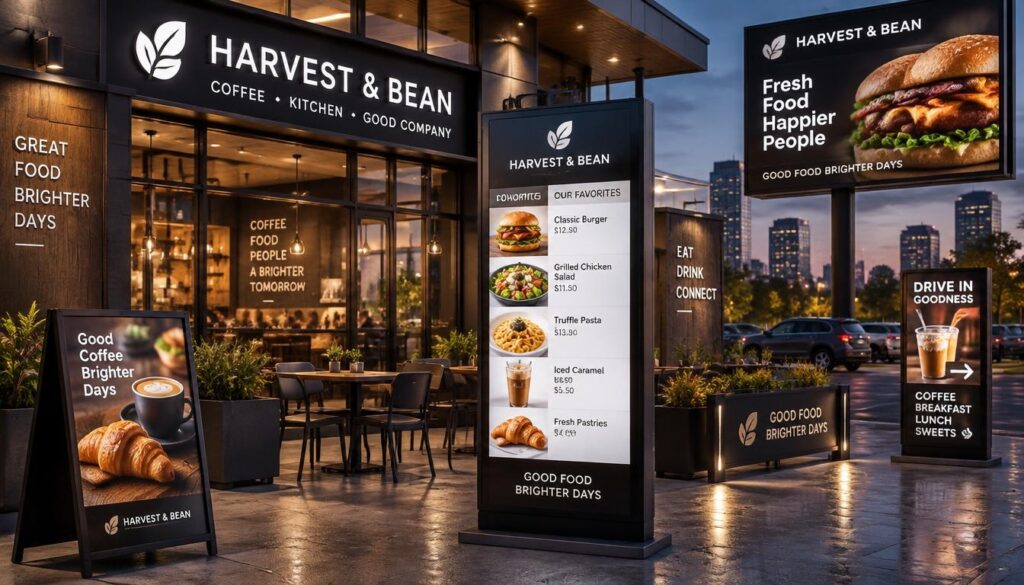
Outdoor digital signage menu board will allow displaying breakfast, lunch, and dinner menus based on the time of the day.
It is also possible to update prices, feature combinations, and delete unavailable products in the restaurants.
For drive-thrus, screen visibility, placement, viewing distance and playback reliability are particularly important.
The menu must be visible at the point of order and must be readable by the customers.
Large Commercial Properties and Campuses
Outdoor signage can be utilized in universities, business parks, hospitals, and shopping centers to provide directions, events, and navigation.
Advertising may not be as important as useful information in these environments.
As an illustration, a campus board could contain instructions to various buildings as well as vital messages.
Not sure which application fits your business? Nento’s experts will help you identify the highest-impact use cases for your outdoor digital signage solutions and commercial displays.
Choosing the Right Outdoor Digital Signage Solution
Businesses ought to put into consideration the environment, viewing conditions, content requirements, and overall ownership costs before they buy hardware.
The most expensive display is not necessarily the most suitable.
Evaluate Installation Environment
Begin by determining where the screen will be placed.
Will it be in the direct sunlight? Is it subjected to heavy rain, dust or snow or high temperatures? Would it be ruined due to accidental hits or vandalism?
These factors affect the brightness needed, enclosure, environmental rating, and cooling.
A display in a covered shopping mall parking lot might require a distinct arrangement than that of one next to an open road.
Adjust the Screen Size to the Viewing Distance
The screen size and resolution should depend on the targeted audience.
Customers who are near a drive-thru menu must be able to read product names and prices.
People viewing a promotional display from farther away might require bigger text and a different pixel pitch.
In the case of an outdoor monitor screen, what you see at the real viewing location should be tested instead of basing your image quality judgments on a brochure of the product.
Select Software That Can Be Managed by Your Team
Think about the frequency of the changes in the content.
A restaurant can require updates to the menu on a daily basis. A retail store may decide to switch campaigns each week. A university may require ongoing event and directory information.
These workflows merit the right software without any unneeded complexity.
The features that can be helpful are scheduling, templates, remote management, user permissions and monitoring of devices.
Centralized administration can prove especially useful in a multi-location business.
Compare Full Cost
The purchase price does not represent the complete investment.
Other expenses that should be budgeted by businesses include:
• Mounting structures and enclosures.
• Electrical installation and cabling.
• Media players and network connections
• Software subscriptions
• Content design
• Electricity consumption
• Maintenance and repairs
• Eventual component replacement
A comparison made in a realistic way should take into account several years of projected operation.
Verify Supplier Support
Enquire with the potential providers regarding installation support, environmental parameters, warranty, maintenance, and compatibility of the software.
Also ensure that you know what services are included in the quoted price.
Some packages include hardware and software, but installation or maintenance is charged separately.
Let Nento simplify the selection process. We provide end-to-end outdoor digital signage solutions and commercial displays tailored to your needs.
Installation and Maintenance Best Practices
Outdoor signs are subjected to conditions that indoor signs are not often exposed to.
An effective installation should consider structural stability, safe electrical connections, weather protection and maintenance in the long run.
Professional Installation Matters
Big outdoor LED panels as well as freestanding display enclosures may pose high loads on their support structures.
During installation, wind exposure and the mass of the equipment should be taken into consideration.
It is recommended that qualified installers consider the mounting requirements, electrical safety, grounding, cable protection, and local regulations.
Permits or other approvals may also be required, depending on the location.
Adequate installation helps to protect equipment and minimize threats to the surrounding population.
Check Weather Protection Every Now and Then
Outdoor enclosures rely on seals, cable glands, covers and other protective elements.
Over time, weather exposure or maintenance work can affect these components.
Frequent checkups can be used to detect damaged seals, loose connections, clogged vents or any other issues before they escalate.
The cleaning and inspection protocols are to be in accordance with the manufacturer.
Ensure Cooling and Ventilation Systems Are Operating
Bright screens produce heat when they are in use.
Other outdoor systems employ fans, heat exchangers, filters or other temperature control devices.
Blocked airflow can increase operating temperatures and affect performance.
Checks of cooling components where necessary should therefore be included in the maintenance plans.
Remote Monitoring of Screen Performance
Certain digital signage systems offer device-health monitoring.
Administrators may be alerted when a player stops reporting, loses network connectivity or has a playback issue.
Remote monitoring can save time required to identify technical problems.
Nevertheless, not all issues can be resolved remotely. Broken displays, power supply issues, and physical enclosure issues could also necessitate an on-site technician.
Keep Content Accurate
The information on the screen is also a part of the maintenance.
Offers that are out of date, wrong prices, and outdated routes may destroy the confidence of the customers.
Delegate the task of content review.
In the case of businesses that have multiple locations, it is possible to be consistent with scheduled campaigns and centralized approval workflows.
Nento provides installation support and continuous services of its signage solutions. Each project must have the precise coverage of maintenance and service arrangements.
Nento offers digital signage support, with installation and maintenance options depending on the project. Get in touch to discuss the support available for your displays.
Maximizing ROI With Outdoor Digital Displays
Outdoor signage is an investment in hardware, software, installation, and maintenance costs.
Businesses must quantify outcomes to be able to assess whether it is worthwhile instead of assuming that a bigger or brighter screen will automatically generate more revenue.
Track Relevant Business Metrics
The appropriate measurements are based on the intention of display.
A retailer could analyze the number of people walking and the sales of advertised goods.
A restaurant can monitor average order value, sales of featured items, and menu printing costs.
A mall might concentrate on revenue of advertisement or participation of visitors.
In the case of wayfinding installations, visitor feedback, questions related to navigation, or directory interactions are useful measures.
Check Foot Traffic
Foot traffic may be an informative background, yet it does not necessarily indicate that signage made customers enter a business.
Visitor numbers can be affected by other factors such as weather, holidays, seasonal demand, and events in the locality.
Businesses can contrast activity under various campaigns where appropriate analytics tools are in place.
Any audience measurement that involves cameras or sensors must adhere to any privacy requirements.
Test Different Messages
Businesses can use A/B testing to compare content.
An example is that a restaurant could run two promotional designs of the same meal combination.
One of them can be a product photograph, and another one has a shorter headline and price-oriented text.
The company might showcase both versions at similar times and compare corresponding sales data.
This is a better method than determining what design is most effective by just looking at it.
Link Outdoor Screens to Mobile Experiences
QR codes have the potential to enable the customer to get more information using their phones.
A hotel may display a QR code linking to an event schedule, while a restaurant may use one to direct pedestrians to an online menu.
Nevertheless, QR codes must be placed in locations that are safe and people can stop and scan them.
They cannot be used as an interaction method of drivers who pass through the traffic.
Take Advantage of Seasonal and Event-Based Campaigns
Digital signage is especially useful when it comes to year-round promotions that vary over time.
Retailers have the opportunity to plan holiday campaigns. Restaurants will be able to plan seasonal menus. The venues of events can refresh their displays with the announcement of new activities.
This flexibility can reduce the labor required to change physical advertisements.
Compute the Financial Return
A simple financial assessment compares the expected net benefit with the initial investment.
As an example, companies can determine the annual benefits of added contribution margin, saved printing costs, advertising revenue, and time.
Additional operating costs, such as software, electricity and maintenance, should then be deducted.
An approximate computation is:
Annual net benefit = Additional contribution margin + Operating cost savings + Advertising income − Additional annual operating costs
With the annual benefits reasonably stable, the outcome can be related to the initial investment to estimate a simple payback period.
These are estimates and not guaranteed results. Equipment replacement, taxes, and time value of money should also be properly factored in a proper financial assessment where applicable.
Ready to maximize your investment? Partner with Nento for data-driven outdoor digital signage strategies.
Future Trends in Commercial Outdoor Digital Signage Displays
The development of outdoor signage is still ongoing due to better display technology, software, and interconnected business systems.
The most helpful innovations are the ones that simplify the control of the screens, make them more interesting to the audience, or more appropriate to where they are installed.
Transparent LED Displays
Transparent LED technology enables pictures and visual effects to be seen on screens that still have some level of visibility through the screen.
They can be applicable in the case of chosen storefronts, building facades, and architectural installations.
For example, a retail store could place a transparent LED screen in a large window instead of covering the whole window with an opaque advertisement panel.
Transparency, brightness, resolution and viewing conditions however differ across products.
The installation should be evaluated to ensure that the content is not obscured.
AI-Assisted Content Selection
AI can assist companies to determine what messages to show depending on sales data, weather, time of the day or other contextual factors.
A restaurant might use inventory information to stop promoting out-of-stock products.
As a retailer, one can change promotions based on the seasonal demand.
Further audience analysis can also be achievable, although systems which gather or deduce information about people raise privacy concerns.
Contextual content depending on time, weather and product availability is a less complicated starting point to many businesses.
Solar-Powered Outdoor Displays
Another area of interest is solar-powered signage, especially where the access to electrical infrastructure is challenging.
An appropriate solar system can consist of photovoltaic panels, power storage, power control devices and a display that is tailored to the supply of power.
Nonetheless, outdoor screens operating at a high brightness may consume a lot of electricity.
Companies must not think that a typical solar panel can power up a large outdoor LED display all the time.
The calculations of energy requirements should be done in accordance with the screen consumption, hours of operation, amount of sunlight at different seasons and storage capacity.
Interactive Outdoor Kiosks
Touchscreen kiosks are able to offer more than displaying advertisements.
They can be used by the visitors to find the places, look into the directories, see maps or use services.
There may be an outdoor wayfinding kiosk that would assist a person to find a shop in a big business building.
The systems must have appropriate touch-enabled hardware, environmental protection, user-friendly interfaces and stable software.
Smart Power and Brightness Control
Outdoor displays can be provided with automatic brightness control to enable them to vary in intensity based on the light levels around them.
A screen might require a lot of brightness during the bright daytime but a lot less brightness during the night.
Proper scheduling and brightness control can improve viewing comfort and reduce unnecessary energy use.
Companies need to ensure that these features are supported by the hardware they have chosen.
Stay ahead of the curve. Nento keeps you informed and equipped with the latest outdoor digital signage solutions and commercial displays.
Conclusion
Outdoor advertising has moved beyond printed posters and conventional billboards.
Modern outdoor digital signage gives businesses greater control over what they display, how often the content changes and where customers see it.
Outdoor menus can be used in restaurants to advertise food and change the prices. The retail stores are able to initiate seasonal campaigns. Announcements can be shared by hotels and event venues, and the big commercial properties can use screens to guide visitors.
However, the technology can only work when the whole system is designed appropriately.
Companies should be careful to pick the displays that suit the environment where they are installed, select the appropriate brightness and resolution, and make sure that the equipment is able to withstand outdoors.
The software is also critical. Outdoor displays are simpler to manage in the long run due to remote scheduling, centralized content management, and dependable playback.
Lastly, the content must be concise, pertinent and suitable for the way individuals will perceive it.
An outdoor screen that is well designed should not merely be eye-catching. It must convey something valuable and help to achieve a quantifiable business goal.
Whether you need one outdoor monitor display or a large system of outdoor LED display screens, defining your requirements early can help prevent unnecessary costs and technical issues.
Transform your exterior communication today. Contact Nento for a free consultation and discover how our outdoor digital signage solutions and commercial displays can elevate your brand.
Frequently Asked Questions
What Is the Lifespan of Outdoor LED Display Screens?
Lifespan depends on the manufacturer, model, working conditions and maintenance.
Some manufacturers specify outdoor LED display lifetimes of up to 100,000 hours.
Nevertheless, these ratings do not assure that the entire display will not have faults during that time.
Maintenance or replacement of power supplies, cooling systems and other components can be necessary.
Look at the rated life of the manufacturer, warranty and maintenance suggestions prior to buying.
How Bright Should Commercial Outdoor Digital Signage Displays Be?
The brightness needs vary depending on the display technology and location.
Outdoor commercial LCD displays can have a rating of about 2,500-4,000 nits and outdoor direct-view LED displays could have a rating of 5,000-10,000 nits.
No standard brightness is applicable to all outdoor installations.
The choice should consider direct sunlight, viewing angle, screen orientation, reflections and viewing distance.
Can I Manage Multiple Outdoor Digital Signage Displays Remotely?
Yes.
Cloud-based digital signage display software can enable authorized users to schedule content, publish updates and manage connected screens through a central platform.
Remote device monitoring is also offered by some systems.
Nento provides centralized content management and multi-location screen control using its software.
What Is the Difference Between Outdoor LED Display Screens and LCD Monitors?
Outdoor direct-view LED displays use individual LEDs to form images and can be assembled into large modular displays.
Liquid crystal technology is employed in outdoor LCD displays that have a backlight and are typically used to display detailed information at a shorter distance.
Direct-view LED is typically installed in large format, and outdoor LCD screens are often installed in menu boards, kiosks, and directories.
Are Outdoor Digital Display Systems Weatherproof?
The outdoor display must be chosen based on the environmental conditions that it will encounter.
Some outdoor equipment is rated IP65, while other displays are rated IP56.
IP65 means the enclosure is dust-tight and protected against water jets under specified test conditions.
But an IP rating does not define resistance to all temperatures, weather conditions and physical impacts.
Never ignore the complete environmental requirements.
How Much Does Commercial Outdoor Digital Signage Cost?
Prices depend on display technology, screen size, pixel density, brightness, enclosure needs, software and complexities of installation.
The cost structures of a small outdoor LCD kiosk and a large building-mounted LED wall are very different.
Businesses should request a quote covering hardware, installation, software, electricity and expected maintenance costs.
Nento is able to offer a quote depending on the planned usage and site.
Can Outdoor Digital Signage for Business Include Interactive Features?
Yes.
Compatible outdoor installations may use touchscreen kiosks, QR codes, interactive directories and other supported features.
They are applicable in wayfinding, customer information and chosen self-service applications.
The interactive displays require appropriate hardware, software, accessibility, and environmental protection.
What Content Works Best on Digital Signage Exterior Screens?
Short messages, high-contrast text, clear images and large readable fonts generally work well.
The design must be in accordance with the distance of viewing and time that people have to read the screen.
Do not cram too many lines in an outdoor display or too much animation.
Where anyone can watch the screen during a drive, the content must be in accordance with the traffic-safety and advertising regulations.
Do I Need Special Software for a Digital Signage Menu Board?
You can present a barebones menu image on a compatible screen without specific signage software.
Nevertheless, dedicated software simplifies updating prices, menu scheduling, promotions and control of multiple displays.
Depending on compatibility, a digital signage menu board platform can also be used to support POS integrations and automated content updates.
Nento offers restaurant-specific menu management and scheduling.
How Do I Choose a Provider for Outdoor Digital Signage Solutions Commercial Displays?
The first step is to verify the experience of the provider in installations of the kind that you have.
Compare hardware, environmental ratings, software, installation, maintenance and warranty.
Ask whether the proposed system supports your content needs and can expand with your business.
Nento provides outdoor signage, content management, installation support and services. Before going any further, ensure that the precise equipment and service package to use in your project is confirmed.