Introduction
Digital signage has long since outgrown simple screens with looping slides. In 2026, it is becoming the central nervous system of modern physical spaces, connecting stores, restaurants, offices, hotels, campuses, and public venues through live content, automation, and real-time data.
The shift is clear: screens are not only broadcasting messages. They are reacting, personalizing, measuring, and blending with the broader customer experience. As AI matures, cloud platforms are becoming more secure, and brands seek better ways to connect online and offline experiences; the biggest digital signage trends in 2026 will be shaped by one theme: relevance.
Businesses are no longer asking, “Should we use digital signage?” The question that they are posing is, how intelligent, interactive, sustainable, and measurable can our screens be?
Recent digital signage statistics also show market growth. Grand View Research projects the digital signage market to reach USD 33.6 billion in 2026, while Fortune Business Insights projects the market to reach USD 34.42 billion in 2026 but predicts further market growth until 2034.
Nento is built for this next stage. Nento enables businesses to transform screens into smart engagement tools with flexible software, cloud-based management, automation, analytics, and integrations that are future-ready.
Ready to upgrade your screens for 2026? Explore Nento’s 2026-ready digital signage features.
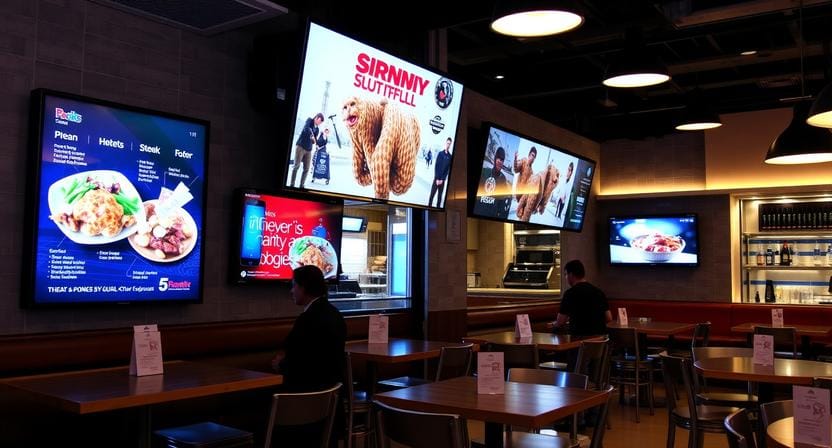
Trend 1: Context-Aware AI & Hyper-Personalization
The shift from simple triggers to contextual AI is one of the biggest digital signage technology trends in 2026. Conventional digital signage could change based on the time of day or weather. Context-aware AI takes it a step further to use data signals to understand which content is most relevant at a particular time.
From Basic Rules to Smarter Decisions
A smart system may not only display an iced coffee promotion when it is hot, but it can also take into account audience trends, location, dwell time, traffic, purchasing patterns, and engagement history. In more sophisticated settings, edge computing and computer vision may facilitate quicker local decisions without transmitting all the signals to a central server.
This matters because customers are accustomed to customized online experiences. Their social media feeds, shopping apps, and streaming platforms change regularly. Physical screens must now be equally as relevant.
Nento’s Role
Nento’s automation and content scheduling tools help businesses automate dynamic content changes without manually updating every screen. That means campaigns can become more responsive while still staying easy to manage.
Trend 2: The Phygital Revolution
The term “phygital” refers to a blend of physical and digital experiences. For signage, this means screens are no longer isolated displays. They are transforming into connectors between stores, websites, mobile apps, loyalty programs, and e-commerce.
Where Retail Is Heading
It is among the retail digital signage trends of 2026 that matter most. Screens can be used to enable click-and-collect walls, QR-based product discovery, virtual try-on mirrors, loyalty promotions, and mobile coupon journeys.
As an example, a customer can scan a QR code on a store screen, save an offer on their phone, and make a purchase online or in-store. Related products can also be displayed on a screen based on what is trending online.
Retail is one of the primary market forces: According to a report by Grand View Research, retail had the biggest portion of the worldwide digital signage market in 2025, with over a 19% share.
Nento’s Role
Nento supports POS, e-commerce, and content workflows, helping retailers connect physical screens with digital sales journeys.
“The store screen is no longer the end of the message. It is the beginning of the customer journey.”
Trend 3: Generative AI for Content Creation
One of the largest digital signage software news stories is generative AI because it changes the speed at which businesses can create content for screens. Rather than spending days to have a design team create variations of campaigns, teams can now create localized advertisements, translated versions of campaigns, product-specific creatives, and seasonal promotions much quicker.
Faster Creative Production
Restaurants can create different menu offers for breakfast, lunch, dinner, and late-night service. Retailers can create location-specific, product-based ads. Hotels can create event-related content in their lobbies in various languages.
This is where the latest signage technology becomes especially useful. Cloud rendering, smart templates, and AI-supported creative workflows reduce the time between idea and screen.
Why It Matters
Digital signage is most effective when the content is up-to-date. Generative AI enables teams to avoid stale screens by making campaign variation faster and less expensive. Generative AI has also appeared in industry coverage in 2026 as part of the new layer of creativity of signage content, particularly for dynamic visual experiences.
Trend 4: Data-Driven Decision Making & Real-Time Analytics
Screens are becoming data-gathering points and not just display surfaces. The performance of content, uptime, dwell time, engagement, QR scans, conversions, and campaign effectiveness can be measured using modern signage platforms.
From Guesswork to Performance
This is among the most practical digital signage future trends since it helps businesses understand what really works. Teams can test two versions and compare results and refine content using real data rather than assuming a promotion is effective.
Predictive analytics is the next step. Systems can over time learn the type of content that works best in particular locations, times, or under certain audience conditions.
Nento’s Role
Nento’s analytics dashboard and A/B testing capabilities help businesses move beyond “publish and hope.” Teams can see what content performs, identify weak campaigns, and improve messaging over time.
Book a Nento demo to explore analytics features.
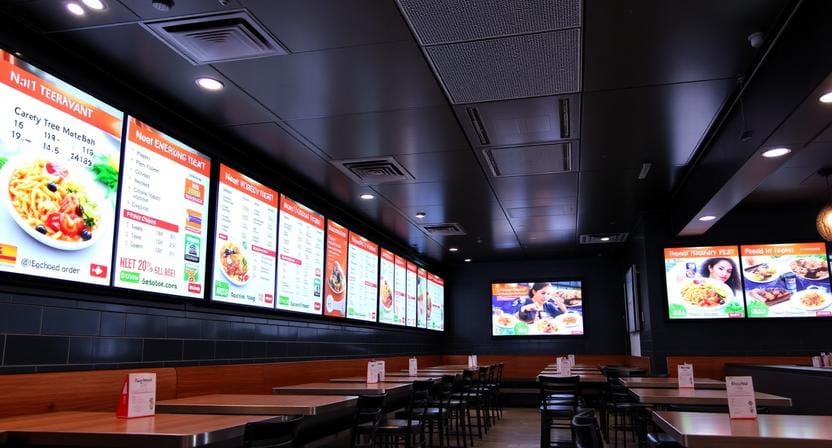
Trend 5: Sustainability & Green Signage
A major digital signage industry trend is the move toward sustainability. Brands are under pressure to cut waste and energy consumption and unnecessary hardware replacement. Digital signage has already minimized the use of printed materials, but the next step is making the screen network itself more efficient.
Energy-Efficient Displays and Smarter Scheduling
The use of low-energy screens, e-ink screens, solar-powered outdoor units, and smarter software scheduling are becoming increasingly relevant. Companies can reduce electricity consumption by dimming screens during low traffic and turning off screens when not in use and by adjusting brightness based on location.
The wider digital signage market trends for 2026 show increased demand for scalable and energy-sensitive hardware and software. The market researchers forecast further growth into the decade, with 360iResearch forecasting the global market of digital signage at USD 30.47 billion in 2026 and USD 48.54 billion in 2032.
Why It Matters
Sustainability is not only about brand image. It also reduces operating costs. A signage network that uses less energy and lasts longer becomes easier to justify financially.
Trend 6: The Rise of Interactive Play
One of the most noticeable digital signage trends in restaurants, retail, entertainment, and hospitality is the rise of interactivity. Screens are becoming participatory rather than passive.
Gamification and Customer Engagement
Restaurants can use interactive screens to entertain children while families wait. Retailers can develop spin-to-win offers, product quizzes, or style finders. Touchscreens can be used to map the event spaces, check-ins, or activity schedules.
This is particularly significant to restaurant digital signage trends since restaurants want to increase average order value, minimize wait frustration, and keep customers engaged during ordering.
Touchless Interaction
There is also growth in gesture control, voice activation, QR codes, and mobile-triggered actions. These alternatives facilitate interaction without requiring every customer to touch the same screen.
“The more customers interact, the more the screen becomes part of the experience—not just part of the décor.”
Trend 7: Omnichannel Orchestration
Digital signage is no longer an independent channel. The most powerful systems in 2026 will connect to mobile apps, in-store sound, loyalty programs, websites, point-of-sale terminals, email marketing, and online out-of-home advertising.
One Campaign, Many Touchpoints
A customer can receive a mobile coupon, enter a store, and then see a corresponding offer on a screen. A loyalty app can trigger a personalized message. A restaurant promotion can appear on the menu boards, social media, and customers’ phones simultaneously.
APIs, webhooks, and real-time integrations are critical to this trend. The signage platform should not be an isolated tool; it should interact with other business tools.
Why Businesses Need It
Omnichannel signage helps brands create consistency. Customers see the same campaign across physical and digital channels, making the message stronger and more memorable.
Trend 8: Remote Management & Cloud-Native Platforms
Cloud-based signage is not new, but the 2026 standard is much higher. Businesses now expect zero-touch provisioning, remote monitoring of devices, secure access, automatic updates, and single-dashboard management.
Why Remote Management Matters
A company with 10, 100, or 1,000 screens cannot handle the content manually. Cloud-native platforms enable teams to publish updates, monitor screen health, troubleshoot issues, and manage permissions without visiting each location.
Centralized control of content, remote monitoring, energy monitoring, and predictive alerts are also highlighted in recent commercial display coverage as part of the next-generation display ecosystems.
Nento’s Role
Nento’s cloud-native infrastructure allows businesses to manage many screens from a single dashboard. This makes digital signage easier to scale, easier to secure, and easier to maintain.
Trend 9: The Humanization of Signage
Brands are moving away from generic stock photography and overly polished corporate messages. Screens will become more human, local, and authentic in 2026.
User-Generated Content and Social Proof
Customer reviews, social media feeds, employee spotlights, behind-the-scenes clips, and real customer photos are some of the ways businesses create trust. This makes signage look less like an advertisement and more like a reflection of the people around the brand.
In the case of restaurants, this can include displaying photos of guests or chefs. In the case of retail, this might include customer styling examples. In corporate spaces, it could be employee appreciation and milestones in the workplace.
Why It Works
People trust people. Screens that show real customers, real teams, and real moments feel more believable than generic promotional content.
Trend 10: Digital Signage as a Service
Digital Signage as a Service, or DaaS, is increasingly appealing to small and medium-sized businesses. Businesses no longer need to purchase hardware, software, content tools, and support individually but can access them as a single subscription package.
Hardware + Software + Content
The DaaS model may include displays, media players, cloud software, content templates, support, and maintenance. This simplifies the initial complexity and allows smaller businesses to enter the signage market more easily.
Retail adoption is also growing, and Research and Markets projects the retail digital signage market to be USD 6.3 billion in 2026 and USD 11.4 billion in 2034, as the market continues to expand.
Nento’s Role
Nento serves as a flexible software layer that fits different hardware setups. That means businesses can avoid getting locked into legacy hardware while still using modern signage tools.
Don’t get locked into legacy hardware. See how Nento’s flexible plans fit many screen setups.
Frequently Asked Questions
What is the biggest trend in digital signage for 2026?
One of the largest trends is contextual AI. Screens are getting smarter and using data, automation, and audience signals to show more relevant content in real time, not just based on weather or time.
How is AI changing digital signage technology?
AI is transforming signage by automating content, creating smarter schedules, personalizing content for the audience, and using predictive analytics. It helps businesses show the right message to the right audience at the right time.
Is digital signage still effective in retail in 2026?
Yes. Retail digital signage is becoming increasingly effective since it is now linked to online and offline customer journeys. Screens can support virtual try-on, click-and-collect, loyalty, social proof, and real-time product promotion.
What are the hardware requirements for 2026 digital signage?
The focus is on energy efficiency, reliable connectivity, and edge computing. Other more advanced applications may need players or displays with the ability to run AI on-device to minimize latency and speed up personalization.
Can Nento help me implement these new trends?
Yes. Nento is built with a flexible architecture to enable integration of AI, advanced analytics, cloud management, and omnichannel orchestration. The platform is regularly updated in order to enable companies to stay ahead of industry changes.
Book a demo with Nento to see these trends in action today.
Conclusion
The biggest takeaway from digital signage trends 2026 news is that the future is relevant. Screens should be intelligent, sustainable, interactive, connected, and measurable.
The old method of adding a playlist and forgetting about it is insufficient. Companies now need signage that is context-sensitive, integrates with digital channels, supports real-time analytics, and improves the customer experience.
It may seem overwhelming to keep up with these changes, but the right platform can make the transition easier. Nento assists companies in streamlining the transition between simple screens and smart digital interactions.
Join the future of digital engagement. Book a demo with Nento today.