
Introduction
There are still some instances of static billboards and printed posters, but they often fail to stand out in busy commercial areas. People are in a rush, the streets are busy, and brands vie on a second-by-second basis. Only one message can be displayed in a fixed sign, but outdoor digital signage can vary, shift, modify, and convey the content that can be considered up-to-date.
Outdoor digital signage is a digital display screen, which is specifically created to be used outdoors. These displays need to withstand sun, rain, dust, temperature variations, risk of vandalism, and extended working hours, unlike indoor screens. They are designed to be visible, durable, and reliable in the real world.
Outdoor digital signage displays are used by businesses to draw pedestrian traffic, advertise offers, provide visitor directions, provide emergency information, and advertise in high-traffic locations. Outdoor screens, such as storefront windows and drive-thru menu boards, LED billboards, and interactive kiosks, assist brands in getting noticed where it is most difficult to secure attention.
This article discusses the key hardware types, price considerations, business applications, software, installation considerations, and future trends that you must consider before investing.
Ready to elevate your brand visibility? Explore Nento’s commercial outdoor digital signage displays built for outdoor conditions.
Why Outdoor Digital Signage for Business is a Game-Changer
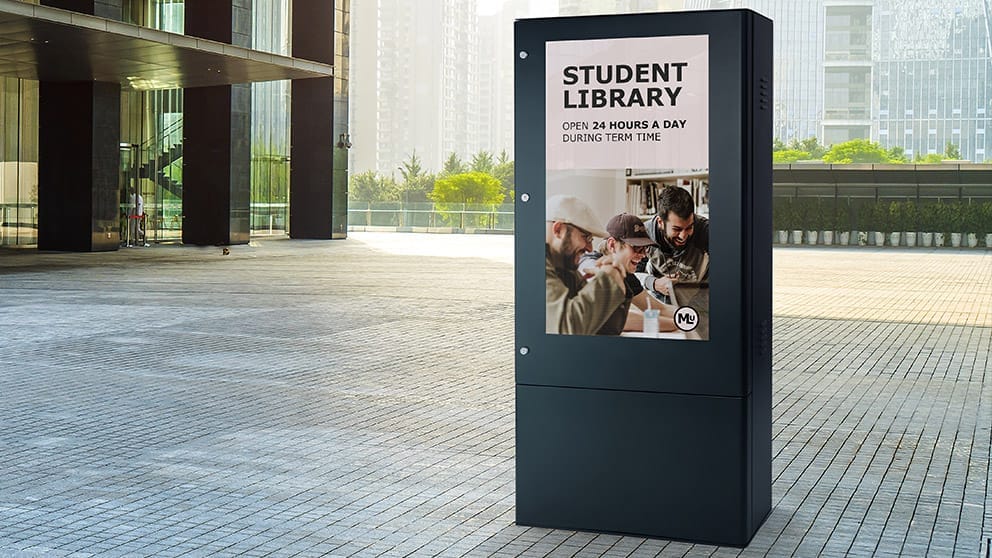
Outdoor advertising is best done when it is timely, visible, and can be updated easily. Conventional signs are not easily modified and are costly to change. Digital signage outdoor solutions eliminate this drawback by providing businesses with real-time control of what is displayed on screen.
Real-Time Flexibility
Using outdoor digital signage for business, promotions, pricing, public messages, emergency messages, or weather-driven advertisements can be updated without the need to print anything new. A restaurant will be able to advertise the hot drinks in cold weather. A retailer has the opportunity to initiate a flash sale when the number of people is high. A transport center will be able to broadcast delays in real time.
This is because outdoor signage is more flexible and therefore useful than static advertising.
Higher Engagement
It is natural that moving visuals attract more attention as compared to the still print. Screen displays in main streets, shopping centers, campuses, and transit stations are enhanced with video, animation, countdowns, live feeds, rotating messages, and other features that make them noticeable in crowded areas.
Motion and brightness can be the difference between being seen and being overlooked in businesses that attempt to attract walk-ins.
Data Integration
Outdoor displays nowadays are able to communicate with live data sources. Social media feeds, traffic updates, weather alerts, news, event schedules, or inventory-based offers can be displayed on screens.
This renders the content relevant and up-to-date. The screen can react to what is going on around it instead of displaying a single generic advert throughout the day.
24/7 Marketing
Outdoor displays do not cease to work during the business hours. A printed poster can still be read during the night, but a glowing digital display can be used to keep advertising offers, display brand messages, and direct visitors even after the staff have left home.
“Outdoor signage is no longer just about being seen. It is about being relevant at the exact moment people pass by.”
Types of Outdoor Digital Signage Displays
One of the most crucial decisions in any outdoor signage project is the selection of the appropriate hardware. The most appropriate option will be based on the distance of viewing, brightness requirements, type of content, where it is installed, and the budget.
Outdoor LED Digital Signage
Outdoor LED digital signage is suitable for big-format displays like billboards, stadium screens, public squares, building facades, and high-impact advertising walls. LED displays are clear, adjustable, and can be seen from a long distance.
Pixel pitch is one such specification, commonly denoted as P2.5, P4, P6, or P10. The distance between pixels is called pixel pitch. A lower pitch produces a crisper image and is more suitable for viewing close objects. A bigger pitch is usually cheaper, as it is used in displays that are further away.
For example, a P2.5 display may be suitable for closer pedestrian viewing, while a P10 display may work well for a large roadside billboard seen from a distance.
Commercial Outdoor LCD Displays
Commercial outdoor LCD displays are used in the front of stores, menu boards of quick-service restaurants, transit shelters, college information kiosks, and outdoor directories. They are sharp in image and can be used in close-up viewing as compared to large LED boards.
Brightness matters. LCDs used outdoors may require high brightness performance (usually 1,500 to 2,500 or more nits) to ensure that the content can be read in daylight. In a shaded outdoor space, reduced brightness might be effective. To have direct sun exposure, higher brightness is necessary.
Outdoor Digital Signage Kiosks
Outdoor kiosks are interactive screens that are employed in wayfinding, ticketing, check-in, tourism information, ordering, and self-service. They frequently have touchscreens, payment methods, cameras, scanners, or accessibility features.
These displays can be used in shopping centers, universities, bus terminals, hotels, city centers, and event halls where people require services or information but do not have to wait in line to be attended to.
Double-Sided Displays
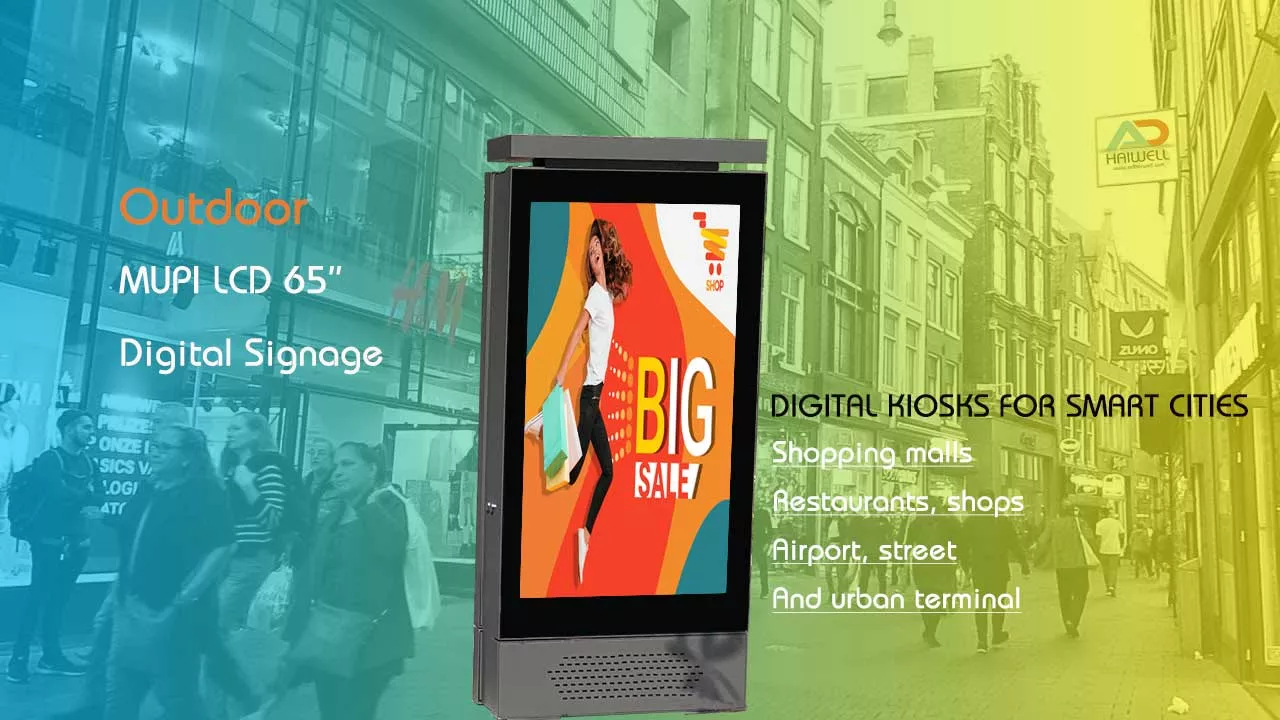
Double-sided displays are viewed from two directions. They come in particularly handy at shopping malls, airports, sidewalks, transit stops, and installations on the street poles.
A two-sided display is able to draw traffic along both sides of a walkway or road and is therefore more efficient in areas where there is a two-way movement.
Essential Features of Commercial Outdoor Digital Signage Displays
Outdoor screens are more challenging than indoor screens. This is why commercial outdoor digital signage displays have to be made durable, visible, and remotely controlled.
Weatherproofing and IP Ratings
Weatherproofing is essential. IP ratings demonstrate the extent of protection of a display against dust and water. IP54 is a bit more resistant to dust and water splashes, whereas IP65 is more resistant and is often chosen in the case of an exposed outdoor setting.
In case your display will be exposed to rain, dust, humidity, or public interaction, the IP rating should be a priority.
Thermal Management
Outdoor screens should be able to withstand heat and cold. Direct sunlight may lead to overheating, and winter conditions may impact performance. In-built cooling, heating, ventilation, and temperature control are used in keeping the system stable.
Without proper thermal management, screens can dim, shut down, or fail early.
Shatterproof Glass and Anti-Glare Protection
Outdoor displays are also subjected to the sun, physical interactions, and vandalism. The glass that covers the screen should be shatter-resistant, and the anti-glare treatment enhances readability.
This is especially important for interactive kiosks, street-facing displays, and screens installed in unsupervised public spaces.
Remote Management
Remote management is a cloud-based feature that enables the teams to schedule the content, monitor screen health, update campaigns, and troubleshoot problems without going to the site.
This feature is important in the case of multi-location businesses. It saves labor, reduces wasted time, and keeps content updated.
Outdoor Digital Signage Price: What to Expect
The price of outdoor digital signage is one of the initial questions that businesses pose. It will depend on the size of the screen, type of display, brightness, weatherproofing, complexity of installation, and software requirements.
Main Factors Affecting Cost
A number of factors affect the end price:
- Screen size and resolution: Bigger and better displays are more expensive.
- Brightness level: The higher the nits, the greater the visibility, but the higher the cost.
- IP rating and durability: More weatherproofing and vandal resistance are more costly.
- Installation type: Pole-mounted, wall-mounted, freestanding, and rooftop displays vary in terms of installation requirements.
- Software and maintenance: The budget should include CMS licensing, monitoring, updates, and support.
- Power and connection: Outdoor screens can need electrical, cabling, or cellular connections.
Rough Price Ranges
| Outdoor Display Type | Typical Price Range | Best For |
| Small outdoor LCD, 32–55 inches | $2,000–$6,000 | Storefronts, menus, directories |
| Medium outdoor LCD or kiosk | $6,000–$15,000+ | Wayfinding, QSRs, campuses |
| Large LED wall, 100 inches+ | $15,000–$100,000+ | Billboards, venues, large advertising |
| Custom interactive outdoor kiosk | Varies widely | Ticketing, self-service, smart city use |
These are general ranges. Final pricing depends on hardware quality, installation, environment, and service requirements.
Hidden Costs to Consider
The purchase price is only part of the total investment. Some of the other items that businesses should plan for include content creation, software subscriptions, maintenance, cleaning, electricity, internet connectivity, permits, and infrequent repairs.
A cheaper system can prove to be expensive in the long run in case it is not durable, supported, or can be remotely managed.
Measuring ROI
The ROI of outdoor signage can be quantified by the number of people walking by, sales growth, scans of QR codes, redemption of promotions, customer interaction, decreased printing expenses, and enhanced advertising adaptability.
It is not just to purchase a display. The idea is to establish a channel that leads to measurable business impact.
Worried about budget? Nento offers custom quotes—request your estimate now.
Top Use Cases for Outdoor Digital Signage Displays for Advertising
Outdoor digital signage displays for advertising are applied in a wide range of industries, as they provide visibility, flexibility, and timing.
Retail Storefronts
Digital window displays allow retailers to appeal to passersby, advertise new arrivals, advertise flash sales, and display seasonal campaigns. A dynamic screen can bring a storefront to life even during off-hours.
Quick-Service Restaurants
QSRs require outdoor digital signage as menu boards at the drive-thru, promotional screens, and pickup information. Dayparting enables the menus to change automatically to lunch or dinner.
This enhances precision and assists in selling high-margin products at the appropriate time.
Transportation Hubs
Outdoor screens are used at the airports, train stations, bus terminals, and parking areas to provide arrivals, departures, route updates, delays, alerts, and advertisements.
Real-time updates are essential in such environments since information keeps on changing.
Healthcare and Education
Outdoor signage is used in hospitals, clinics, schools, and universities to help people find their way, notify them about emergencies, guide visitors, share campus news, and update them on events.
Big organizations have the advantage of displays that can direct individuals in a short time and minimize confusion.
Corporate Campuses
Outdoor signage is used by corporate campuses to greet visitors, provide building directories, announce events, convey safety messages, and communicate internally.
A well-placed outdoor digital signage display setup can improve both branding and navigation.
How to Choose Among Outdoor Digital Signage Companies
There are many outdoor digital signage companies, and not all offer the same experience, quality of hardware, software support, or after-sales services.
What to Look For
Select a provider who has successful industry experience and case studies. The outdoor signage is more complicated than an indoor one, and thus the provider should know about weatherproofing, brightness, installation, software, and maintenance.
Find end-to-end support that covers hardware, software, installation, monitoring, and continued service. A supplier of screens might leave you with content management problems or technical problems in the future.
After-sales and warranty are important as well. The displays will be outdoors, thus a long-term investment, and you will require a partner who can help in repairing, upgrading, and troubleshooting them.
Questions to Ask
Prior to making a decision on whether to go with outdoor digital signage manufacturers or service providers, inquire about the following:
- Do you provide cloud-based content management?
- What IP ratings are your displays?
- What brightness level would you recommend for my location?
- How long do you take on average to repair?
- Do you provide installation and site assessment?
- Does the system have the ability to connect with my POS, CRM, or social media feeds?
- What warranty and maintenance options do you offer?
Why Nento Stands Out
Nento offers rugged and weather-tested displays, non-technical user-friendly software, responsive customer service, and on-site installation service. This is what makes Nento a good collaborator for the companies that wish to have outdoor signs but do not want to deal with all the technical aspects independently.
Outdoor Digital Signage Solutions: Software Matters
The focus is on hardware, but the outcome is governed by software. The optimal outdoor digital signage systems offer robust displays and robust content management software.
Content Management Systems
A CMS enables users to plan the content, make playlists, update various screens, and manage campaigns remotely. This is particularly crucial with outdoor screens, since it might be challenging to access them physically.
As an example, a retailer can update the promotions in several storefronts, and a restaurant chain can update outdoor menu boards with a single central dashboard.
Integration Capabilities
The modern signage software is able to integrate with weather APIs, social media feeds, POS systems, inventory solutions, CRM systems, and IoT sensors.
This enables the content to be more relevant. A clothing store will be able to market rainwear when the weather is bad. A restaurant will be able to prevent the display of sold-out items. Live travel information can be displayed on a transport display.
Analytics and Reporting
Analytics assist companies to quantify performance in terms of impressions, dwell time, interaction rates, QR scans, campaign conversion, and screen uptime.
This makes outdoor signage more accountable. Rather than guessing on whether a display is working or not, businesses will be able to monitor what content is getting attention and action.
Installation and Maintenance Best Practices
Installation of outdoor signage should be planned carefully. The proper installation enhances visibility, dependability, and safety.
Site Assessment
Prior to installation, consider the direction of the sunshine, distance of viewing, traffic, screen angle, power, internet connectivity, and local regulations. A screen that is put in an incorrect direction can suffer from glare or have low visibility.
Structural Integrity
Outdoor displays should be firmly attached. Poles, walls, brackets, and freestanding structures should be able to support screen weight, vibration, and wind load.
Large screens, roadside displays, and high-location placements are highly suggested to be installed by professionals.
Regular Cleaning
Visibility can be diminished by dust and rain marks and pollution, fingerprints, and debris. Regular cleaning ensures that screens are readable and the display surface is safeguarded.
This is particularly critical to storefronts, kiosks, and displays along roads.
Software and Firmware Updates
Hardware remains stable with firmware updates, and features and security are enhanced with software updates. An appropriate maintenance strategy must encompass routine updates, monitoring, and performance tests.
Future Trends in Outdoor Digital Signage
Outdoor signage is smartening up, speeding up, and becoming more sustainable. Businesses investing today must decide on the systems that will be able to support future growth.
AI-Powered Personalization
AI can be used to customize content according to the audience trends, time of the day, weather, place, or customer behavior. Some advanced systems may use sensors or privacy-conscious analytics to adjust content based on broad audience context.
5G Connectivity
5G will be able to deliver content more quickly, deliver video with smoothness, and have interactive displays that are more responsive. This is particularly applicable in remote areas or outdoor networks that are not able to depend on wired networks.
Sustainability
Energy-efficient screens, intelligent brightness, solar power, and automatic dimming will gain significance as businesses pursue cutting operation expenses and their impact on the environment.
Augmented Reality
AR will enable outdoor displays to be linked to smartphones, and users will be able to scan screens and have access to interactive elements, product demonstrations, maps, or promotional content.
“The future of outdoor signage is not only brighter. It is smarter, more connected, and more measurable.”
FAQ – Outdoor Digital Signage Displays
What is the average lifespan of outdoor digital signage displays?
The commercial outdoor displays of high quality may last between 50,000 and 100,000 hours based on the usage, environment, maintenance, and quality of hardware. This is approximately 5-10 years of operation.
Are outdoor digital signage displays waterproof?
The IP ratings of most outdoor displays are IP54 or IP65. IP65 is dust-tight and resistant to low-pressure water jets, which makes it more appropriate in the exposed outdoor conditions.
Can I use indoor digital signage outdoors?
No. Indoor screens are not as bright, thermally controlled, weatherproofed, or durable as outdoor screens. They may overheat, break down easily, or be illegible in the sun.
How much does outdoor digital signage cost?
Prices may vary between approximately $2,000 to purchase small outdoor LCDs and above $100,000 to buy large LED walls. The total budget should also comprise installation, software, maintenance, electricity, and content creation.
Do I need a special license to install outdoor digital signage?
Often, yes. Prior to installation, businesses are supposed to verify local zoning, building codes, and landlord regulations and sign permit regulations.
Can I update content remotely?
Yes. Cloud-based CMS tools are featured in many modern solutions and enable users to plan their content and update it in real time wherever they are.
What brightness do I need for direct sunlight?
In the case of shaded areas, 1,500 nits can be sufficient. To have the maximum readability, 2,500+ nits is typically suggested when it is in full-sun exposure.
How do I choose between LED and LCD for outdoor use?
LEDs are more suitable in large, high-impact displays that are seen at a distance, like billboards and stadiums. LCD is more suitable in close-up detailing like in menus, kiosks, storefront displays, and wayfinding.
Are outdoor digital signage solutions energy-efficient?
The displays in modern use are usually energy-saving with backlighting, auto-dimming, and brightness sensors to save energy depending on the amount of light in the environment.
Can outdoor digital signage integrate with my existing systems?
Yes. Numerous outdoor digital signage systems are capable of connecting with POS systems, customer relationship management software, social media feeds, weather APIs, and IoT.
Conclusion
Outdoor digital signage is an effective business tool that enables a business to stand out, catch the eye, and communicate instantly. It provides brands with the flexibility to update the messages in real time, do targeted advertising, enhance customer guidance, and establish a more powerful presence in high-traffic areas.
However, it is all about selecting the correct hardware, software, and partner. Brightness, weatherproofing, and the quality of installation, remote management, analytics, and support are all important.
Nento assists companies in streamlining the process with rugged, reliable, and professionally operated outdoor digital signage solutions constructed to deliver real results.
Don’t settle for outdated advertising. Partner with Nento for rugged, reliable outdoor digital signage solutions that deliver results. Contact Nento today to discuss your next outdoor signage project.